
The choice between a backpack and panniers isn’t just about comfort; it’s about engineering a ride that biomechanically separates your spine from the load and your laptop from road shock.
- Panniers create a balanced, low-center-of-gravity system that preserves your bike’s natural handling and your spinal alignment.
- Proper pannier adjustment is critical for safety, while layered shock protection (sleeve + suspended compartment) is non-negotiable for electronics.
Recommendation: To eliminate commute-related back pain and safeguard your tech, switch to a dual pannier system with a dedicated, shock-absorbing laptop compartment.
The daily commute for a professional carrying a laptop often feels like a compromise. You sling a backpack over your shoulders for its grab-and-go convenience, only to arrive at your destination with a sore lower back and a shirt soaked in sweat. The familiar advice is to switch to panniers to “get the weight off your back.” While true, this advice barely scratches the surface. The problem isn’t just the weight itself, but the entire dynamic of how that weight is integrated with your body and your bike.
Most discussions focus on the obvious: backpacks cause postural strain and reduce airflow, while panniers mount cargo to the bike’s frame. But this overlooks the critical engineering and ergonomic principles at play. The real question isn’t just about moving weight, but about creating a smarter, safer, and more stable transportation system for both you and your expensive electronics. A backpack makes you and your cargo a single, top-heavy, and unstable unit. A well-chosen pannier system isolates you from the load entirely.
But if the solution is a biomechanically separate system, how do we build one that truly works? It’s about more than just buying any bag and clipping it on. It involves understanding the materials that shield your gear from the elements, the mechanics of a secure attachment that can handle real-world speeds, the physics of load balance, and the specific features that dampen the constant vibration that can destroy a laptop from the inside out. This guide moves beyond the basics to give you an orthopedic cargo consultant’s perspective on engineering the perfect commute.
This article provides a comprehensive breakdown of the factors you must consider to make an informed choice, from waterproofing and security to the crucial details of protecting your electronics. Explore the sections below to build a carry system that serves your health and your hardware.
Contents: Backpack vs Panniers for the Modern Commuter
- Why PVC Coated Panniers Outlast Canvas in Daily Rain?
- How to Adjust Pannier Hooks so They Don’t Fly Off at 20mph?
- 20L Pair vs Single 40L: Which Affects E-Bike Balance Less?
- The Mistake of Leaving Panniers on the Bike While Shopping
- When to Use Laptop Sleeves Inside Waterproof Bags for Shock Protection?
- Why Merino Wool Is the Only Fabric That Doesn’t Smell After 5 Rides?
- Why Zipcar + Cargo Bike Is the Ultimate Furniture Moving Combo?
- Credit Card Touring vs Camping: Managing E-Bike Charging Logistics on the Road
Why PVC Coated Panniers Outlast Canvas in Daily Rain?
The first duty of any laptop transport system is to guarantee protection from the elements. While canvas bags have a classic aesthetic, they fail structurally under the demands of a daily, all-weather commute. Their weakness lies in their construction: stitched seams. Water inevitably penetrates these needle holes over time, and canvas requires frequent re-application of waxing treatments to maintain any level of water resistance. In contrast, modern PVC-coated polyester or nylon panniers offer a fundamentally superior solution through their manufacturing process.
These bags utilize radio-frequency welding to fuse the panels together, creating a single, monolithic piece of material with no holes for water to exploit. This method is why many high-quality PVC-coated panniers achieve an impressive IP64 water resistance rating, signifying they are completely dust-tight and resistant to water splashes from any direction. It’s the difference between a water-resistant jacket and a true drysuit.
The long-term performance difference is stark. In a real-world case study of long-distance cyclists, many reported using their Ortlieb brand PVC panniers for over a decade, and in some cases up to 20 years, without any degradation in their waterproof capabilities. Conversely, canvas bags used in similar daily conditions often needed seam repairs and diligent re-proofing after just a couple of seasons to prevent leaks. For a commuter whose livelihood is inside their bag, the reliability of a welded PVC pannier is not a luxury; it’s a foundational requirement.
How to Adjust Pannier Hooks so They Don’t Fly Off at 20mph?
A waterproof bag is useless if it detaches from your bike at the first pothole. The connection between the pannier and the rack is the most critical mechanical interface in your entire cargo system. A loose or poorly adjusted pannier is not just an annoyance that rattles; it’s a significant safety hazard that can swing into your spokes or fall into traffic. The goal is to create a connection so solid that the pannier and the bike behave as a single, unified object. This requires a few minutes of initial setup that pays dividends in safety and peace of mind.
Modern panniers from reputable brands feature highly adjustable hook systems designed to fit a range of rack tube diameters, typically from 10mm to 16mm. The key components are the main load-bearing top hooks and a lower stabilizing hook or rail. The top hooks often come with inserts to perfectly match your rack’s diameter, eliminating vertical play. The lower hook is the crucial element for preventing the bag from swinging outwards on turns or bouncing off on bumps. It must be positioned to brace against a vertical stay on the rack, effectively locking the pannier in three dimensions.
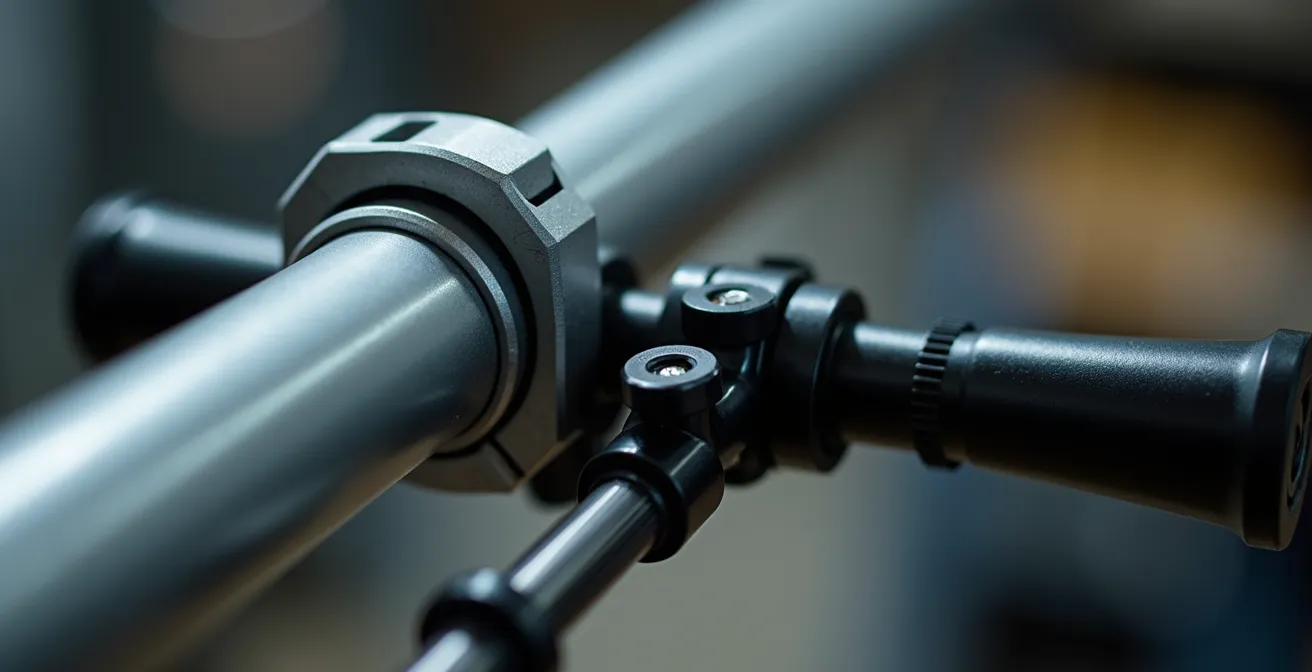
As the detail shot above illustrates, the precision of this mechanism is key. A properly adjusted system exhibits zero movement. The definitive check is the “rattle test”: once mounted, grab the pannier firmly and try to shake it. If you hear any clicking or feel any movement, the connection is not yet secure. This small investment in time transforms your pannier from a simple bag into an integrated part of the bicycle’s chassis.
Your Pre-Ride Pannier Security Checklist
- Verify Hook Fit: Check that the top hook inserts match your rack’s tube diameter (usually 10-16mm) to prevent rattling.
- Set the Stabilizer: Adjust the lower hook or anti-sway mechanism so it sits snugly against a vertical strut of the rack.
- Perform the Rattle Test: Aggressively shake the mounted pannier. It should feel like a solid part of the bike, with no clicks or movement.
- Engage the Lock: Ensure any locking or anti-sway mechanism is fully engaged and properly tensioned according to the manufacturer’s instructions.
- Conduct a Low-Speed Test: Ride slowly for a short distance, listening for any sounds that might indicate a loose mounting point.
20L Pair vs Single 40L: Which Affects E-Bike Balance Less?
Once your panniers are securely attached, the next consideration is how their load affects your bike’s handling. This is where the concept of a balanced system becomes paramount, especially for e-bike riders. While a single large pannier offers the convenience of one bag to carry off the bike, it introduces an asymmetric load that your body and the bike must constantly fight to correct. This requires a subtle but continuous counter-steering effort and makes the bike more susceptible to being pushed by crosswinds.
Splitting the same total volume into a pair of smaller panniers (e.g., two 20L bags instead of one 40L) creates a balanced, low-slung center of gravity. This preserves the bike’s natural handling characteristics and requires no extra effort from the rider to keep the bike tracking straight. For e-bike users, particularly those with powerful rear hub motors, this is even more critical. The torque from the motor can amplify the imbalance of a single pannier, leading to a feeling of instability, especially during acceleration.
The following table, based on rider feedback and handling principles, breaks down the key differences. A recent comparative analysis of commuting setups confirms these findings, highlighting that a balanced load is a cornerstone of a safe and comfortable ride.
| Factor | 20L Pair | Single 40L |
|---|---|---|
| Weight Distribution | Balanced on both sides | Asymmetric load |
| Steering Effort | Normal | Requires constant counter-steer |
| Crosswind Stability | Stable | Prone to drift |
| Off-Bike Convenience | Two bags to carry | Single bag easier |
| E-bike Motor Interaction | Minimal impact | Amplifies imbalance with rear hub motor |
From an orthopedic perspective, the choice is clear. A balanced system eliminates the need for your core and upper body to make constant micro-adjustments to counteract the asymmetric load. This reduces muscular fatigue and promotes better spinal alignment over the duration of your ride. While carrying two bags into the office is a minor inconvenience, it is a small price to pay for a safer, more stable, and ergonomically sound commute.
The Mistake of Leaving Panniers on the Bike While Shopping
A perfectly engineered cargo system is only effective if it, and its contents, remain in your possession. A common mistake new pannier users make is treating their bags like a car’s trunk, leaving them attached to the bike while running errands. This exposes you to the significant risk of opportunistic theft. Even in supposedly safe areas, an unattended bag is an open invitation for a thief to quickly rummage through or simply detach the entire pannier and walk away.
This is precisely why modern pannier design has focused heavily on quick-release systems. The goal is to make detaching the pannier so effortless that taking it with you becomes an automatic habit. As one cyclist noted, the rule is simple: “Whenever you want to leave your bike parked for a natural break or to go into a shop to buy some food or drink you should take the panniers with you to avoid being targeted by thieves.” This isn’t paranoia; it’s practical risk management. The ease of removal is a feature, not a bug.
The speed of this process is a key design element. Advanced modern quick-release pannier systems can be removed in just 5 seconds. Often, a simple lift of the handle is all that’s required to disengage the hooks from the rack. This makes the transition from riding to walking seamless. For those concerned about security, the solution isn’t to bolt the bag to the bike, but to integrate the bag into your off-bike routine. Think of it less like a bicycle accessory and more like a briefcase or messenger bag that simply docks to your bike for transport.
When to Use Laptop Sleeves Inside Waterproof Bags for Shock Protection?
For the laptop commuter, waterproofing is only half the battle. The other, often-neglected, threat is damage from constant, high-frequency vibration and sudden shocks from potholes and curbs. A standard waterproof pannier is essentially an empty, rigid shell that transmits every jolt from the road directly to its contents. Placing a laptop inside without adequate padding is a recipe for disaster. The solution lies in a multi-layered approach to vibration damping.
The baseline for protection is always using a padded laptop sleeve. This provides a crucial first layer of shock absorption. However, for a daily commute, this is often not enough. A superior setup involves placing that sleeved laptop inside a pannier that has its own dedicated, padded laptop compartment. This “bag within a bag” approach creates two distinct layers of protection.
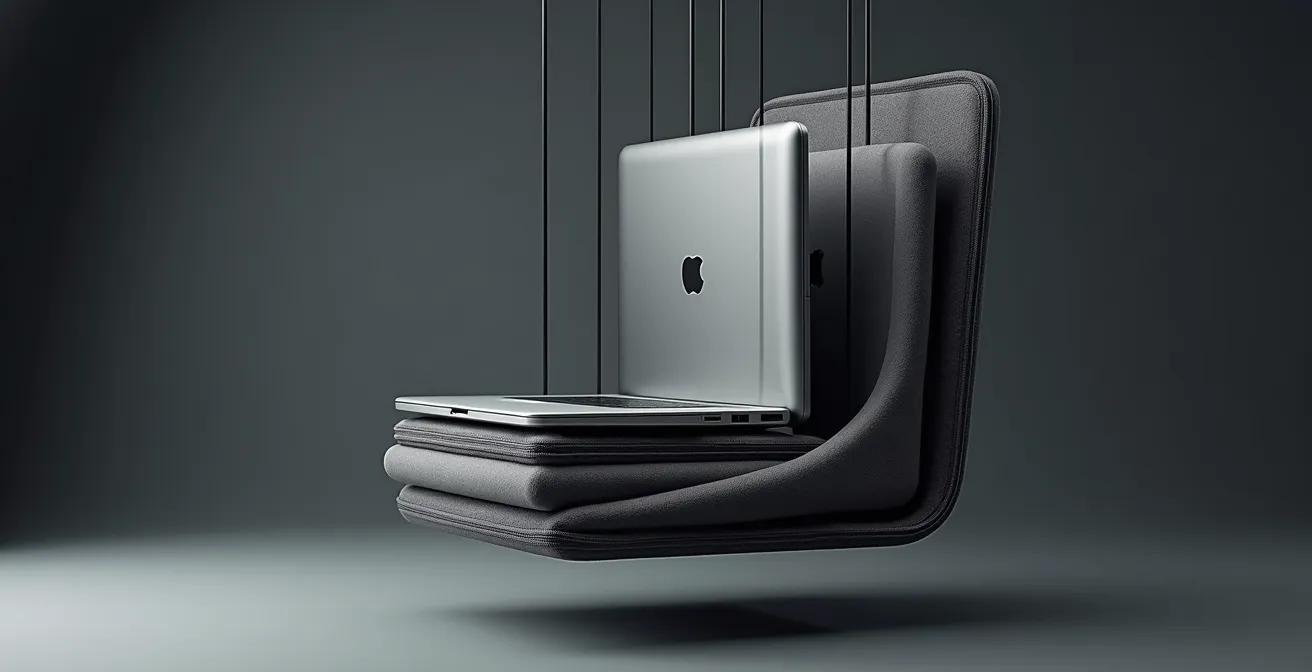
The gold standard, however, is a pannier with a suspended laptop compartment, as conceptually shown above. In this design, the padded compartment doesn’t rest on the bottom of the bag but is hung from the sides, leaving a gap below. This physically isolates the laptop from the pannier’s floor, preventing direct shock transfer from the most jarring impacts. A case study of commuters in Denver demonstrated this principle perfectly: laptops carried in panniers with this dual sleeve-and-suspended-compartment system survived daily commutes that included curb jumps. In contrast, laptops in bags with only basic waterproof protection suffered screen and hard drive damage from vibration within three months.
Here is a clear hierarchy for protecting your most valuable asset:
- Good: A padded sleeve inside any waterproof pannier.
- Better: A padded sleeve placed within a pannier that has its own dedicated, padded laptop compartment.
- Best: A padded sleeve inside a pannier featuring a suspended and padded laptop compartment. This is the optimal solution for protecting against both vibration and impact.
- Essential: Always use at least a sleeve for any ride, especially on rough surfaces. Double protection is particularly critical for devices with mechanical hard drives, which are far more susceptible to vibration damage than solid-state drives (SSDs).
Why Merino Wool Is the Only Fabric That Doesn’t Smell After 5 Rides?
Now that we’ve established the superiority of the pannier system for carrying cargo, let’s address the primary physiological reason for abandoning the backpack: the dreaded “sweaty back.” When you wear a backpack, you’re essentially adding another layer of insulation directly against your largest body surface. This traps heat and moisture, preventing sweat from evaporating. Cyclists often describe this as the “additional layer effect”, which forces the body’s cooling system to work overtime, leading to excessive perspiration, discomfort, and a guaranteed need for a shower or a change of clothes upon arrival.
By moving the load to the bike, panniers liberate your back, allowing air to circulate freely. This simple change has a profound impact on thermal regulation and comfort. However, even without a backpack, commuting is exercise, and some level of sweat is inevitable. This is where your choice of clothing fabric becomes critical. Synthetic fabrics like polyester are notorious for retaining odor-causing bacteria. Cotton absorbs moisture, becoming heavy and clammy against the skin.
Merino wool, however, is unique. Its fibers have a complex structure that is both naturally wicking (pulling moisture away from the skin) and antimicrobial. The lanolin present in the wool actively inhibits the growth of bacteria that cause bad odors. This means you can often wear a merino wool base layer for multiple rides before it needs washing, making it the perfect fabric for the practical realities of a daily commute, especially when a shower isn’t available at the office. As one rider aptly put it while debating carry methods, “This week sweaty back has been an issue as I have no shower at work.” Merino wool is the direct solution to this common commuter problem, completing the comfort-focused system that begins with panniers.
Why Zipcar + Cargo Bike Is the Ultimate Furniture Moving Combo?
Adopting a pannier-based commute is often part of a larger shift towards a more flexible, bike-centric urban lifestyle. Once you’ve perfected your daily carry system, you begin to see how capable bicycles can be, which opens up new possibilities for larger tasks. This leads to a powerful and cost-effective strategy for occasional large-item transport, like moving furniture: the cargo bike and car-share combination.
This hybrid approach leverages the strengths of each mode of transport while avoiding their weaknesses. Instead of owning a car for the 1% of the time you need to move something bulky, you can use a car-share service like Zipcar for the initial “heavy lift” — getting the flat-packed furniture from the store to your neighborhood. This avoids the high costs of car ownership (insurance, parking, maintenance).
Once the item is near your home, you switch to a cargo bike for the “last mile” delivery. This allows you to navigate directly to your door, avoiding the frustrating search for parking and the hassle of carrying a heavy box several blocks. A case study of urban cyclists found this to be a popular and highly efficient strategy. It provides complete logistical flexibility for major purchases without the financial and environmental burden of a personal vehicle. It reframes the bicycle not just as a commuter tool, but as a central component of a sophisticated, multi-modal urban transport system.
Key Takeaways
- Spinal Health: A balanced pair of panniers is the only system that truly removes the load from your spine, preventing postural strain and pain.
- Hardware Protection: Waterproofing is not enough; a suspended, padded laptop compartment is essential to protect electronics from road vibration and impacts.
- System Integrity: A pannier is a system. Its effectiveness depends on the material (welded PVC), the connection (adjusted hooks), and the load distribution (balanced pair).
Credit Card Touring vs Camping: Managing E-Bike Charging Logistics on the Road
The principles of a well-engineered cargo system for daily commuting—security, weatherproofing, and balanced loading—scale up directly to the world of bicycle touring. When you’re on the road for days or weeks, your panniers are not just carrying your lunch and laptop; they are carrying your entire life. The demands on the system intensify, especially when managing the logistics of an e-bike.
The capacity requirements expand dramatically. While a 40L pair is ample for commuting, long-distance camping tours require up to 70 liters per pair to accommodate a tent, sleeping bag, cooking gear, and clothing. However, a lighter-weight “credit card tour,” where you stay in hotels each night, has different logistical challenges, primarily centered around your e-bike’s charger. You must have a flexible system for getting your battery and charger into your room each night.
Managing these charging logistics requires a clear strategy based on your accommodation style:
- Credit Card Touring (Hotels/Motels): The easiest method. Carry your charger in a small, easily accessible pannier or a convertible pannier-backpack. This allows you to quickly bring the battery and charger inside for overnight charging.
- Organized Campgrounds: If camping at sites with electrical hookups, you can store the charger in a dedicated waterproof compartment within a larger pannier, protecting it from the elements.
- Wild Camping: For off-grid touring, your panniers must have the capacity for power banks or even portable solar panel systems to top up your battery.
- Daily Routine: Regardless of your style, the rule is to charge every single night. Never assume you’ll find a convenient charging spot mid-day.
This demonstrates that whether you’re commuting to the office or crossing a continent, your pannier system is the foundation of a successful journey. It must be robust, secure, and thoughtfully organized.
Assess your daily cargo and route today. Investing in a properly fitted pannier system isn’t just a gear upgrade; it’s a long-term commitment to a pain-free commute and the safety of your essential electronics. Choose the system that protects both your spine and your tech.