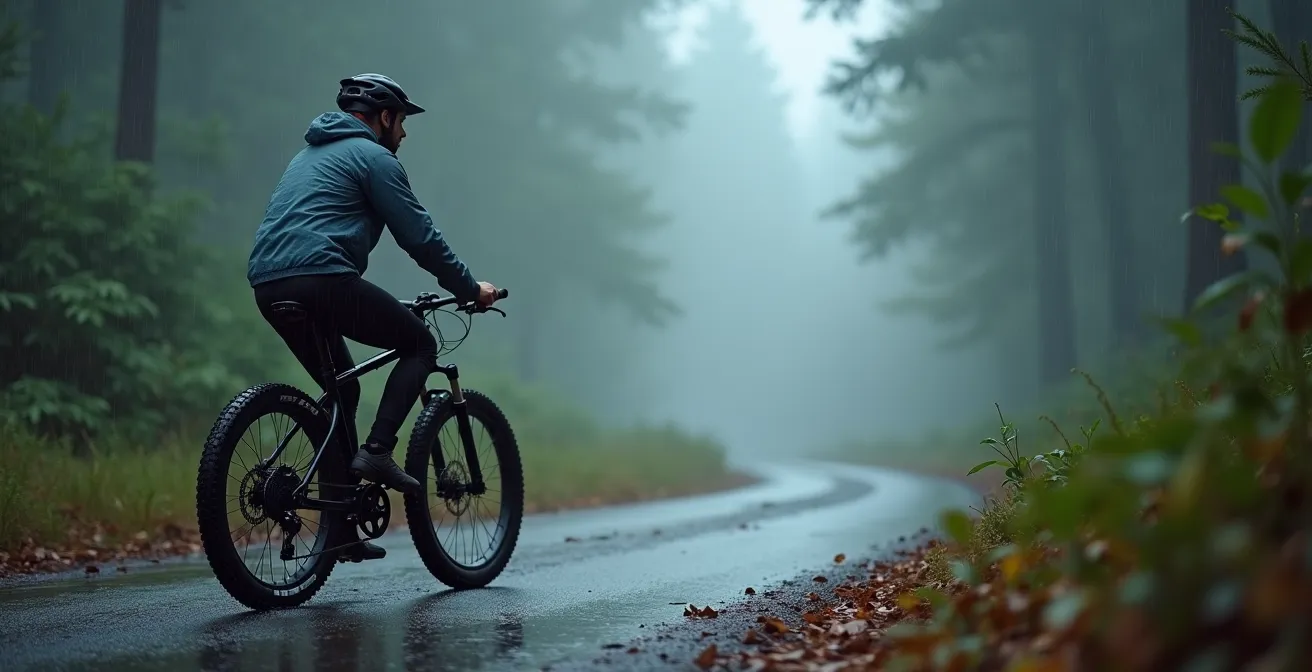
Contrary to popular belief, the most expensive ‘breathable’ jacket is not the guaranteed solution to arriving soaked in sweat after an e-bike commute in the rain.
- High-tech membranes like Gore-Tex lose their breathability when the outside temperature is warm and humid, creating a personal greenhouse effect.
- For the variable effort of e-biking, a system based on mechanical airflow and smart layering often outperforms a single high-tech fabric.
Recommendation: Prioritize gear with adjustable venting and master a layering system over chasing the highest breathability rating alone.
The scenario is frustratingly common for the modern e-bike commuter. You invest in premium waterproof gear, confident it will shield you from the downpour. You arrive at your destination, dry from the rain on the outside, only to find yourself uncomfortably soaked in sweat on the inside. This “boil in the bag” phenomenon suggests a fundamental misunderstanding of what keeps a rider truly dry. The market is saturated with advice focused on waterproof ratings and brand names like Gore-Tex, treating them as a silver bullet against moisture.
However, the unique physics of e-biking—intermittent pedaling effort, higher average speeds, and a motor that changes your thermal output—requires a more nuanced approach. The standard solutions often fail because they don’t account for the primary source of moisture in this context: your own body. The problem isn’t just about keeping rain out; it’s about efficiently letting perspiration escape. When a fabric’s breathability is compromised, you are simply trading one form of wetness for another.
But what if the key to staying dry wasn’t found in a more advanced, more expensive membrane, but in a different philosophy altogether? This guide will deconstruct the material science behind rain gear, moving beyond marketing claims to explain why high-tech fabrics have a critical failure point. We will explore a system-based approach where mechanical airflow, strategic layering, and an understanding of your equipment are more valuable than any single fabric technology.
By examining everything from breathability ratings and DWR maintenance to the surprising effectiveness of a simple poncho, you will gain the technical knowledge to build a commuting system that keeps you genuinely dry and comfortable, regardless of the weather or your effort level. This article provides a structured path to understanding these principles and applying them effectively.
Summary: A Technical Framework for Dry E-Bike Commuting
- Why a 10k Breathability Rating Is the Minimum for Active Pedaling?
- How to Wash Waterproof Gear Without Destroying the DWR Coating?
- Poncho vs Jacket: Why Airflow Matters More Than Waterproofing for E-Bikers?
- The Error of Buying Black Rain Gear That Makes You Invisible at Night
- When to Use Gaiters: Keeping Water Out of Your Shoes During Downpours?
- Why IP54 Is Not Enough for Riding in Heavy Downpours?
- How to Layer for a 40°F Morning and a 60°F Afternoon?
- Commuting in Office Clothes: Strategies to Arrive Fresh Without a Shower
Why a 10k Breathability Rating Is the Minimum for Active Pedaling?
To understand why you get wet from the inside, we must first quantify moisture. A fabric’s “breathability” is measured by its Moisture Vapor Transmission Rate (MVTR), typically expressed in grams of water vapor per square meter of fabric over 24 hours (g/m²/24h). A higher number indicates a greater ability to let sweat vapor escape. For a sedentary person, the body produces minimal moisture. However, an active e-bike commuter, even with assistance, generates a significant amount of perspiration that needs to be managed.
For low-output activities like casual e-biking on flat terrain, a rating of 5,000 to 10,000 g/m²/24h might suffice. However, as soon as your commute involves hills, stronger headwinds, or periods of lower assistance, your physical exertion increases dramatically. At this point, a jacket with a rating below 10,000 g/m²/24h becomes a barrier. The rate of sweat production exceeds the fabric’s capacity to transport it, leading to condensation on the inside of the garment. This is the “boil in the bag” effect in action.
Therefore, for moderate e-biking that includes any form of sustained effort, a minimum baseline is essential. Industry analysis shows that breathability ratings between 8,000-10,000 g/m²/24h are the threshold for moderate cycling activity. For optimal comfort during a varied commute, aiming for the 10,000-15,000 g/m²/24h range is a more reliable strategy. Anything rated 20,000+ g/m²/24h is considered high-performance, suitable for intense riding or use in warmer climates where the body works harder to cool itself. It is also crucial to remember that high ambient humidity reduces the effectiveness of any membrane, making mechanical venting features even more critical.
How to Wash Waterproof Gear Without Destroying the DWR Coating?
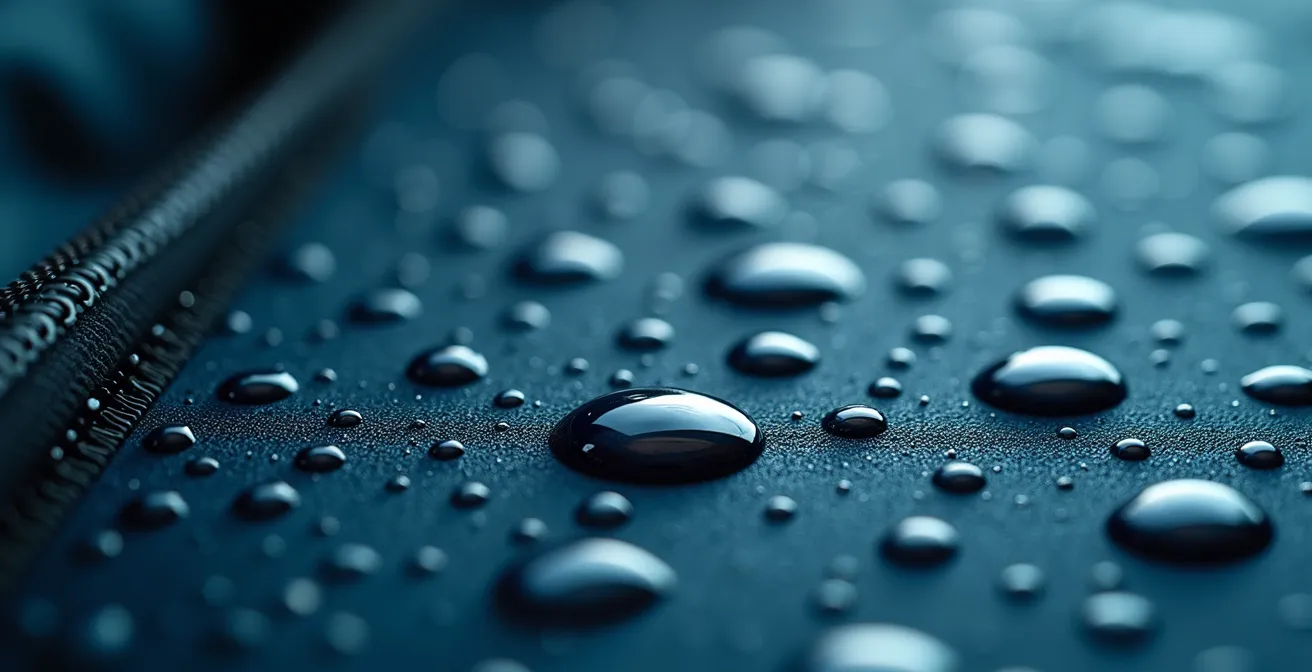
A high-performance breathable membrane is only half of the equation. The outer face of your rain gear is treated with a Durable Water Repellent (DWR) coating. This is a chemical finish that causes water to bead up and roll off the surface, rather than soaking into the fabric. When the DWR is working correctly, it keeps the outer fabric from becoming saturated, a condition known as “wetting out.” A wetted-out fabric cannot breathe, regardless of how advanced the underlying membrane is. This is a common and often misunderstood reason why expensive jackets suddenly feel like plastic bags.
The primary enemies of DWR are dirt, body oils, and conventional laundry detergents. These contaminants mask the DWR finish, attracting water (a hydrophilic action) instead of repelling it. Washing your gear is therefore not an option, but a necessity for maintaining breathability. However, the process must be done correctly. Using standard detergents is counterproductive, as their surfactants and softeners leave behind residues that further inhibit DWR performance.
This macro photograph shows water beading perfectly on a well-maintained DWR-treated surface, preventing the fabric from becoming saturated and allowing the membrane underneath to breathe effectively.
The correct procedure involves two stages: cleaning and reactivating. First, wash the garment using a technical cleaner specifically designed for waterproof textiles, such as Nikwax Tech Wash or Grangers Performance Wash. Follow the instructions carefully, ensuring all zippers are closed and pockets are empty. Second, reactivate the existing DWR with heat. A 20-minute cycle in a tumble dryer on low-to-medium heat will often restore the coating’s performance. If water no longer beads up after cleaning and heating, it’s time to re-apply a DWR treatment, which comes in either a spray-on or wash-in formula.
Poncho vs Jacket: Why Airflow Matters More Than Waterproofing for E-Bikers?
The obsession with fabric breathability ratings overlooks a more powerful and reliable mechanism for moisture management: mechanical airflow. Breathable membranes, including high-end ones like Gore-Tex, rely on a temperature and moisture pressure differential to function. They work best when it is cold and dry outside and you are warm and humid inside. However, testing reveals that these membranes stop being effectively breathable when the ambient temperature exceeds 15-18°C (59-64°F). In warm, humid rain, this differential vanishes, and the membrane’s performance plummets, causing internal condensation.
This is where low-tech solutions like the cycling poncho demonstrate their superiority for many e-bike commuting scenarios. A poncho creates a vast, open space underneath it, allowing for constant, massive airflow that physically carries away heat and moisture-laden air. This is a far more effective cooling and drying mechanism than relying on a fabric’s limited vapor transmission rate. While a form-fitting jacket traps a microclimate around your body, a poncho actively ventilates it.
This does not mean the jacket is obsolete. The choice between a poncho and a jacket is a technical decision based on speed, distance, and conditions, as this comparative analysis shows.
| Feature | Poncho | Jacket |
|---|---|---|
| Breathability | Excellent (natural airflow) | Variable (10k-20k g/m²/24h) |
| Speed Range | Best under 15 mph | Effective at all speeds |
| Wind Resistance | Poor (acts as parachute) | Excellent (form-fitting) |
| Coverage | Full body + bike | Upper body only |
| Best Use Case | Short urban commutes | Longer/faster rides |
As the data from comparative tests indicates, the poncho excels in short, low-speed urban commutes where its poor wind resistance is not a major issue. For longer, faster, or windier rides, a well-vented, form-fitting jacket is superior. The ideal jacket for an e-biker, therefore, is not just one with a high breathability rating, but one with ample mechanical venting options, such as pit zips, back vents, and a two-way main zipper, which allow you to manually introduce airflow when the fabric’s passive breathability is insufficient.
The Error of Buying Black Rain Gear That Makes You Invisible at Night
While managing moisture is critical for comfort, managing visibility is critical for survival. A common mistake commuters make is choosing rain gear in dark colors like black or navy blue. While stylish, this gear renders a cyclist virtually invisible to drivers during the low-light conditions of dusk, dawn, and nighttime. The statistics are stark: according to NHTSA data, 77% of cyclist fatalities occur in darkness. Choosing gear that enhances visibility is not an aesthetic choice; it is a primary safety requirement.
Effective visibility strategy is based on understanding the difference between two types of materials. Fluorescent colors (like neon yellow or pink) work by converting invisible UV light into visible light, making them exceptionally conspicuous during the daytime and in twilight. However, at night, with no UV light source, they appear dull and offer no significant advantage over other colors. At night, retroreflective materials are essential. These materials use glass beads or microprisms to reflect light directly back to its source (e.g., a car’s headlights) with minimal scattering, making the cyclist appear brilliantly illuminated.
The most effective gear combines both. A fluorescent jacket ensures daytime visibility, while strategically placed retroreflective strips provide nighttime safety. The placement of this reflective material is also crucial. When placed on moving joints like the ankles, knees, and elbows, it leverages a phenomenon called biomotion. The human brain is hardwired to recognize this pattern of movement, allowing a driver to identify a figure as a human cyclist much faster than if they were just a static block of light.
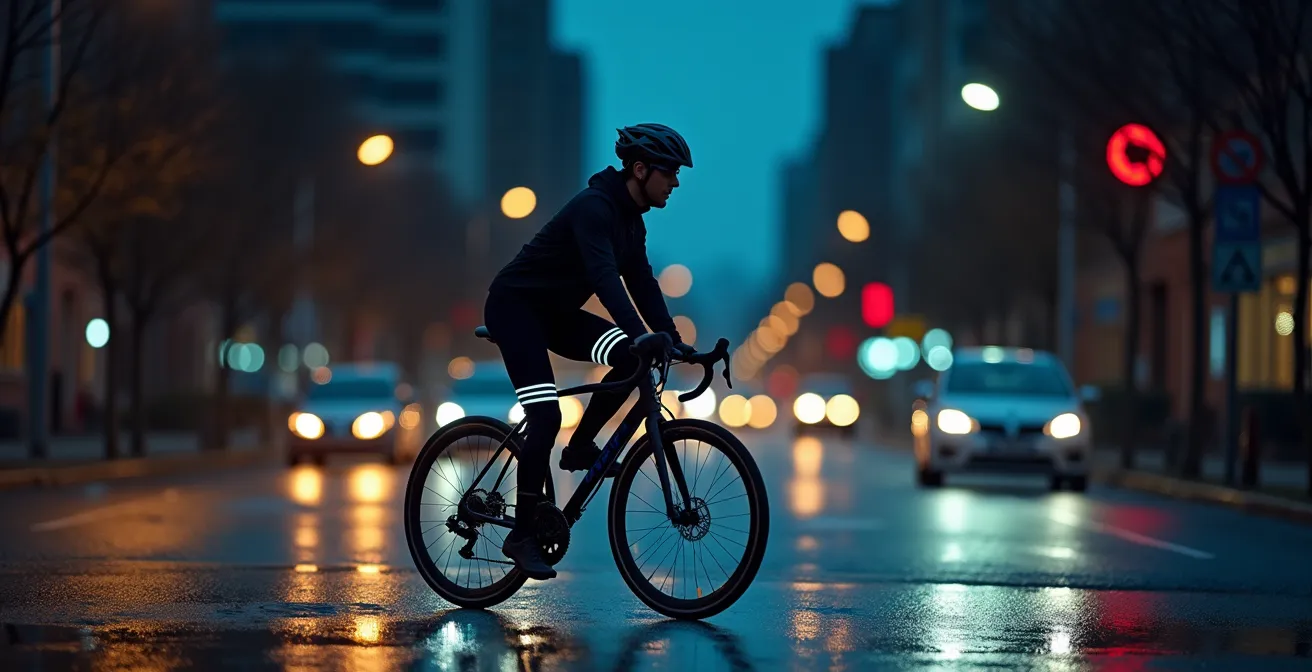
Action Plan: Implementing a 360° Visibility System
- Assess Moving Joints: Apply retroreflective tape or wear gear with strips on your ankles, knees, and elbows to maximize biomotion recognition.
- Combine Material Types: Choose gear that integrates fluorescent colors for daytime visibility with extensive retroreflective detailing for nighttime.
- Verify 360-Degree Coverage: Stand in a dark room and have someone shine a light on you from all angles (front, back, sides) to identify and fix any visibility blind spots.
- Elevate Your Profile: Add reflective elements to your helmet, as it is often the highest and most visible point to surrounding traffic.
- Conduct a Final Pre-Ride Check: Before riding in new gear at night, use a phone flashlight in a dark area to confirm how well the reflective elements perform and ensure you are conspicuous.
When to Use Gaiters: Keeping Water Out of Your Shoes During Downpours?
Even with a top-tier waterproof jacket and pants, many cyclists find themselves with soaked feet after a ride in heavy rain. This is often due to a simple but critical system failure known as the “pant gutter effect.” Water that lands on your waterproof pants runs down the fabric, and due to the rider’s position, it channels directly into the opening of your shoes. Over time, even a light rain can completely fill your footwear, defeating the purpose of your expensive gear.
This is a problem that cannot be solved by a better jacket or more waterproof shoes alone; it requires addressing the interface between the pant leg and the footwear. The two primary solutions are dedicated cycling overshoes and gaiters. Overshoes are booties made of waterproof material (like neoprene) that cover the entire shoe. They are highly effective but can be cumbersome to put on and take off, especially over office footwear.
Gaiters, often integrated into high-end rain suits or available as separate accessories, offer a more targeted solution. A gaiter is a fabric sleeve that creates a shingled, overlapping seal between the bottom of the pant leg and the top of the shoe. By ensuring the pant leg is over the top of the gaiter, which in turn is over the top of the shoe, a continuous path for water to flow down and away from the foot is created. Case studies from urban e-bike delivery services have shown that lightweight, packable rain suits with integrated gaiters provide superior protection against this specific issue compared to separate components, especially during sustained riding in heavy rain.
The choice to use gaiters or overshoes depends on the intensity and duration of the rain. For light showers or short commutes, they may be unnecessary. However, for any ride in a sustained or heavy downpour, they become an essential component of a truly waterproof system, preventing the inevitable “pant gutter effect” and ensuring your feet arrive as dry as the rest of you.
Why IP54 Is Not Enough for Riding in Heavy Downpours?
Protecting the rider from water is only one part of the challenge; protecting the e-bike’s sensitive electronics is equally important. Many e-bikes are marketed as “water-resistant” and carry an Ingress Protection (IP) rating, such as IP54 or IPX4. It is critical to understand what these codes actually mean. The first digit refers to protection against solid particles (dust), and the second refers to protection against liquids. An ‘X’ simply means it has not been tested for that category.
According to industry standards, an IPX4 rating only protects against splashing water from any direction. This is sufficient for riding on wet roads or in a very light drizzle. IP54 offers the same level of water protection with added dust resistance. However, neither of these ratings guarantees protection against the conditions encountered in a moderate to heavy downpour. Heavy rain involves sustained streams and potentially high-pressure jets of water, especially from passing cars, which can easily exceed the protective limits of an IPX4-rated component.
For reliable all-weather commuting, a higher rating is required. The following provides a clearer guideline for what different IP ratings mean in practical terms:
- IPX4: Safe for light rain and road spray. Avoid heavy downpours.
- IPX5: Can handle sustained, low-pressure water jets. Suitable for riding in moderate rain.
- IPX6: Resists powerful water jets. This is a reliable level of protection for riding in heavy rain.
- IP67: Fully protected against dust and can withstand temporary immersion in water up to 1 meter deep. This offers a very high degree of security.
Regardless of the rating, it’s a best practice to take precautions. After any wet ride, thoroughly dry the battery, motor, and especially the charging port and electrical contact points before plugging it in. For added protection on bikes with lower IP ratings, applying dielectric grease to vulnerable cable entry points can help prevent water ingress and corrosion.
How to Layer for a 40°F Morning and a 60°F Afternoon?
Commuting often involves significant temperature swings, such as a crisp 40°F (4°C) morning and a mild 60°F (16°C) afternoon. Dressing for these conditions requires an adaptable system, not a single outfit. The key is a three-part layering strategy: a base layer for moisture management, a mid-layer for insulation, and a shell for weather protection. The material choice for each layer is critical.
The base layer, worn next to the skin, must be hydrophobic—it must wick moisture away from your body. This is where material science is paramount. As technical experts often state, cotton is the worst possible choice.
The saying ‘cotton kills’ refers to the fact that cotton holds onto moisture which means that it will become heavy and cold when wet
– Kathmandu Technical Team, Waterproof and Breathability Ratings Guide
Cotton is hydrophilic; it absorbs and holds sweat, chilling you in the cold morning and feeling clammy in the warm afternoon. Superior choices are merino wool, which insulates even when damp, or polyester, which wicks moisture extremely fast.
The mid-layer provides insulation and should be easily removable. For cycling, a fleece jacket is often too bulky and not breathable enough. A much more versatile system for a 40-60°F swing is to combine the base layer with arm warmers and a packable gilet (vest). This allows for micro-adjustments on the fly. As the day warms, the gilet can be unzipped, and the arm warmers can be pushed down to the wrists or removed entirely. This entire adjustment can be done in under 30 seconds without stopping.
The outer layer, or shell, is your waterproof jacket. On a day with variable temperatures, this shell should be a lightweight, packable model that can be stowed away when not needed. By combining a high-performance wicking base layer with adaptable insulation like arm warmers and a gilet, you create a system that can be precisely tuned to your effort level and the ambient temperature, ensuring comfort throughout your entire journey.
Key Takeaways
- The “boil in the bag” effect is often caused by fabric “wetting out” or membranes failing in warm, humid conditions, not a lack of quality.
- Mechanical airflow from ponchos or jacket vents is often more effective at removing sweat vapor than a fabric’s passive breathability.
- A complete weather protection system addresses all failure points, including the shoe-pant interface (gaiters) and the bike’s electronics (IP ratings).
Commuting in Office Clothes: Strategies to Arrive Fresh Without a Shower
The ultimate test of a commuting system is arriving at the office fresh and ready to work, without needing a full change of clothes or a shower. This requires synthesizing all the principles of moisture management, layering, and strategic use of your e-bike’s power. For the commuter riding in office attire, minimizing sweat production is the primary goal, shifting the focus from managing sweat to preventing it in the first place.
The most powerful tool at your disposal is the e-bike’s assistance level. Be strategic: use a higher level of assist on hills and during the final mile of your commute. This reduces your physical exertion precisely when you are most likely to overheat, allowing you to cool down before you step into the office. This approach is supported by experienced commuters who note that with an e-bike, they generate less heat and can prioritize simple impermeability over complex breathability.
Your clothing choices, even within a business casual dress code, can make a significant difference. Opt for office attire made with modern technical fabrics that offer stretch and some moisture-wicking properties. A subtle but highly effective strategy is to wear a thin, lightweight wicking base layer (like merino or silk) underneath your office shirt. This invisible layer will manage any minor perspiration and can be easily removed in a restroom upon arrival. For rain, full-zip rain pants that can be put on over your trousers and shoes are far more practical than standard rain pants.
Finally, a small “fresh-up” kit at your desk is the final piece of the puzzle. This should include essentials like deodorant and face wipes. Allowing for a five-minute cool-down period—perhaps by handling emails on your phone in a lobby or break room before sitting down at your desk—lets your body temperature normalize, preventing the dreaded post-ride sweat. By combining reduced effort, smart clothing choices, and a simple arrival routine, commuting in office clothes becomes not just possible, but comfortable.
By shifting your focus from a single magic jacket to a complete, integrated system of materials, airflow, and strategic behavior, you can conquer the commuter’s paradox and arrive at your destination truly dry, both inside and out. Evaluate your current gear not by its price tag, but by its function within this system, and make targeted upgrades where you identify the weakest link.