
Smart helmets promise a future of integrated, high-tech safety, but their real-world effectiveness is not guaranteed by a list of electronic features alone.
- The significant added weight of many smart models can create a “biomechanical penalty,” causing neck strain that undermines safety by reducing rider comfort and alertness.
- “Smart” features like turn signals often fail the crucial test of universal driver recognition, potentially creating more confusion than clarity on the road.
Recommendation: Prioritize a helmet with certified, speed-appropriate rotational impact protection and the lowest possible weight before considering any electronic add-ons. The foundation of safety is mechanical, not electronic.
The modern urban cyclist is often a rolling beacon of light. We strap strobes to our seatposts, handlebars, and backpacks, all in the noble pursuit of being seen. Smart helmets enter this picture as an elegant, all-in-one solution. They promise integrated lights, automatic brake signals, and even turn indicators, seemingly consolidating a mess of accessories into one sleek package. On paper, it’s a compelling upgrade for any safety-conscious rider willing to invest upwards of $200.
The marketing is seductive, painting a picture of effortless visibility and communication with traffic. But as a protective equipment tester, my job is to look past the glow and question the core assumptions. The central conflict of the smart helmet is a trade-off that is rarely discussed: features versus physics. Every gram of battery, LED, and circuit board is a gram added to your neck. The on-paper promise of a smart feature can easily be negated by the real-world, biomechanical penalty of its weight.
This isn’t about dismissing innovation. It’s about applying a critical lens. Does a high-mounted light truly improve driver reaction time enough to justify the cost? Do drivers even understand what a blinking helmet light means? Most importantly, is the added cognitive load of managing these features a distraction that undermines the very safety they claim to provide? This article moves beyond the feature checklist to dissect the genuine, evidence-based safety gains—and hidden costs—of stepping up to a smart helmet.
To help you decide if this investment is right for you, we will break down the critical factors that separate marketing hype from measurable safety. This analysis covers everything from the physics of impact protection at e-bike speeds to the practical realities of using these high-tech features in dense urban traffic.
Summary: Evaluating the True Worth of Smart Bike Helmets
- Why Rotational Impact Protection Matters More at E-Bike Speeds?
- How High-Mounted Lights Improve Driver Reaction Time by 2 Seconds?
- Remote vs Automatic Signals: Do Drivers Actually Notice Helmet Blinkers?
- The Mistake of Buying a Heavy Smart Helmet That Causes Neck Strain
- When to Choose a NTA-8776 Speed Pedelec Helmet Over a Road Helmet?
- How to Stay Visible in a Bus Driver’s Blind Spot at Intersections?
- Why Class 3 E-Bikes Are Banned on Most Multi-Use Paths?
- The Essential Emergency Kit: What to Carry for Commutes Under 10 Miles?
Why Rotational Impact Protection Matters More at E-Bike Speeds?
Before we even discuss electronics, a helmet’s primary job is impact management. At the higher average speeds of an e-bike, the nature of a potential crash changes. Most real-world falls involve an angled impact, which generates rotational forces on the brain—a violent twisting motion that is a primary cause of concussions and serious brain injury. Standard helmets are tested for direct, linear impacts, but this doesn’t address the more dangerous rotational element.
This is where technologies designed to mitigate rotational forces become critical. Systems like MIPS, WaveCel, and KinetiCore work by allowing a small amount of slip or deformation between the helmet and the head during an angled impact, redirecting those harmful forces. For a long time, these systems came with a weight penalty, a crucial factor when considering a smart helmet that is already heavy. However, newer innovations are changing the game, integrating this protection without adding mass.
The table below compares some of the leading technologies. Notice how they differ in their mechanism, effectiveness, and especially their added weight—a key consideration in our overall analysis. The goal is to maximize rotational protection without contributing to the biomechanical penalty of a heavy helmet.
| Technology | Rotational Force Reduction | Linear Force Reduction | Weight Added |
|---|---|---|---|
| MIPS | Yes (10-15mm slip) | No | 25-45g |
| WaveCel | 34-73% | 16-26% | 50g |
| SPIN | Yes (silicone pads) | No | 30-40g |
| KinetiCore | Yes (EPS blocks) | Yes | No added weight |
Ultimately, a smart helmet without state-of-the-art rotational protection is a failed investment. Prioritizing features over this fundamental safety layer is a critical error, especially for riders reaching the 20-28 mph speeds of modern e-bikes.
How High-Mounted Lights Improve Driver Reaction Time by 2 Seconds?
The single most compelling argument for a smart helmet is the position of its lights. A light mounted high on the head is inherently more visible over cars and other obstructions than one mounted low on a seatpost. But the benefit goes beyond a simple line of sight; it taps into driver psychology and perception. Research from a Clemson University and Trek partnership revealed that using a flashing tail light in the daytime makes you 2.4x more noticeable than with no lights at all, and height is a major amplifier of this effect.
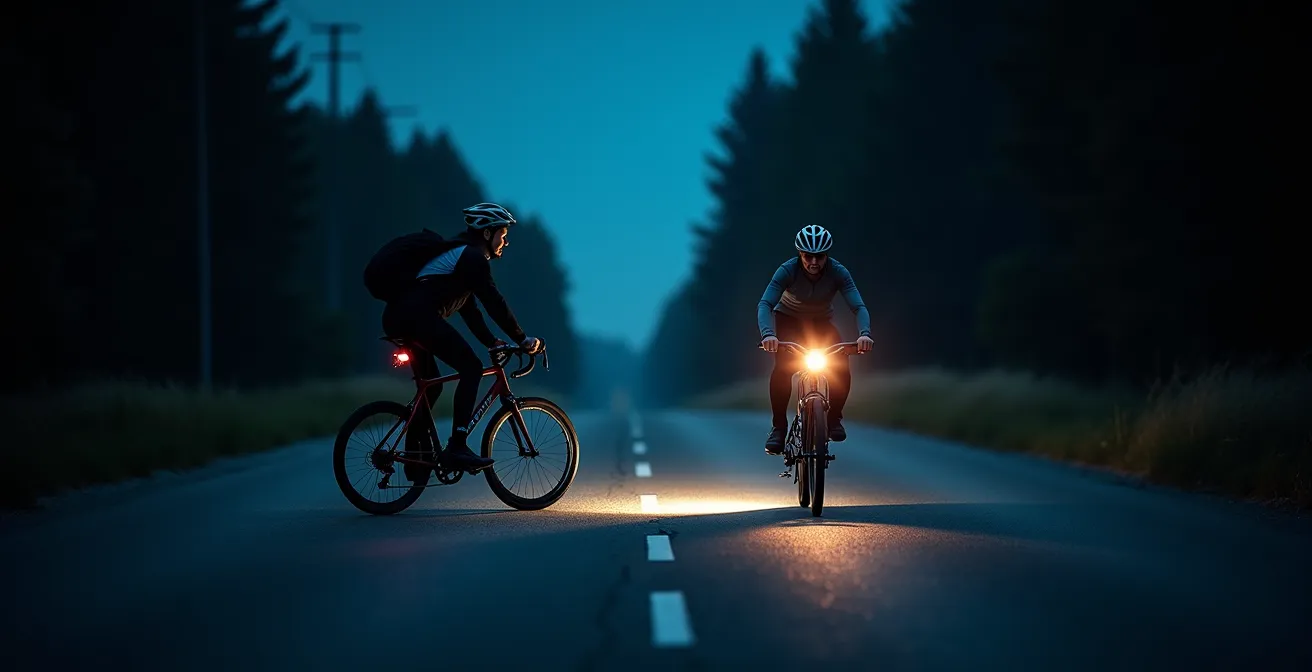
As the comparison shows, the elevated light cone cuts through the visual noise of traffic at a driver’s eye level. A landmark study on road visibility confirmed this with powerful data. In open-road testing, researchers found that drivers were 270% more likely to see a cyclist using a flashing rear light, with high-mounted lights providing visibility from up to 2 kilometers away even in daylight. This increased distance gives a driver a crucial 2-second advantage in reaction time, which can be the difference between a safe pass and a collision.
This is not just about brightness; it’s about recognition. The brain is wired to notice movement, and a high, bobbing light is more easily identified as a vulnerable human. This principle of “biomotion” is one of the few smart helmet features with unequivocal, data-backed safety benefits. The question is whether this benefit alone justifies the price and weight.
While other features may be debatable, the visibility advantage of a well-designed, high-mounted light is scientifically sound. It is arguably the primary reason to even consider a smart helmet in the first place.
Remote vs Automatic Signals: Do Drivers Actually Notice Helmet Blinkers?
Turn signals are one of the most heavily marketed features of smart helmets, promising car-like communication. The reality, however, is fraught with ambiguity and risk. The core problem is the lack of a universal standard. While hand signals are taught in driver’s education and are legally recognized, a blinking light on a helmet has no established meaning. To an unfamiliar driver, it could be a decorative flourish, a malfunction, or simply part of a random flashing pattern.
This “perceptual effectiveness” is a major hurdle. But the usability issues run deeper. Handlebar-mounted remotes introduce a significant cognitive load. In a complex intersection, a rider’s focus should be on scanning for threats, not fumbling for a button. Taking a hand off the bar to activate a signal can be less stable and more dangerous than simply extending an arm for a traditional hand signal.
Automatic, accelerometer-based signals attempt to solve this, but they introduce a different problem: false positives. The systems can misinterpret a quick head check, a sudden stop, or a swerve to avoid a pothole as a turn or braking maneuver, sending confusing and erroneous signals to following traffic. In beta testing, these systems have shown inconsistent activation, which is worse than no signal at all, as it erodes any trust a driver might have in the technology.
From a skeptical tester’s perspective, helmet-based turn signals are currently a solution in search of a problem. They are less clear than hand signals, can increase cognitive load, and risk creating confusion. Until they are as universally understood as a car’s blinker, they remain a high-tech gimmick with questionable safety value.
The Mistake of Buying a Heavy Smart Helmet That Causes Neck Strain
Here we arrive at the smart helmet’s greatest physical liability: weight. A standard road helmet weighs around 250-300 grams. A smart helmet, packed with batteries, LEDs, and processors, can easily exceed 500 grams. For instance, real-world testing shows a smart e-bike model can weigh 530g with MIPS compared to 385g for a standard version of the same helmet. This extra 150-200g (a third of a pound) might not feel like much in your hands, but it creates a significant biomechanical penalty when worn for an extended commute.
This additional mass acts as a lever on your neck and upper back muscles. Over a 30-minute ride, this can lead to fatigue, stiffness, and even chronic pain. More dangerously, it can subconsciously discourage proper safety habits. When your head feels heavy, you are less likely to perform frequent, rapid head checks (shoulder checks) to scan for traffic. This fatigue-induced reduction in alertness and situational awareness can completely negate any benefit provided by the helmet’s electronic features.
The placement of the weight is also a factor. A helmet with a large battery pack at the rear will create more strain than one with a more balanced weight distribution. Before investing, it’s crucial to assess your own tolerance for this extra weight.
Action Plan: Self-Assessment for Helmet Weight Tolerance
- Wear your current helmet and note any neck discomfort after 30 minutes of riding.
- Add 100-150g of weight to simulate a smart helmet (e.g., tape a few rolls of coins securely to the top).
- Repeat your typical ride duration and monitor for increased fatigue or a reduced frequency of head-checking.
- If you experience significant discomfort or find yourself moving your head less, prioritize lighter smart helmet models under 400g.
- Pay attention to battery placement during your test; rear-heavy designs create more leverage strain than centered weight distribution.
A helmet that is too heavy to wear comfortably and safely is not a safety device; it’s a liability. No amount of flashing lights can compensate for the danger of a rider who is too fatigued to stay aware of their surroundings.
When to Choose a NTA-8776 Speed Pedelec Helmet Over a Road Helmet?
If you ride a Class 3 e-bike capable of reaching 28 mph (45 km/h), your impact protection needs are fundamentally different from those of a traditional cyclist. A standard road helmet is simply not designed or tested for falls at these speeds. This is why the Dutch have created a specific certification for high-speed e-bikes: NTA-8776. It’s the only standard in the world specifically for “speed pedelecs.”
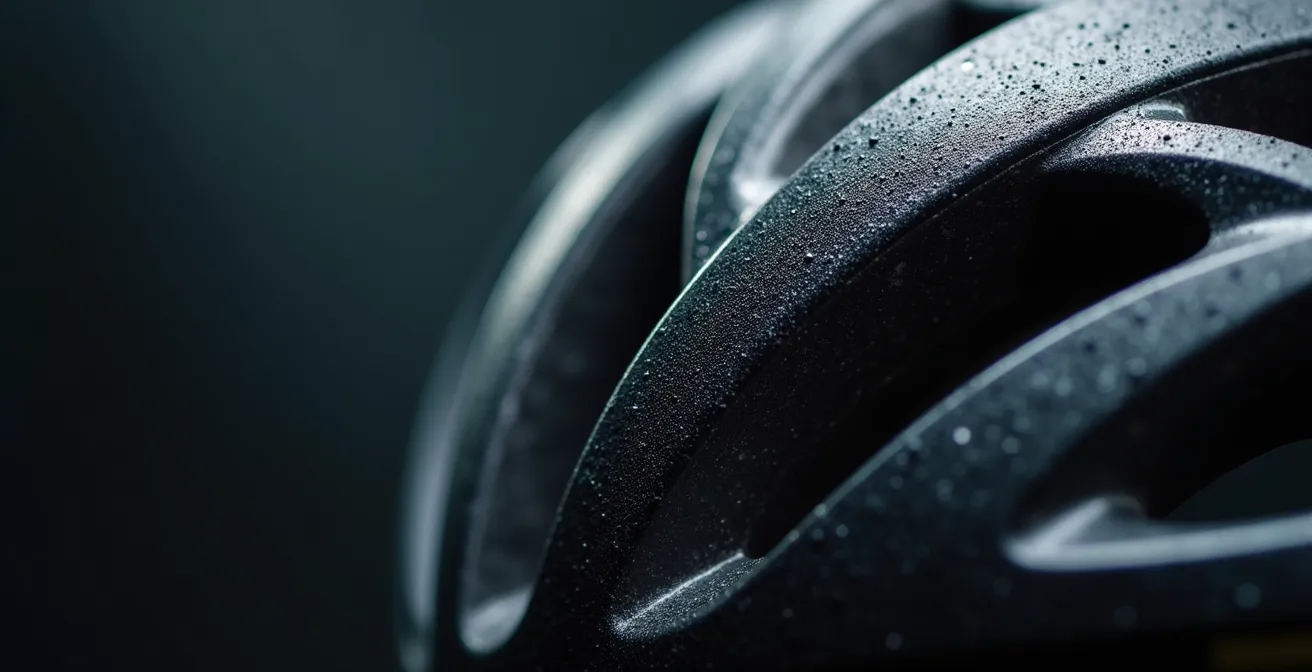
An NTA-8776 certified helmet isn’t just a beefed-up road helmet. It must pass much more rigorous testing. The standard requires testing at 45 km/h impact speeds, whereas standard European helmets are tested at only 25 km/h. Furthermore, these helmets are required to provide significantly more coverage to vulnerable areas of the head, particularly the temples and the back of the skull, as shown in the image above. This extended protection is critical in the higher-energy impacts associated with e-bike speeds.
For a safety-conscious rider on a fast e-bike, choosing an NTA-8776 certified helmet should be non-negotiable. Many smart helmets are now available with this certification, but it’s crucial to verify this. Do not assume a helmet marketed for “e-bikes” meets this standard unless it explicitly carries the NTA-8776 label. This certification is a far more meaningful safety feature than any electronic gimmick.
In short, if your e-bike can exceed 20 mph, your helmet search should start and end with the NTA-8776 list. Find a certified helmet that fits well and is a comfortable weight first, and only then consider if you want one with added smart features.
How to Stay Visible in a Bus Driver’s Blind Spot at Intersections?
Intersections involving large vehicles like buses or trucks represent one of the most dangerous situations for a cyclist. Their high cab height and massive blind spots can make a cyclist completely invisible, especially one positioned alongside them. This is a scenario where the geometric advantage of a helmet-mounted light becomes a critical survival tool.
Visibility research confirms that a high-mounted light is far more likely to appear in the peripheral view of a commercial vehicle’s mirrors than a low-mounted seatpost light. But visibility can be further enhanced by combining light with motion. The “biomotion” principle states that a driver’s brain is exceptionally good at recognizing a pattern of human movement. By combining a steady, high-mounted helmet light with flashing lights mounted on your ankles, you create a distinctive “pedaling” motion that is far more recognizable than static lights alone. This transforms you from a random point of light into an identifiable, vulnerable human.
However, technology is only part of the solution. Defensive positioning and proactive communication are just as vital. Experts recommend a series of strategies to avoid disappearing in a blind spot:
- Never stop alongside a large vehicle at a red light. Your only safe positions are far enough behind to be seen in the mirror or far enough ahead to be in the driver’s direct forward view.
- Use a “rocking motion” when stationary. A subtle side-to-side movement makes your lights dynamic and more likely to catch a driver’s eye.
- Make noise. Use your bell or even the clicking sound of your freehub as an audio cue that can penetrate a driver’s cabin when visual contact is lost.
- Know the mirror zones. Actively position yourself where you can see the driver’s face in their side mirror. If you can’t see them, they absolutely cannot see you.
A smart helmet can be a powerful tool in this specific context, but it must be paired with the knowledge of where blind spots are and the discipline to actively avoid them.
Why Class 3 E-Bikes Are Banned on Most Multi-Use Paths?
The controversy over e-bike access on trails and multi-use paths often seems like a culture clash, but the primary reason for banning high-speed Class 3 e-bikes is rooted in simple, undeniable physics. These paths are designed for a predictable mix of pedestrians, joggers, and casual cyclists moving at relatively low and similar speeds. The introduction of a vehicle traveling at 28 mph creates a dangerous speed differential that the infrastructure cannot safely accommodate.
The core issue is reaction time and stopping distance. A pedestrian can stop almost instantly. A casual cyclist at 12 mph needs about 20 feet. A Class 3 e-bike rider at 28 mph, however, can require over 75 feet to come to a complete stop, even in ideal conditions. This massive gap in stopping distance means that by the time a high-speed rider sees a hazard—a child chasing a ball, a dog on a long leash, a sudden stop ahead—a collision may be unavoidable.
This isn’t an opinion; it’s a mathematical certainty. The table below, based on an analysis of speed and stopping distances, clearly illustrates the disparity that makes mixing these user types so hazardous.
| User Type | Average Speed | Stopping Distance (Dry) | Reaction Time Buffer Needed |
|---|---|---|---|
| Pedestrian | 4 mph | 2 feet | N/A |
| Casual Cyclist | 12 mph | 20 feet | 1.5 seconds |
| Class 3 E-bike | 28 mph | 75+ feet | 2.5 seconds |
Therefore, these bans are not an emotional reaction against e-bikes. They are a logical safety measure based on the physical limitations of a shared-use environment. For Class 3 e-bike riders, this means accepting that their vehicle belongs on the road, with infrastructure and traffic patterns designed for higher speeds.
Key Takeaways
- For high-speed e-bikes (Class 3), NTA-8776 certification is the most crucial safety feature, far outweighing any electronic gimmick.
- The added weight of smart helmets is a significant safety liability (“biomechanical penalty”) that can cause neck strain and reduce a rider’s situational awareness.
- High-mounted lights offer a scientifically-proven visibility benefit, but the effectiveness of features like turn signals is highly questionable in real-world traffic.
The Essential Emergency Kit: What to Carry for Commutes Under 10 Miles?
The final consideration for a skeptical tester is failure point analysis. What happens when your $200+ smart helmet’s battery dies mid-commute on a dark, rainy evening? Relying solely on integrated electronics for visibility is a risky strategy. Every smart helmet owner should carry a minimalist emergency kit to account for technological failure, as well as common roadside issues.
The reliance on a rechargeable battery introduces a new daily task. Forgetting to charge your helmet can leave you dangerously invisible. This is not a hypothetical problem, as this commuter’s experience shows:
After nearly two years of daily commuting through all four seasons, I’ve learned to charge everything on Sunday nights. My Lumos Ultra now holds about 85% of original battery capacity. For longer commutes, I’ve gotten in the habit of charging at work rather than trying to remember when I get home. The backup clip-on lights have saved me twice when I forgot to charge.
– Real-world smart helmet battery management experience
This testimony highlights the need for redundancy. For short commutes under 10 miles, you don’t need a full touring setup, but a few key items can be the difference between getting home safely and being stranded. Your kit should address both smart feature failure and basic mechanical or medical needs.
Here are the essentials to pack in a small seat bag or backpack:
- Small USB power bank (min. 2000mAh): For an emergency helmet charge to get your lights back on.
- Backup clip-on lights: A simple, coin-cell powered front and rear light set as a crucial failsafe.
- Antiseptic wipes and large adhesive bandages: For treating minor road rash immediately.
- Laminated emergency contact/medical info card: In case you are unable to communicate after a crash.
- High-quality multi-tool: Ensure it includes a chain breaker, tire lever, and a way to inflate a tire (CO2 or mini-pump).
Ultimately, a smart helmet is a computer you wear on your head. Like any computer, it can fail. The truly smart rider prepares for this eventuality and builds redundancy into their safety system, ensuring that technology serves them, not the other way around.
Frequently Asked Questions About Beyond the Standard Shell: Are Smart Helmets With Lights Worth the Extra Weight?
Do drivers understand helmet turn signals?
Unlike standardized hand signals, helmet blinkers lack universal recognition. Older drivers or those unfamiliar with cycling tech may interpret them as decorative lights rather than directional indicators.
What are the risks of handlebar remotes?
Fumbling for a remote control while riding can take your hand off the bar and eyes off the road, potentially negating safety benefits. The cognitive load of remembering to activate signals adds complexity.
How reliable are automatic accelerometer-based signals?
Automatic signals can produce false positives during sudden stops or swerves, creating confusing messages for following traffic. Beta testing shows inconsistent activation patterns.