
Contrary to popular belief, an e-bike’s motor isn’t about making rides ‘easier’—it’s a precision tool for building serious endurance by controlling external variables.
- Using assist strategically allows you to lock in your perfect aerobic heart rate (Zone 2) for hours, maximizing fat-burning and base fitness.
- This method enables longer training durations, resulting in superior total calorie burn and metabolic benefits compared to shorter, unsustainable acoustic rides.
Recommendation: Stop thinking of assist as a crutch. Start using it as a variable controller to manage wind and hills, keeping your effort consistent and unlocking your true endurance potential.
You feel the ambition: to complete a long, satisfying three or four-hour ride, the kind that builds true endurance. But there’s a problem. Your legs don’t yet have the deep, foundational strength to sustain that effort, especially when a grueling headwind or a series of steep rollers appears. You either push too hard into the red and bonk, or you cut the ride short, frustrated. For many cyclists, this is the “acoustic ceiling”—the point where terrain and fatigue dictate the limits of your training, not your ambition.
The common advice is to simply “ride more” or “push through it,” but this often leads to over-training, injury, or burnout. Others look to an e-bike and hear the common refrain that it’s “cheating” or that you won’t get a real workout. They see the motor as a simple tool to make things easier, missing its profound potential as a sophisticated training device. This view is not just outdated; it’s holding you back from your endurance goals.
But what if the motor wasn’t for reducing effort, but for controlling variables? This is the strategic shift that transforms an e-bike from a recreational vehicle into a precision endurance-building machine. The secret to a 3-hour ride without bonking isn’t just having a motor; it’s using that motor to meticulously manage external forces like wind and gradients. This allows you to lock in a specific, productive physiological state—your aerobic base-building zone—for the entire duration. It’s not about making the ride easier; it’s about making it *perfectly effective*.
This guide will deconstruct this strategic approach. We will explore the science of base training, how to use assist modes as a training partner, and the critical mistakes to avoid. By the end, you’ll see your e-bike not as assistance, but as your most powerful tool for unlocking endurance you never thought possible.
For those who prefer a visual format, the following video offers a great overview of why endurance training is so fundamental for improving overall cycling performance, complementing the specific e-bike strategies we’ll cover.
This article is structured to provide a comprehensive coaching plan for using your e-bike to build a powerful aerobic engine. Each section addresses a key component of a successful long-distance training strategy.
Summary: A Strategic Guide to E-Bike Endurance
- Why Long Slow Distance (LSD) Rides Are Crucial for Aerobic Base?
- How E-Biking Saves Runner’s Knees While Maintaining Cardio?
- Eco Mode Training: Using the Motor to Compensate for Wind, Not Effort
- The Mistake of Forgetting to Eat Because You “Have a Motor”
- When to Ride for Active Recovery: Flushing Lactate Without Fatigue?
- Turbo Mode Addiction: The Habit That Halves Your Ride Distance
- When to Take Breaks: Preventing Saddle Sores on Your First 4-Hour Ride?
- Is It Cheating? Why You Still Burn 300 Calories an Hour on an E-Bike?
Why Long Slow Distance (LSD) Rides Are Crucial for Aerobic Base?
The foundation of all endurance performance is the aerobic base. This is your body’s ability to efficiently use oxygen to produce energy, primarily by burning fat. The most effective way to build this is through Long Slow Distance (LSD) rides, specifically in what is known as Zone 2 of your heart rate (roughly 60-70% of your maximum). Training in this zone stimulates mitochondrial growth, increases capillary density in your muscles, and improves your metabolic efficiency. The goal isn’t speed; it’s time spent in the correct physiological state.
Herein lies the challenge of acoustic bikes. On a flat, calm day, holding Zone 2 is manageable. But introduce a stiff headwind or a rolling hill, and you’re quickly pushed into Zone 3 or 4 (anaerobic), burning precious glycogen and accumulating fatigue. Conversely, on a long descent, your heart rate drops to Zone 1, providing zero training stimulus. This inconsistency undermines the very purpose of an LSD ride. For optimal development, research shows that elite cyclists dedicate 60-70% of total training volume to this specific zone.
This is where the e-bike becomes a game-changing training tool. By providing just enough assistance to counteract external variables, it allows you to maintain a consistent pedal pressure and cadence, effectively locking your heart rate in Zone 2 for hours. One study found e-bike riders maintained more consistent heart rate zones, burning 444 calories per hour, effectively turning the bike into a “Zone 2 machine.” It’s not about making the ride easy; it’s about making it perfectly, relentlessly consistent. You can pedal lightly into a headwind or even up a slight incline on a descent, eliminating “junk miles” and ensuring every minute of your 3-hour ride contributes to building your aerobic engine.
How E-Biking Saves Runner’s Knees While Maintaining Cardio?
Many athletes, particularly former runners or those with knee sensitivities, are drawn to cycling for its low-impact nature. However, even on a bike, improper technique can stress the joints. The most common culprit is “mashing” the pedals—pushing a heavy gear at a low cadence. This creates high peak torque forces that strain the patellar tendon and cartilage. The ideal for both performance and joint health is to maintain a higher, smoother cadence.
A high cadence (typically 85-95 RPM) promotes a more circular, fluid pedal stroke, distributing the load more evenly and reducing peak stress on the knee. The problem is, maintaining this high cadence on an acoustic bike requires significant leg strength and cardiovascular fitness, especially when facing an incline or a headwind. A developing cyclist will naturally slow their cadence and start mashing the gear to compensate, putting their knees at risk.
This is another area where the e-bike’s motor acts as a strategic training partner. It allows you to decouple cadence from raw power output. You can select a lighter gear, spin at a comfortable 90 RPM, and let the motor provide the small amount of torque needed to maintain speed. This trains your neuromuscular system to pedal efficiently without overloading your joints. It’s the perfect environment to develop a smooth, knee-friendly pedal stroke that will serve you well for years.
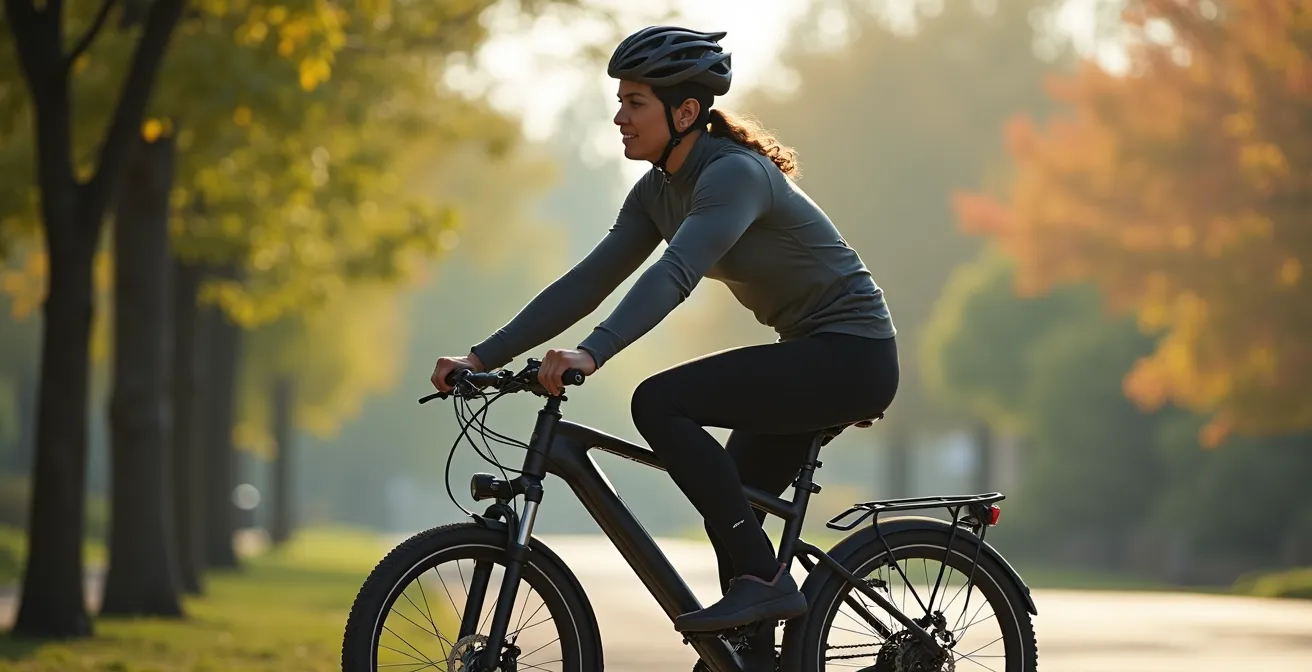
This image demonstrates the ideal leg position for smooth, high-cadence pedaling, a technique made more accessible with e-assist.

By using the motor to maintain momentum, you can focus entirely on the *quality* of your movement. This not only protects your knees but also builds a more efficient and powerful pedaling technique, ensuring your cardiovascular system remains the limiting factor, not joint pain. This allows you to extend your rides and reap the cardio benefits without the painful side effects of high-impact or high-torque exercise.
Eco Mode Training: Using the Motor to Compensate for Wind, Not Effort
The biggest mental shift for an aspiring endurance e-biker is to see the assist modes not as “easy, medium, hard,” but as tools to negate external forces. Your internal effort—your heart rate and perceived exertion—should remain constant. The motor’s job is to adjust to the world around you so your body doesn’t have to. This is the art of using the motor as a variable controller.
Your primary training mode should always be the lowest effective setting, often labeled “Eco.” On a calm, flat day, you might even have the motor off entirely, pedaling at your target Zone 2 heart rate. Now, a 10 mph headwind appears. On an acoustic bike, you’d have to increase your power output by 50-70 watts just to maintain speed, rocketing your heart rate out of Zone 2. On your e-bike, you simply engage Eco mode. The motor adds the extra 50 watts, your speed is maintained, and your heart rate remains perfectly stable. You’ve used the motor to cancel out the wind, not to reduce your effort.
This same principle applies to cadence. As one study on cycling cadence notes, trained cyclists naturally find their optimal pedaling speed, but untrained riders often fall short. The e-bike’s assist helps you maintain that ideal 85-95 RPM cadence, even when fatigue sets in or the terrain changes, reinforcing good habits. The following table provides a strategic framework for this approach.
| Conditions | Target HR Zone | Assist Level | Cadence (RPM) |
|---|---|---|---|
| Calm day, flat terrain | Zone 2 (60-70% max HR) | Off or Eco (0-25%) | 85-95 |
| Moderate headwind | Zone 2 (60-70% max HR) | Eco+ (25-40%) | 85-95 |
| Strong headwind/hills | Zone 2 (60-70% max HR) | Tour (40-60%) | 85-95 |
| Recovery ride | Zone 1 (<60% max HR) | Tour+ (60-75%) | 90-100 |
By mastering this method, you transform the ride into a controlled laboratory for aerobic adaptation. Your body stays in the optimal fat-burning, endurance-building state for the entire duration of the ride, something that is nearly impossible to achieve in the variable conditions of the real world on an acoustic bike.
The Mistake of Forgetting to Eat Because You “Have a Motor”
One of the most dangerous traps for new e-bike endurance riders is a false sense of security. Because the perceived effort can feel lower and the average speed higher, it’s easy to neglect one of the cornerstones of long-distance cycling: fueling. You might think, “I have a motor, I don’t need to eat as much.” This is a critical error that will lead you directly to “bonking”—the cyclist’s term for crashing due to depleted glycogen stores.
The reality is you are still doing a significant amount of work. Even at a moderate pace with assistance, studies show riders still burn 280-300 calories per hour. Over a three-hour ride, that’s 900 calories—a substantial energy expenditure that your body cannot cover without incoming fuel. The motor helps your muscles, but it doesn’t replenish your liver’s glycogen.
The rule for any ride over 90 minutes is simple: you must eat. A good starting point is to consume 30-60 grams of carbohydrates every hour, starting after the first 45-60 minutes. This could be a gel, a chew, or a small energy bar. Forgetting to do this because the motor is making things “feel” easy is a recipe for disaster. The bonk will still come; it will just arrive more suddenly and surprisingly, as your baseline effort is masked by the motor’s support. You’ll go from feeling fine to feeling dizzy, weak, and unable to turn the pedals in a matter of minutes.
Think of fueling as essential maintenance for your body, the engine, while the motor is just a temporary turbocharger. Your ride’s duration is ultimately limited by your body’s fuel tank, not the bike’s battery. A smart e-bike rider respects this and fuels with the same discipline as an acoustic rider, ensuring they can finish the last hour of their ride just as strong as the first.
When to Ride for Active Recovery: Flushing Lactate Without Fatigue?
Endurance training isn’t just about hard days; it’s equally about smart recovery. After a strenuous workout (like a long run or a high-intensity interval session), your muscles are filled with metabolic byproducts like lactate. While passive rest is good, “active recovery” is often better. This involves very light physical activity that increases blood flow to the muscles, helping to flush out these waste products and deliver nutrients, speeding up repair and reducing soreness.
The perfect active recovery session is a 30-60 minute ride at a very low intensity—Zone 1, or less than 60% of your max heart rate—with a light, steady cadence. The challenge? On an acoustic bike, even the slightest incline or a mild headwind can push your effort level too high, adding fatigue instead of reducing it. It’s difficult to maintain the precise, feather-light effort required for optimal recovery. You end up either working too hard or coasting, neither of which is effective.
The e-bike is the ultimate active recovery tool. It allows you to dial in the exact level of assistance needed to keep your heart rate firmly in Zone 1, regardless of terrain. You can spin your legs at a high, smooth cadence (90-100 RPM) with almost no muscular load, transforming your ride into a therapeutic flush for your legs. The science supports this: research on cyclists showed that active recovery at 40% of VO2max resulted in significantly better lactate clearance than passive recovery. The e-bike is the only tool that allows an amateur athlete to hold this precise intensity in real-world conditions.
Using your e-bike for a dedicated recovery ride the day after a hard effort will leave your legs feeling fresher and more prepared for your next key workout. It’s a strategic use of the technology that accelerates your fitness gains by optimizing the time between hard sessions. Instead of another day off, you’re actively promoting your body’s repair processes.
Turbo Mode Addiction: The Habit That Halves Your Ride Distance
Every e-bike has it: that thrilling, top-tier assist level. Turbo, Boost, Sport—whatever the name, the feeling of effortless acceleration is seductive. It flattens hills and makes you feel superhuman. While it’s a useful tool for getting out of a tricky situation or conquering a truly brutal climb, relying on it as a default is the single fastest way to sabotage your endurance ride. This is “Turbo Mode Addiction.”
The problem is twofold. First, it decimates your battery. The power consumption is not linear; it’s exponential. In fact, battery usage data shows that 5 minutes in Turbo mode consumes battery equivalent to 20 minutes in Eco mode. Abusing Turbo can literally cut your potential ride distance in half, ending your 3-hour endurance ambition at the 90-minute mark. You’re trading long-term training goals for short-term thrills.
Second, and more importantly for training, it completely detaches you from the feeling of effort. It prevents you from spending time in the valuable Zone 2. Instead of building your aerobic engine, you’re simply letting the motor do all the work. It becomes a crutch, not a tool, preventing your body from making the adaptations you’re riding for in the first place. A true endurance rider uses the *lowest possible* assist level to achieve their target heart rate, reserving Turbo for emergencies only. To break this habit, you need a clear strategy.
Your Action Plan: Gamified Turbo Weaning Strategies
- The One-Bar Challenge: Set a goal to complete your regular 2-hour route using only a single bar of your battery display.
- Turbo Budgeting: Grant yourself a strict “budget” of only 5 minutes of Turbo per hour, to be used exclusively on the steepest sections.
- The Downgrade Ride: Intentionally complete your entire ride one full assist level lower than you normally would (e.g., use only Eco if you usually use Tour).
- Heart Rate Over Power: Cover your bike’s assist level display. Instead, use your heart rate monitor as your only guide, adjusting assist only to stay in Zone 2.
- Progressive Reduction: Track your average assist level usage and aim to decrease it by 10% each week, weaning yourself off the higher modes.
Breaking the Turbo addiction is a mental game. By gamifying the process, you can retrain your brain to value efficiency and duration over raw, motor-assisted speed. This discipline is the hallmark of a strategic e-bike endurance athlete.
When to Take Breaks: Preventing Saddle Sores on Your First 4-Hour Ride?
As you push into longer ride durations of three, four, or even more hours, the limiting factor often shifts from your muscles or lungs to your contact points. Specifically, saddle discomfort and the risk of sores become a primary concern. The constant pressure and friction can lead to chafing and pain that can end a ride prematurely, no matter how fit you are. Proactively managing this is key to unlocking ultra-endurance distances.
The most effective strategy is a combination of in-saddle and off-saddle relief. While riding, make a conscious effort to briefly stand up on the pedals every 10-15 minutes. This simple act takes all pressure off your sit bones for 15-30 seconds, restoring blood flow and giving the tissue a much-needed break. The e-bike’s motor makes this easier, as you can maintain momentum while standing without a huge spike in effort.
This image shows the standing pedaling technique, a vital skill for relieving pressure on long rides.
In addition to these micro-breaks, planned stops are non-negotiable on a 4-hour ride. Getting off the bike completely allows for a full reset. These breaks are not a sign of weakness; they are a strategic tool used by all professional endurance athletes. A well-structured break protocol allows you to hydrate, fuel, and stretch, ensuring you can maintain comfort and power for the entire duration.
This protocol, adapted for e-bike riding, provides a clear roadmap for your first long-distance efforts. Notice how assist is strategically used after breaks to ease back into the rhythm.
| Time Elapsed | Break Duration | Activities | Assist Level After Break |
|---|---|---|---|
| 60-75 minutes | 5 minutes | Hydrate, light stretch, adjust position | Increase by 1 level for 5 min |
| 120-150 minutes | 10 minutes | Eat, hip flexor stretches, walk briefly | Increase by 1 level for 10 min |
| 180+ minutes | 15 minutes | Full nutrition, comprehensive stretching, check contact points | Maintain higher assist for 15 min |
By integrating both standing pedaling and planned stops, you proactively manage discomfort. This transforms the 4-hour ride from a daunting test of pain tolerance into a manageable and enjoyable endurance achievement.
Key Takeaways
- An e-bike’s primary training function is to act as a “variable controller,” negating external forces like wind and hills to lock in a consistent Zone 2 heart rate.
- The goal of e-assist in endurance is not to reduce effort, but to extend the duration of quality training time, leading to superior aerobic adaptations.
- Fueling and proactive breaks are just as critical on an e-bike; the motor assists your muscles but does not replace your body’s need for energy or pressure relief.
Is It Cheating? Why You Still Burn 300 Calories an Hour on an E-Bike?
Let’s address the elephant in the room: the persistent myth that using an e-bike is “cheating.” This argument is fundamentally flawed because it incorrectly assumes the goal of every ride is maximum suffering over a short distance. For endurance training, the goal is *maximum effective time* in a specific training zone. By this metric, the e-bike is not a cheat code; it is a superior tool.
The effort is still very real. While you burn fewer calories per hour than on an acoustic bike at the same speed, the work is substantial. For example, a New York Times study found that e-bike riders burn 344-422 calories per hour compared to 505 for traditional bikes. You are still performing a significant workout. The key difference, as a landmark 2019 European study from Transportation Research Interdisciplinary Perspectives points out, is that the e-bike enables a crucial trade-off:
E-bikers may compensate, at least in part, the lower effort per kilometre of e-biking by traveling longer distances.
– Transportation Research Interdisciplinary Perspectives, 2019 European E-bike Usage Study
This is the core of the argument. You are trading a small amount of intensity for a massive gain in duration. And when it comes to building an aerobic base, duration is king. This isn’t just theory; it’s a matter of simple math, as the following analysis demonstrates.
Case Study: 3-Hour E-Bike Ride vs. 1.5-Hour Acoustic Ride
An analysis of a cyclist aiming for base fitness shows that a 3-hour ride on an e-bike, maintaining a consistent Zone 2 effort and burning 300 kcal/hour, results in a total expenditure of 900 calories. The same cyclist on a regular bike might push harder, burning 500 kcal/hour, but hits their “acoustic ceiling” and is forced to stop from exhaustion after just 1.5 hours, for a total expenditure of only 750 calories. The e-bike ride not only burned more total calories but also provided double the time under tension in the optimal fat-burning zone, resulting in far superior metabolic and endurance-building benefits.
So, is it cheating? Only if you believe a shorter, more painful, and less effective workout is somehow more virtuous. If your goal is to build a deep, resilient aerobic base and unlock the ability to ride for hours, the e-bike isn’t cheating. It’s training smarter.
Now that you understand the strategy, the next step is to apply it. Plan your next ride with a clear heart rate target, a fueling plan, and the discipline to use your motor as the precision tool it is. Start building the endurance you’ve been aiming for.
Frequently Asked Questions About E-Bike Endurance Training
Should I eat less on an e-bike ride compared to a regular bike?
No, you should maintain similar nutrition timing. E-bike riders burn 200-600 calories per hour depending on the assist level, which absolutely requires regular fueling. Plan to consume carbohydrates every 45-60 minutes on any ride longer than 90 minutes to avoid bonking.
When should I increase assist level around eating?
This is a smart, strategic use of the motor. Increase your assist level for the five minutes leading up to a planned fuel stop. This will lower your heart rate and breathing rate, making it physically easier to chew and swallow. After eating, reduce the assist level back to your training baseline over the next 10 minutes.
What are early signs of bonking on an e-bike?
The signs are similar to an acoustic bike but can feel more sudden because the motor masks the initial decline. Watch for irritability or a negative mood shift, difficulty maintaining your target cadence even with motor assistance, mental fog or trouble concentrating, and a sudden feeling of deep fatigue despite the motor’s help. If you feel these, consume sugar immediately.