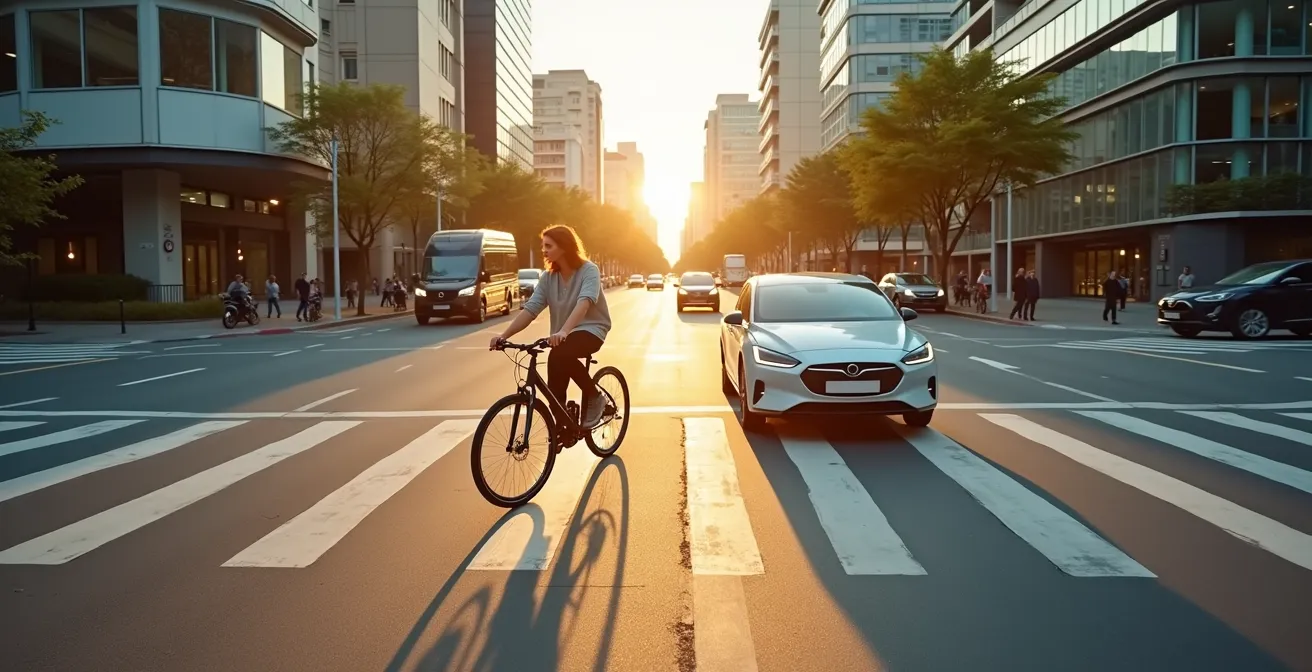
An electric car’s “zero tailpipe emissions” claim hides a cascade of environmental costs related to its mass, making an e-bike exponentially cleaner across its entire lifecycle.
- Heavy EVs produce significant “second-order” pollution, such as toxic tire microplastics, which lightweight e-bikes virtually eliminate.
- The massive difference in battery scale and charging efficiency means an EV’s material and grid impact is orders of magnitude greater than an e-bike’s.
Recommendation: For true eco-minimalism, the analysis proves that replacing car trips with an e-bike provides a far greater reduction in total environmental impact than switching from a gas car to an EV.
For the eco-minimalist, the transportation dilemma seems straightforward: replace the fossil-fuel-burning car with an electric one. A Tesla, for instance, promises a future free from tailpipe emissions, a clean break from the old world of gasoline. On the other side, a lightweight electric bicycle, perhaps from a brand like Tern, offers a different vision of green mobility—one based on efficiency and minimalism. The common wisdom pits both against the gas car, declaring them joint victors in the fight for cleaner air. This satisfies the surface-level desire for a green solution.
However, this perspective dangerously oversimplifies the problem. It fixates on a single metric—tailpipe emissions—while ignoring the much larger, systemic impact of a vehicle’s existence. What if the true environmental cost is not in the exhaust, but in the sheer mass of the object we choose to move? This is the central question. A critical analysis must go beyond the tailpipe to account for the “emission cascade” triggered by weight. This includes second-order emissions from tire and brake wear, the monumental difference in resource consumption for batteries, and the pressure exerted on our energy grid.
This article provides that critical analysis. We will dismantle the “zero-emission” myth by dissecting the hidden environmental costs that separate electric cars and e-bikes not by a small margin, but by orders of magnitude. We will examine the data on tire pollution, grid energy consumption, traffic impact, and the crucial mistake of equating a 10-pound battery with a 1,000-pound one. The goal is to equip you with a new framework for evaluating electric mobility, one based on total impact rather than marketing slogans.
To navigate this in-depth analysis, the following sections will systematically break down the key differences between these two electric options, revealing the true champion of low-emissions transport.
Contents : A Data-Driven Verdict on E-Bike vs. EV Emissions
- Why Heavier EVs Generate More Tire Microplastics Than E-Bikes?
- How Charging an E-Bike Uses 100x Less Grid Power Than an EV?
- Traffic Jams: How E-Bikes Reduce Idling Emissions for Everyone?
- The Mistake of Equating a 10lb Battery With a 1,000lb Battery
- When to Ride: Avoiding Peak Pollution Hours in the City?
- Grid vs Solar Charging: How Green Is Your E-Bike Fuel Really?
- Door-to-Door Speed: Why E-Bikes Beat Traffic in Rush Hour Zones?
- The 2-Ton Diet: How Replacing Short Car Trips Cuts Your Annual Emissions by 1 Ton?
Why Heavier EVs Generate More Tire Microplastics Than E-Bikes?
The most overlooked environmental flaw of electric vehicles is not their battery, but their tires. An EV’s “zero tailpipe emissions” label creates a powerful illusion of cleanliness, but it ignores the significant pollution generated by tire wear. This is a direct consequence of their immense weight. Heavy batteries mean EVs weigh substantially more than their gasoline counterparts, leading to accelerated tire degradation. The instant torque from electric motors further exacerbates this issue, grinding away rubber with every acceleration. This creates a constant stream of non-exhaust emissions (NEE) in the form of fine rubber particles.

The scale of this problem is alarming. Recent research from Emissions Analytics revealed that a Tesla Model Y can produce 26% more tire particulate pollution than a comparable hybrid vehicle. These particles, laden with chemicals, wash into our waterways and soil. In contrast, an e-bike, weighing a fraction of an EV, imparts minimal wear on its tires. Its low mass and gentle power delivery make its tire particulate emissions almost negligible, preventing this second-order pollution at its source.
Case Study: The Toxic Truth of Tire Dust
The environmental impact of tire particles is not theoretical. For two decades, scientists on the U.S. West Coast were baffled by mass die-offs of coho salmon. The cause was eventually traced to a single chemical, 6PPD, used in tires to prevent degradation. Research published in the journal Science found that when 6PPD-laced tire dust reacts with ground-level ozone, it transforms into a chemical so toxic it killed salmon in laboratory tests within hours. This discovery proves that tire pollution has direct, lethal consequences for wildlife, a problem that heavier vehicles like EVs inherently worsen.
Ultimately, while an EV moves the emission source from the tailpipe to the tire, an e-bike nearly eliminates it altogether. This distinction is not minor; it is a fundamental difference in environmental philosophy.
How Charging an E-Bike Uses 100x Less Grid Power Than an EV?
Beyond material emissions, the energy efficiency gap between an e-bike and an electric car is staggering. Both draw from the same electrical grid, but the quantity of energy they require is not comparable. The primary reason is, once again, mass. An EV must move over two tons of metal, glass, and plastic just to transport a single person. An e-bike moves a person and about 50 pounds of equipment. This physical reality translates into a colossal difference in energy consumption.
This is best illustrated using the “miles per gallon equivalent” (MPGe) metric, which measures the efficiency of vehicles that don’t use gasoline. While a highly efficient EV like a Tesla Model 3 might achieve around 130 MPGe, the numbers for e-bikes are in a completely different dimension. A 2019 study demonstrated that e-bikes can achieve an astonishing 2,200 to 3,800 MPGe. This means they are, at a minimum, 20 to 35 times more energy-efficient than one of the most efficient electric cars on the market. For every unit of energy pulled from the grid, an e-bike provides vastly more transportation.
This radical efficiency has profound implications. For an individual, it means the electricity cost to power an e-bike for a year is often less than a single tank of gas. For the grid, it means e-bikes represent a negligible load, easily absorbed by existing capacity and even more easily powered by small, local renewable sources. An EV, by contrast, represents a significant new demand on an already-strained grid, requiring substantial infrastructure investment to support at scale. The e-bike’s efficiency is its superpower, making it a far more scalable and sustainable solution for personal mobility.
Therefore, when evaluating the “fuel” of these vehicles, it’s not enough to say they are both “electric.” One sips energy with surgical precision, while the other consumes it in volumes that challenge the very infrastructure they rely on.
Traffic Jams: How E-Bikes Reduce Idling Emissions for Everyone?
An electric car, despite its green credentials, remains a car. It occupies the same 150 square feet of road space, contributes to the same traffic congestion, and spends time idling in the same gridlock as its gasoline-powered predecessors. While an idling EV isn’t spewing CO2 from a tailpipe, its contribution to systemic inefficiency has a significant environmental cost. E-bikes, by their very nature, dismantle this paradigm. By using dedicated bike lanes and filtering through slow-moving traffic, they not only offer a faster mode of transport for the rider but also reduce the total number of cars on the road, thereby mitigating congestion for everyone.
This is not just a theoretical benefit. A mode-shift to e-bikes has a measurable impact on a city’s overall emissions. Groundbreaking research from Portland State University modeled the effect of increased e-bike adoption. The study found that a 15% mode shift from cars to e-bikes in the Portland metro area would slash daily CO2 emissions by over 900 metric tons. This demonstrates the powerful network effect of micromobility: every e-bike that replaces a car trip helps reduce the idling time and emissions of the remaining vehicles, creating a positive feedback loop of decongestion and cleaner air.
Case Study: Cargo Bikes as Car Replacements
The potential for e-bikes to replace cars extends far beyond personal commuting. Research indicates that electric cargo bikes can replace a significant portion of commercial and private trips in cities. One study found they could substitute for 32% of delivery trips, 50% of service trips, and up to 80% of private car errands. The CEO of DHL Express Europe has stated that their delivery bicycles make twice as many stops per hour as vans at less than half the total cost of ownership. This proves that e-bikes are not just a supplement to cars but a viable, more efficient replacement for a huge swath of urban vehicle miles traveled.
Action Plan: Leveraging E-Bikes for Maximum Traffic and Emission Reduction
- Replace Short Trips: Target all personal car trips under 5 miles, as this is where conventional vehicles are least efficient and produce the most emissions per mile.
- Prioritize Gas-Powered Trips: Identify and substitute the most frequent trips you take in a gas-powered vehicle to achieve the largest immediate reduction in your carbon footprint.
- Integrate with Public Transit: Use an e-bike for the “last mile” of your journey, connecting your home or workplace to bus, train, or subway stations without needing a car.
- Advocate for Micromobility: Support and advocate for local infrastructure improvements like protected bike lanes, which encourage wider adoption and make cities less car-dependent.
In essence, an EV solves the problem of the individual car’s tailpipe; an e-bike starts to solve the systemic problem of cars themselves.
The Mistake of Equating a 10lb Battery With a 1,000lb Battery
The argument that “both have batteries, so both have an environmental cost” is a classic example of a false equivalency. It ignores the most critical factor: scale. An e-bike battery is a small, manageable object, typically weighing between 5 and 10 pounds. It contains a modest amount of lithium, cobalt, and other minerals. An electric car battery is a monumental piece of engineering, weighing, on average, 1,000 pounds—and in the case of large trucks and SUVs, approaching 3,000 pounds. This is not a quantitative difference; it is a qualitative one. The resource extraction, manufacturing energy, and eventual recycling challenge of a 1,000-pound battery are orders of magnitude greater than for its 10-pound counterpart.
This colossal difference in scale is the primary driver of the lifecycle emissions gap between the two technologies. A comprehensive lifecycle analysis is the only way to capture the true, cradle-to-grave environmental cost. Such an analysis includes emissions from raw material extraction, manufacturing, vehicle use, and end-of-life processing. When this is done, the results are unequivocal.
One comprehensive study comparing vehicles over a 200,000 km lifespan found a petrol car generates about 57.5 tons of CO2. An electric car, while better, still generates a substantial 50.5 tons of CO2. In stark contrast, an e-cargo bike used for similar distances generates only 3 tons. This means that, over their lifetimes, e-cargo bikes emit 94% less CO2 than electric cars. The vast majority of this difference comes from the manufacturing phase, dominated by the immense material and energy requirements of the EV’s battery and oversized frame. To compare the two based on the mere presence of a battery is to miss the entire point.
The lifecycle data confirms that an e-bike is not just a slightly better version of an EV; it belongs to a completely different class of environmental impact. It represents a philosophy of radical resource minimization, while the EV, in many ways, perpetuates the resource-intensive model of its gasoline-powered ancestors.
When to Ride: Avoiding Peak Pollution Hours in the City?
For the committed e-bike rider, the primary source of pollution exposure isn’t what they generate—which is next to nothing—but what they are surrounded by. Riding during rush hour means immersing oneself in a cloud of particulate matter, nitrogen oxides, and volatile organic compounds spewed by the cars, trucks, and buses nearby. This raises a strategic question for the urban cyclist: how to minimize personal exposure to traffic-related air pollution? The simplest answer is timing. Air pollution levels in cities typically follow a diurnal pattern, peaking during the morning and evening commutes and troughing in the middle of the day and late at night.
Therefore, riders who have flexibility in their schedules can significantly reduce their inhaled dose of pollutants by avoiding these peak hours. Traveling between 10 a.m. and 4 p.m., or after 7 p.m., can make a substantial difference. Choosing routes that prioritize bike paths separated from major arterials or side streets with less traffic volume is another critical strategy. While an e-bike itself is a zero-emission vehicle, the rider’s health is part of the sustainability equation. Protecting one’s lungs from the pollution of others is a key aspect of long-term, sustainable urban cycling.
Even when considering the full lifecycle, the e-bike’s annual emissions footprint remains minuscule compared to a car. One environmental study calculated that an e-bike ridden 15,000 miles in a year is responsible for approximately 300kg of CO2. A car traveling the same distance generates around 7,000kg of CO2. This 23-fold difference underscores that even the most heavily used e-bike is an incredibly low-impact mode of transport. The rider’s primary concern shifts from generating pollution to navigating it.
Ultimately, the discussion around e-bike pollution is not about what the bike emits, but about how the rider can best interact with an environment still dominated by polluting vehicles—a problem that more e-bikes will help solve.
Grid vs Solar Charging: How Green Is Your E-Bike Fuel Really?
A common critique of any electric vehicle is that it’s only as clean as the grid that charges it. This is true, but the e-bike’s radical efficiency fundamentally changes the equation. Because it consumes so little energy, the source of that energy has a much smaller impact on its overall carbon footprint. The emissions associated with charging an e-bike are tiny, even on the most carbon-intensive grids.
A detailed analysis of regional grid differences in the U.S. illustrates this point perfectly. The study calculated the grams of CO2 emitted per mile of e-biking based on the local energy mix. It found significant variation, from 3.778g of CO2/mile in hydro-rich Alaska to 12.568g in coal-heavy Wisconsin. While this is a threefold difference, the absolute numbers are incredibly small. For comparison, the average gasoline car emits around 250g of CO2 per mile. This means that even in the “dirtiest” grid scenario, an e-bike is still over 20 times less carbon-intensive per mile than a typical car.

Furthermore, the e-bike’s low energy requirement opens the door to true carbon-neutral fueling in a way that is impractical for an EV. An e-bike battery, with its capacity of 400-800 watt-hours, can be fully charged by a small, portable solar panel in a single sunny day. This allows for genuine “off-grid” transportation, completely decoupled from fossil fuels. Charging a 75-kilowatt-hour EV battery with solar, by contrast, requires a massive, permanent rooftop installation, a far less accessible solution. The e-bike makes personal energy sovereignty an achievable goal for the average person.
Whether charged from a “dirty” grid or a personal solar panel, the e-bike’s fuel remains exceptionally green due to the simple fact that it requires so little of it.
Door-to-Door Speed: Why E-Bikes Beat Traffic in Rush Hour Zones?
In the congested arteries of a modern city, the most powerful car is often the slowest. The raw horsepower of a performance EV is rendered useless by gridlock. In this environment, efficiency is not measured in 0-60 times, but in door-to-door travel time. Here, the e-bike has a decisive, and often counter-intuitive, advantage. By leveraging a network of bike lanes, paths, and the ability to filter through stationary traffic, e-bike riders can maintain a consistent average speed while car-bound commuters are left to the mercy of bottlenecks and red lights.
This real-world advantage is not just a feeling; it’s a quantifiable reality for urban commuters. The ability to bypass traffic jams and avoid the time-consuming hunt for parking can dramatically shorten journey times, especially for trips under five miles, which constitute the majority of urban travel. An e-bike allows a rider to park directly at their destination’s entrance, eliminating the “last 500 feet” problem of walking from a distant parking spot or garage.
Case Study: The 75% Commute Time Reduction
Consider the real-world experience of a school principal whose commute was transformed by an e-bike. Previously navigating city traffic by car, her trip was unpredictable and lengthy. After switching to an e-bike, her commute dropped to a consistent 10-12 minutes. She could zip past idling cars in the bike lane and park directly in front of the school. Her total travel time was cut by over 75%, making her journey effectively 3 to 4 times faster than a car could achieve during rush hour. This is not an isolated incident but a common testimony from urban e-bike converts who rediscover time they thought was lost forever to traffic.
For the eco-minimalist, this presents a rare win-win: the fastest, most reliable, and cheapest option for navigating the city is also, by an enormous margin, the most environmentally friendly.
Key Takeaways
- The immense weight of EVs is their primary environmental flaw, causing significant “second-order” pollution like toxic tire microplastics which e-bikes avoid.
- E-bikes are 20-35 times more energy-efficient than EVs, placing a negligible load on the grid and making true solar charging practical.
- Lifecycle analysis proves the emissions gap is massive: an e-bike’s cradle-to-grave CO2 impact can be over 94% lower than an EV’s due to the colossal difference in battery and material scale.
The 2-Ton Diet: How Replacing Short Car Trips Cuts Your Annual Emissions by 1 Ton?
The core message of this analysis is one of targeted replacement. The greatest leverage for an individual to reduce their transport emissions lies not in swapping one type of multi-ton vehicle for another, but in eliminating the multi-ton vehicle from the equation wherever possible. The majority of car trips are short, inefficient, and carry only the driver. These are the journeys where a car is at its worst and an e-bike is at its best. Embracing this “2-ton diet” by replacing these specific trips yields a disproportionately large environmental benefit.
Every time an e-bike is chosen over a car for a short errand, a significant amount of carbon is saved. The impact is immediate and cumulative. While the exact savings depend on the car being replaced, the principle holds true across the board. The simple act of choosing a 50-pound vehicle over a 4,000-pound one for a three-mile trip to the grocery store is a powerful climate action.
This philosophy of substitution is endorsed by transportation experts who see it as the most effective path to decarbonization. As analysts from a UK transportation study noted when evaluating the switch to e-bikes:
By switching to an ebike, carbon emissions could be cut by up to 50%
– UK Environmental Experts, UK transportation analysis
This 50% reduction refers to an individual’s total transport carbon footprint, achieved simply by replacing a portion of car trips. It highlights that an e-bike is not just an alternative vehicle but a powerful tool for behavioral change, enabling a lifestyle that is less car-dependent, healthier, and profoundly more sustainable.
Therefore, the most logical next step for the eco-minimalist is to critically audit their personal travel needs, identifying every short trip that can be shifted from a car to an e-bike. This is not merely a choice between two products, but a fundamental shift in one’s approach to mobility and resource consumption.