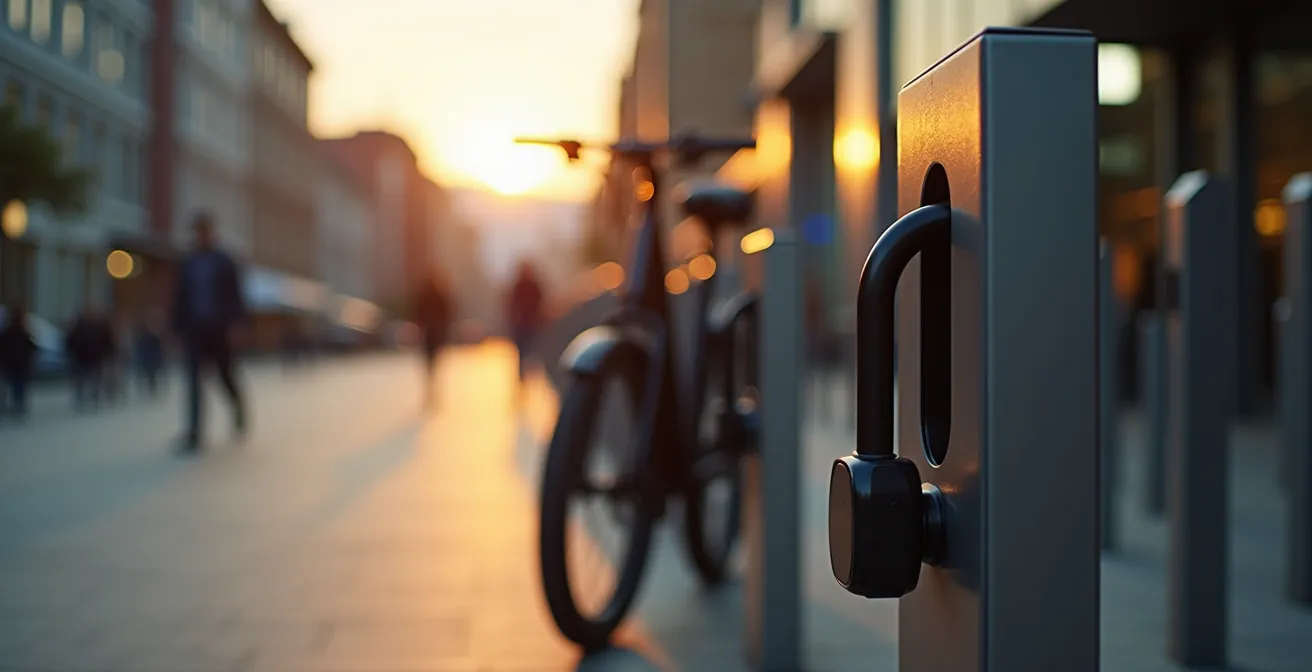
Relying solely on a Gold-rated lock for a high-value e-bike is a rookie mistake; a professional thief sees it as a minor delay, not a genuine obstacle.
- Thieves calculate risk based on the tools and time required to defeat a lock, not just its rating.
- Your security strategy must account for the high resale value of individual components (battery, motor) and your insurance policy’s fine print.
Recommendation: Adopt a layered security mindset. Combine a Diamond-rated primary lock with a secondary lock of a different type and supplement with GPS tracking to make your e-bike an unprofitable and high-risk target.
You feel it every time you leave your $3,000 e-bike chained to a post. That knot in your stomach, the quick glance back, the mental calculation of how long you’ll be gone. You bought a “good” lock, probably a Gold-rated one. The guy at the shop said it was strong. But here’s the street-level truth: to a professional thief, that “good” lock is just part of a simple equation they solve in their head, what I call the Tool-Time Calculus. They don’t see your beautiful bike; they see a collection of parts worth cash, and your lock is the only thing standing between them and a payday.
Most advice you’ll find online is well-meaning but naive. It tells you to “buy the best lock you can afford” or “lock your frame to a solid object.” This is basic, Level 1 thinking. It doesn’t prepare you for a Level 10 threat. A pro isn’t just stealing a bike; they’re executing a plan. They know which components are most valuable in a Component Part-Out—your battery alone can fetch hundreds. They know most insurance policies have tricky clauses about lock ratings that can void your claim in a second.
So, let’s stop thinking like worried owners and start thinking like the people we’re trying to defeat. The key isn’t just about buying a stronger lock; it’s about building a smarter security strategy that makes a thief look at your bike and think, “Too much hassle. Too much risk. I’ll find an easier target.” This is about making your bike an unprofitable nightmare for them.
This guide will break down the thief’s playbook. We’ll analyze the real-world difference in attack times between lock ratings, show you the right way to secure your bike’s most valuable parts, and dive into the strategic use of multiple locks. We’ll also cover the insurance traps to avoid and how new technology is finally starting to tip the scales back in your favor.
This article provides a complete strategic overview of how to secure your high-value e-bike. Explore the sections below to build a security system that actively deters professional thieves.
Summary: A Thief’s Guide to E-Bike Security Ratings and Strategy
- Why Cable Locks Are Cut in 3 Seconds and U-Locks Take 2 Minutes?
- How to Lock Your Frame and Wheels to an Immovable Object Correctly?
- Folding Lock vs Chain: Which Is Easier to Carry on an E-Bike Frame?
- The Error of Using a Silver Rated Lock That Voids Your Theft Insurance
- When to Use Two Different Types of Locks to Confuse Thieves?
- How Apple Find My and GPS Tags Are Changing Bike Recovery Rates?
- How Dropping Car Insurance Saves Enough to Buy a New E-Bike Every 2 Years?
- V2X and Smart Cities: Will Your Next E-Bike Talk to Traffic Lights?
Why Cable Locks Are Cut in 3 Seconds and U-Locks Take 2 Minutes?
Let’s get one thing straight: a cable lock is not security. It’s a decoration. A thief with a pair of cheap cable cutters hidden in their sleeve can snip it in less time than it takes you to order a coffee. This is the foundation of the Tool-Time Calculus. For a pro, the only question is: what tool do I need and how many seconds am I exposed? A cable lock requires the simplest tool and offers zero time-based resistance. It’s a free lunch.
This is where security ratings from organizations like Sold Secure (Gold, Diamond) come in. They aren’t just marketing; they represent the type of attack a lock can withstand. A Silver-rated U-lock might resist basic hand tools but will pop open with a good set of bolt cutters in under 30 seconds. That’s still too fast. A Gold-rated U-lock forces the thief to upgrade their tools. Bolt cutters are often ineffective, so they need to bring out a portable angle grinder. Now the calculus changes: a grinder is loud, throws sparks, and draws attention. A Gold lock might buy you 30 to 60 seconds against a grinder. Better, but for a $3,000 machine, it’s still a gamble in a busy city.
A Diamond rating is the next level. These locks are specifically designed to resist angle grinders. They use hardened materials and advanced construction that chew through grinder blades and batteries. For example, some high-end locks have been shown to be incredibly tough, where one model in particular took nearly 8 minutes to fully defeat in rigorous testing. For a thief, 8 minutes is an eternity. It’s a high-risk operation that most will simply walk away from. The table below breaks down this calculus in stark terms.
| Lock Type | Cable Cutters | Bolt Cutters | Portable Angle Grinder |
|---|---|---|---|
| Cable Lock | 3 seconds | 3 seconds | N/A |
| Silver U-Lock | Not effective | 20-30 seconds | 15-20 seconds |
| Gold U-Lock | Not effective | Not effective | 30-60 seconds |
| Diamond U-Lock | Not effective | Not effective | 2-8 minutes |
How to Lock Your Frame and Wheels to an Immovable Object Correctly?
A thief doesn’t just see a bike; they see a shopping list. This is the Component Part-Out mentality. Your battery is worth $800-$1200 on the black market. The motor, another $600-$1000. Even the suspension fork and wheels have value. Locking only your frame is an open invitation to strip the bike clean. Your goal is to make removing these valuable parts as difficult as stealing the whole thing.
The correct technique involves securing the most valuable components with your primary, high-security lock. The “Sheldon Brown” method is a good start: pass your U-lock through the rear wheel (inside the rear triangle of the frame) and around the immovable object. This secures the rear wheel and the frame together. Since the frame is the bike’s core and the rear wheel is often more expensive and harder to remove than the front, this is an efficient use of one lock. Your front wheel can then be secured with a secondary lock or a cable lassoed to your primary U-lock (though cables are weak, they act as a minor deterrent for a quick snatch).
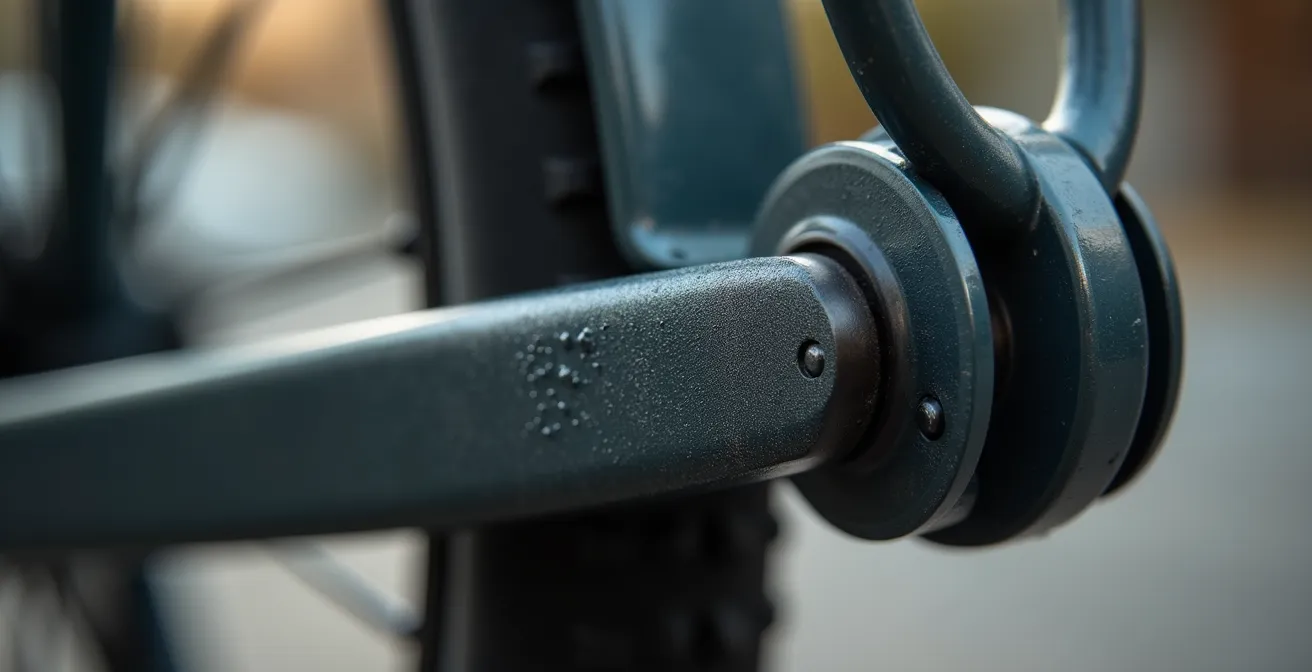
Just as important is the “immovable object.” A pro will perform the Immovable Object Test in a split second. Is that signpost just bolted to the pavement? Can I lift the bike over the top of this short pole? Is this “tree” thin enough to be cut with a portable saw? Always choose a thick, cemented-in-place, dedicated bike rack or a metal pole that is tall and sturdy. Never lock to something that can be defeated more easily than your lock itself. You’ve just spent money on a Diamond lock; don’t attach it to a wooden fence.
Folding Lock vs Chain: Which Is Easier to Carry on an E-Bike Frame?
The U-lock is the classic choice, but the realities of carrying a heavy chunk of metal mean riders look for alternatives. The two main contenders are folding locks and chains. Each has a different profile in a thief’s Tool-Time Calculus and, just as importantly, in your daily convenience. A lock you leave at home because it’s a pain to carry is useless.
Folding locks are an engineering marvel for portability. They collapse into a compact brick that mounts cleanly to your e-bike’s frame, often using the water bottle bolts. They are quick to deploy and offer more locking flexibility than a small U-lock, easily wrapping around awkwardly shaped posts. However, their main weakness lies in the rivets that connect the bars. While a Gold-rated folding lock is tough, a thief with the right leverage tools can target these pivot points. Some newer models, like the Foldylock Forever, have addressed this with patented rivet protection, making them significantly more robust.
High-security chains offer a different trade-off. They provide maximum flexibility, allowing you to lock your bike to thick poles, lamp posts, or even two bikes together. Their security-to-weight ratio is often excellent, as the hardened steel links are tough for bolt cutters and grinders. The downside is bulk and weight. Carrying a heavy, clanking chain is a chore. Most don’t come with a good frame mount, meaning they end up in a backpack, which isn’t ideal for every trip. The table below outlines these practical differences.
| Criteria | Folding Lock | Chain Lock |
|---|---|---|
| Security-to-Weight Ratio | Good (3/5) | Excellent (4/5) |
| Packed Volume (cm³) | 300-400 | 600-1000 |
| Frame Mounting | Excellent – Compact holder | Poor – Bulky/Heavy |
| Deployment Speed | Fast (5 seconds) | Slow (15 seconds) |
| E-MTB Compatibility | Excellent | Good |
| Cargo E-Bike Compatibility | Good | Excellent |
The Error of Using a Silver Rated Lock That Voids Your Theft Insurance
Here’s a costly mistake I’ve seen countless times: you buy a $3,000 e-bike, get it insured, and use a Silver-rated lock because it was on sale. Your bike gets stolen, and when you file the claim, the insurance company denies it. Why? You fell into the Insurance Compliance Trap. Buried in the fine print of your policy is a clause requiring an “approved locking device,” which for a bike of that value almost always means Sold Secure Gold or higher.
Insurance companies aren’t in the business of losing money. They know that studies show e-bikes are three times more likely to be stolen than regular bikes. To mitigate this risk, they mandate a minimum level of security. In the UK, for instance, many insurers require Gold-rated locks for bikes worth more than £1,500. Using a lesser lock, even if it’s a U-lock, is a breach of your policy. When the theft occurs, you have no leg to stand on.
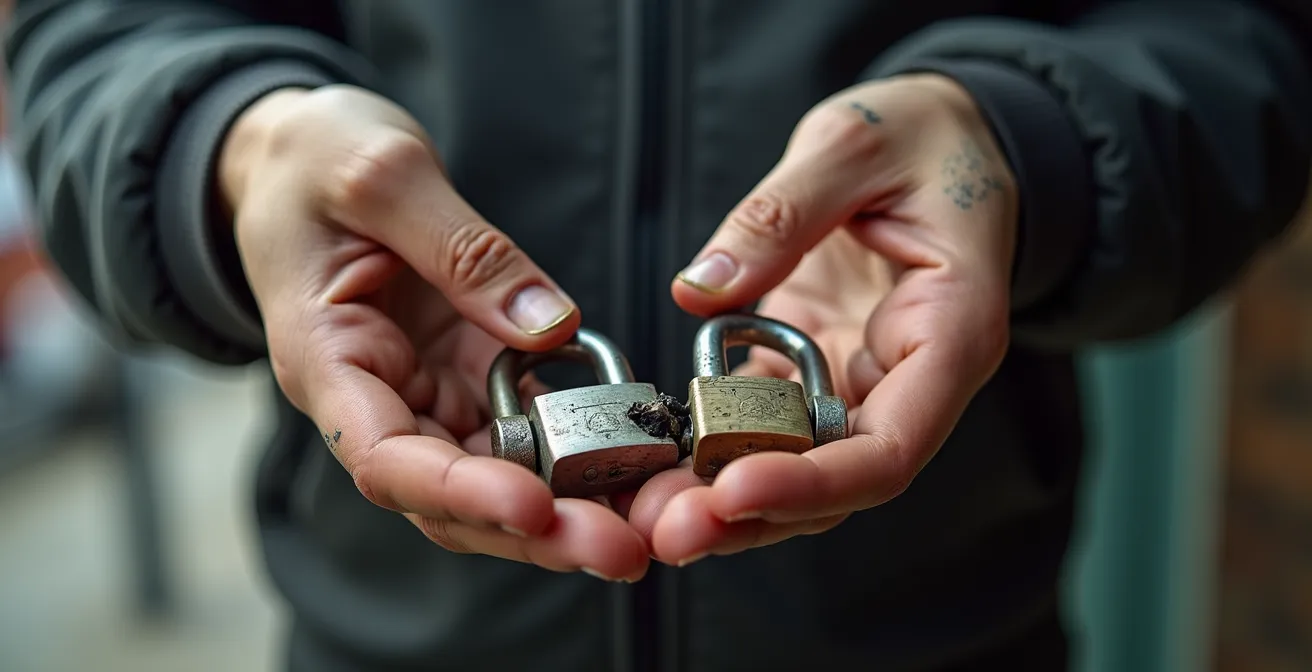
Furthermore, policies often require “evidence of force.” If a thief picks your cheap lock, there might not be any visible damage, giving the insurer another reason to deny your claim. A high-quality lock defeated with an angle grinder leaves undeniable proof. You must become a detective and read your policy document before you buy your lock, not after your bike is gone. Look for the specific security rating required for your bike’s value. Don’t assume; verify.
Action Plan: Your Insurance Policy Decoder
- Search for ‘Sold Secure Gold requirement’ or a similar phrase in your policy documents.
- Look for the definition of an ‘approved locking device’ and any specific brand or rating specifications.
- Check the ‘evidence of force’ requirements needed to process a theft claim successfully.
- Verify if there are different security stipulations for ‘at-home’ versus ‘away-from-home’ storage.
- Confirm if your policy has an age limit on the lock itself (e.g., must be less than 2 years old).
When to Use Two Different Types of Locks to Confuse Thieves?
If you really want to frustrate a pro, you use Security Layering. This is more than just using two locks; it’s about using two *different types* of locks. Most professional thieves specialize. The guy with the angle grinder setup for U-locks might not be carrying a massive pair of 42″ bolt cutters for a heavy-duty chain. The thief equipped to defeat chains might not have the tools or experience to quickly tackle a Diamond-rated U-lock.
By using two different lock types—for example, a Diamond U-lock on the frame and rear wheel, and a high-security chain weaving through the front wheel and frame—you force them to make a choice. They either have to be carrying a whole arsenal of heavy tools, which is risky, or they have to leave and come back. This dramatically increases their exposure time and effort. Most will just move on to the next bike that only has one lock. It’s a simple, effective way to make your bike the least appealing target on the rack.
Your lock pairing should be calibrated to your risk level. A quick stop in a low-crime suburb is different from overnight street parking in a downtown core. Here are some common strategic pairings:
- Level 1 (Low-Risk / Quick Stop): A primary Gold or Diamond U-Lock on the frame and rear wheel, supplemented by a cable lasso to secure the front wheel and your helmet.
- Level 2 (Urban Commuting / All-Day Parking): A primary Diamond U-Lock combined with a secondary Gold-rated folding lock or chain. This offers a strong deterrent against both specialized toolsets.
- Level 3 (High-Risk / Overnight Parking): A maximum security, heavy-duty chain (14mm+ links) combined with an alarmed disc lock on the rotor. The noise from the alarm adds another layer of deterrence.
For an extra edge, use locks from different brands, like Kryptonite and Abus. This introduces keyway diversity, making it harder for a thief who specializes in picking one type of cylinder.
How Apple Find My and GPS Tags Are Changing Bike Recovery Rates?
Mechanical locks are about preventing the theft. Digital trackers are about recovery after the worst has happened. For years, GPS trackers were clunky, had terrible battery life, and required expensive monthly subscriptions. The game has changed completely with the rise of crowd-sourced networks like Apple’s Find My network.
A cheap, simple Apple AirTag hidden discreetly on your e-bike leverages the billion-plus iPhones in the world as a massive, passive tracking network. When someone with an iPhone passes by your stolen bike, their phone anonymously reports its location back to you. It’s not real-time, military-grade GPS, but for a one-time $30 purchase with no monthly fee and a year of battery life, it’s an incredible value proposition. The precision is typically within 10-30 meters, often enough to guide you or the police to the right building or block. Android has a similar network rolling out.
For those needing higher precision and real-time tracking, dedicated cellular GPS trackers are the answer. These devices offer 5-10 meter accuracy and report their location on a set interval. The downsides are battery life (often just a few days to a week) and a monthly subscription fee ($5-$20). Some e-bikes now come with this technology integrated directly into the bike’s system, drawing power from the main battery and offering the highest level of anti-detection. Don’t underestimate the effectiveness of this tech; data from Bike Index shows that police were involved in 63% of stolen bike recoveries, and a precise location is the key to getting them engaged.
How Dropping Car Insurance Saves Enough to Buy a New E-Bike Every 2 Years?
Let’s talk about the ultimate ROI. Many people hesitate to spend $200 on a Diamond-rated lock after dropping $3,000 on an e-bike. This is flawed thinking. The cost of proper security is not an expense; it’s an investment that protects your primary investment. The math is simple and brutal.
Consider a comprehensive security package for your $3,000 e-bike: a $200 Diamond U-lock, a $30 AirTag, and a $150/year specialist bike insurance policy. The total first-year cost is $380. That’s about 12.6% of your bike’s value. Now, compare that to the 100% loss of $3,000+ (bike value plus accessories) if your bike is stolen because you cheaped out on a $50 lock. The return on your security investment is realized the very first time a thief walks past your bike in favor of an easier target.
For many urban dwellers who have replaced their car with an e-bike, the financial perspective is even clearer. The average cost of car ownership, including insurance, gas, and maintenance, can easily exceed $5,000 a year. By going car-free, you are saving a significant amount of money. Investing a tiny fraction of those savings into top-tier security for your primary mode of transport is the most logical financial decision you can make. The money saved by not having a car for even six months would more than cover the best lock, a GPS tracker, and an insurance policy for years to come. It’s not about affording the security; it’s about affording the loss.
Key Takeaways
- Adopt the “Tool-Time Calculus”: Evaluate locks based on how many minutes of high-risk, high-noise attack they can withstand.
- Implement “Security Layering”: Use two different types of high-security locks (e.g., U-lock + chain) to force a thief to carry multiple toolsets.
- Master the “Insurance Compliance Trap”: Read your policy’s fine print and buy a lock (usually Gold or Diamond) that meets the requirements for your bike’s value.
- Embrace digital recovery: Supplement physical locks with a hidden GPS tracker or an Apple AirTag to dramatically increase your chances of getting your bike back.
V2X and Smart Cities: Will Your Next E-Bike Talk to Traffic Lights?
While we’re focused on today’s threats, the future of bike security is already taking shape. It’s moving beyond a simple hunk of metal and into the realm of integrated smart technology, often called V2X (Vehicle-to-Everything). This is where your e-bike starts communicating with its environment.
We’re seeing the early stages of this with systems like Bosch’s eBike Lock function. Here, your smartphone acts as a digital key. When you walk away from your bike, the Bluetooth connection is lost, and the system automatically disables motor support. A thief can still pedal it away, but they can’t use the expensive electric motor, drastically reducing the bike’s value and appeal. It’s a simple but effective form of digital immobilization.
The next evolution will be bike-to-infrastructure communication. Imagine a smart bike rack in a future city. When you lock up, the rack digitally authenticates your lock. If your lock is tampered with or cut while you’re away, the rack itself could trigger an alert to your phone and even notify local authorities with a precise location. This creates an active, monitored security ecosystem, not just a passive deterrent. Your bike won’t just be a vehicle; it will be a node in a city-wide security network.
Choosing a Diamond-level lock today is the best way to bridge the gap until smart-city security ecosystems are a reality
– Industry Analysis, Cycling Infrastructure Security Report
While this fully integrated future is still a few years out, the trend is clear. Security is becoming smarter and more connected. Investing in the best physical and digital security available today ensures your bike is protected now while being ready for the innovations of tomorrow.
Your e-bike is more than a vehicle; it’s your freedom and a significant investment. Protecting it requires moving beyond wishful thinking and adopting a deliberate, multi-layered security strategy. Start today by auditing your current lock, reading your insurance policy, and upgrading your setup to make your bike the hardest target on the block.