
In summary:
- Your e-bike’s advertised range is a baseline, not a limit; disciplined riding and gear choices can unlock up to 20% more distance.
- Focus on reducing “energy waste” from soft tires, excessive weight, and high-assist modes, which can collectively cut your range in half.
- Mastering hill-climbing techniques and strategic “power nap” charging stops are more effective than simply riding in Eco mode.
- Long-term battery health, achieved by following the 20-80% charge rule, is the ultimate range-extending strategy, doubling your battery’s lifespan.
The dreaded feeling is universal among e-bike riders: you’re miles from home, enjoying the ride, when you glance at your display and see the battery indicator flashing its final bar. Range anxiety kicks in, and the leisurely cruise turns into a stressful calculation of whether you’ll make it back without pedaling a 50-pound unassisted bike. Many riders immediately assume the solution is an expensive new battery with a higher capacity. This is often an unnecessary and costly reaction to a problem that can be solved with knowledge and technique.
The common advice—”use eco mode” or “pedal more”—is true but vastly incomplete. It scratches the surface of a much deeper discipline: e-bike hypermiling. This isn’t about sacrificing the joy of the electric boost; it’s about understanding the physics of efficiency. It’s about conducting a conscious energy audit of your riding style, your gear, and even the air in your tires. The truth is, your current battery likely holds a significant amount of untapped potential, a hidden reserve of 15-20% more range waiting to be unlocked.
But if the solution isn’t just about selecting the lowest assist level, what is it? The key lies in shifting your mindset from a passive consumer of power to an active manager of energy. It involves learning how to “bank” momentum before a climb, understanding the dramatic voltage sag caused by unnecessary weight, and adopting a charging discipline that can double the functional lifespan of your battery. This is the science of stretching every last watt-hour from your machine.
This guide will deconstruct the core principles of e-bike energy management. We will move beyond the obvious tips and delve into the specific, data-backed strategies that separate casual riders from true efficiency experts. By mastering these techniques, you will not only conquer range anxiety but also transform your relationship with your e-bike, viewing it as a finely-tuned system you can optimize for any journey.
Contents: Mastering E-Bike Efficiency for Maximum Range
- Why Soft Tires Are Silent Range Killers Costing You 5 Miles per Charge?
- How to Climb Hills Efficiently Without Draining the Battery in Minutes?
- Turbo Mode Addiction: The Habit That Halves Your Ride Distance
- The Mistake of Carrying Unnecessary Gear That Saps Your Voltage
- When to Charge: Strategic Stops for Rides Over 50 Miles
- When to Use “Eco” vs “Tour” Profiles Customised in the App?
- Why Heavy Puncture Protection Might Reduce Your Battery Range by 5%?
- How to Make Your $500 Battery Last 5 Years Instead of 2?
Why Soft Tires Are Silent Range Killers Costing You 5 Miles per Charge?
The most significant and easily correctable drain on your e-bike’s battery isn’t the motor; it’s the friction between your tires and the road. This force, known as rolling resistance, is dramatically increased by under-inflated tires. When a tire is soft, it deforms more as it rolls, creating a larger contact patch with the ground. Your motor must then expend significantly more energy—measured in watt-hours—just to overcome this “sticky” effect and maintain the same speed. It’s like trying to ride through shallow sand, and it’s a silent killer of range.
The energy cost is not trivial. While specific numbers vary by tire type and rider weight, comprehensive tire pressure studies show that a 25% drop from the optimal pressure can reduce your total range by a staggering amount. For a bike that typically gets 40 miles, that could be a loss of 5 to 10 miles per charge, all because of a few minutes of neglect. This single factor has a greater impact on efficiency than almost any other adjustment you can make.
Therefore, treating your tire pump as a primary charging tool is the first step in becoming an efficiency expert. You must move from a reactive “I’ll fill them when they look flat” approach to a proactive, weekly maintenance protocol. Checking your pressure with a reliable gauge before your first ride of the week is a non-negotiable habit. The correct pressure is not a single number; it’s a range printed on the tire’s sidewall. For maximum efficiency, aim for the upper end of this range, only reducing it for comfort on very rough terrain or for traction in loose conditions.
This simple discipline provides the highest return on investment for range extension. Before you ever touch your assist settings or worry about weight, ensuring your tires are properly inflated establishes the most efficient physical foundation for every ride. It is the single biggest “free” gain in mileage you can achieve.
How to Climb Hills Efficiently Without Draining the Battery in Minutes?
Hills are the ultimate test of battery endurance. A steep incline can drain more power in two minutes than ten minutes of riding on flat ground. Most riders react by shifting to a lower gear and mashing the “Turbo” button, watching their battery percentage plummet. An expert rider, however, sees a hill not as an obstacle, but as a physics problem to be solved with technique. The key is to trade raw power for intelligent momentum management, a strategy known as momentum banking.
Instead of hitting the base of a hill at a slow speed and demanding maximum assistance from the motor, you should anticipate the climb. On the approach, increase your speed slightly, building kinetic energy. As you begin the ascent, maintain a consistent and high-cadence pedal stroke—ideally between 70-75 revolutions per minute. This keeps the motor operating in its most efficient powerband. Use your gears to keep your legs spinning at this optimal cadence, rather than relying on the motor to compensate for slow, heavy pedaling.
Case Study: The Momentum Banking Technique
E-MOUNTAINBIKE Magazine tested the momentum banking approach with riders using a steady pedaling frequency of 70-75 revolutions per minute. By building speed before hills and maintaining consistent circular pedal strokes, riders achieved significant battery savings. The magazine found that anticipating terrain changes and maintaining momentum through corners saves battery power in the long run, as exiting corners at speed reduces the energy needed for re-acceleration.
This technique is about being smooth and proactive. Think of your battery’s energy as a finite account. A sudden, massive withdrawal (like using Turbo from a standstill on a hill) incurs a heavy penalty. A series of smaller, smoother withdrawals allows you to accomplish the same task—climbing the hill—with far less total energy expenditure. The visual below captures the moment of commitment, where speed on the flat is converted into upward momentum.
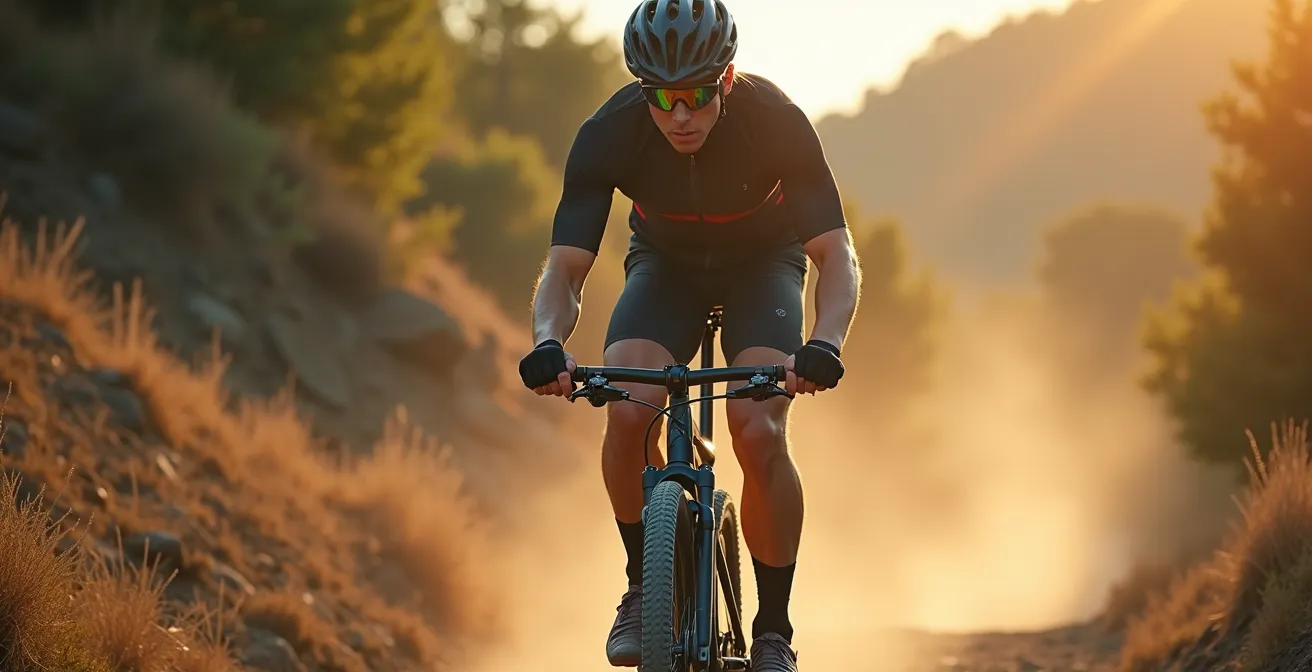
As you can see, the rider is already in an athletic, forward-leaning position before the trail even points up. This proactive stance is crucial. By mastering momentum banking, you transform hills from battery-draining monsters into satisfying technical challenges that you can conquer with skill and efficiency, preserving precious watt-hours for the rest of your ride.
Turbo Mode Addiction: The Habit That Halves Your Ride Distance
The “Turbo” or “Boost” mode on an e-bike is a thrilling feature, delivering instant, powerful acceleration that flattens hills and pulls you away from traffic lights. However, this exhilarating power comes at a steep, often hidden, cost to your battery’s range. Developing an addiction to this highest level of assistance is the single fastest way to cut your potential ride distance in half. The relationship between speed, wind resistance, and energy consumption is not linear; it’s exponential.
The physics are unforgiving. As you double your speed, the aerodynamic drag you must overcome quadruples. This means your motor has to work exponentially harder. While it might not feel like a huge difference to the rider, the energy draw from the battery skyrockets. Detailed analysis confirms this; research from Upway demonstrates that riding at 25 mph more than doubles the energy consumption (watt-hours per mile) compared to a steady 15 mph. Essentially, by habitually using Turbo mode to maintain high speeds, you are choosing a short, fast ride over a long, efficient one.
Treating assist levels like gears in a car is a more strategic approach. Turbo mode is your first gear, meant for very short bursts: starting on a steep incline or a critical acceleration in traffic. “Tour” or “Sport” mode is your all-around driving gear, providing a healthy balance of assistance and efficiency. “Eco” mode is your overdrive gear, perfect for long, flat stretches or when you need to conserve every last drop of power. The goal is to spend the vast majority of your ride in the lowest possible assistance mode that still feels comfortable and enjoyable.
Breaking the Turbo addiction requires a conscious mental shift. Instead of seeing it as the default, reframe it as a special-use tool. Challenge yourself to complete a familiar route using only Eco and Tour modes. You may be surprised to find that your average speed doesn’t drop significantly, but your remaining battery at the end of the ride is dramatically higher. This discipline is a core tenet of hypermiling: accomplishing the same journey with a lower energy budget.
The Mistake of Carrying Unnecessary Gear That Saps Your Voltage
Every extra pound you carry on your e-bike is another pound the motor must help accelerate from a stop, push against the wind, and haul up a hill. While a few extra items may seem insignificant, their cumulative effect on your battery is a constant, subtle drain known as increased voltage sag. When the motor is under a heavy load, it draws more current, which causes the battery’s output voltage to temporarily drop. The battery’s management system (BMS) interprets this lower voltage as being closer to empty, which can lead to a premature reduction in power or even a complete shutdown, even if there’s still charge left.
The impact of weight is especially pronounced on routes with frequent stops or varied terrain. Studies show that each additional 10kg (about 22 pounds) of cargo can reduce your range by 5-8% on flat ground, and by as much as 15% on a hilly route. That heavy D-lock, the extra water bottle for a short trip, the full toolkit—they all add up. This is why conducting a regular “cargo audit” is a critical, yet often overlooked, component of maximizing range.
The goal of a cargo audit is not to ride unprepared, but to think strategically about what is truly necessary for *that specific ride*. Are you commuting to work where you could leave a heavy lock and a charger? Are you on a short local loop where a single water bottle and a lighter folding lock would suffice? This systematic evaluation of your payload can yield surprising weight savings, directly translating into more miles from your battery.
Your Commuter’s Cargo Audit Checklist
- Charger Duplication: Leave duplicate chargers at frequent destinations like your workplace or gym to avoid carrying one back and forth.
- Lock Strategy: Replace heavy D-locks with lighter folding or cable locks for quick, low-risk stops. Save the heavy-duty lock for overnight security.
- Tool Consolidation: Use a compact, frame-mounted multi-tool instead of carrying a full, heavy toolkit in a pannier.
- Hydration Planning: Only carry the amount of water you need for the ride’s duration. Empty and refill bottles at your destination.
- Accessory Purge: Remove non-essential accessories like empty panniers, extra lights, or bike computers when not in use for a specific journey.
By adopting this minimalist mindset, you reduce the baseline energy required for every pedal stroke. This not only extends your range but also improves the bike’s handling and makes it easier to lift and store. Reducing weight is a powerful lever in your efficiency toolkit, ensuring your motor’s power is used for motion, not for hauling dead weight.
When to Charge: Strategic Stops for Rides Over 50 Miles
For ambitious rides that push the limits of your e-bike’s single-charge range, your strategy must evolve beyond just conserving power. It must include a plan for adding power. However, simply stopping to charge for an hour is inefficient. The secret to ultra-long-distance e-biking is the “power nap”—a short, strategic charging stop that coincides with a natural rest break. This technique leverages how lithium-ion batteries charge: they absorb power much faster when they are at a lower state of charge (e.g., 20-50%) than when they are nearly full.
The ideal time to plan a “power nap” is when your battery hits the 20-30% mark. At this level, even a standard charger can add a significant amount of range in a short time. Planning a route that passes a cafe, library, or bike-friendly park with an outlet around the point you expect to hit this battery level is key. A 30-45 minute stop for a coffee or a snack can be enough to add 10-15 miles of range, effectively turning a 50-mile bike into a 65-mile machine.
Case Study: The Coffee Shop Power Nap
EVELO’s testing shows that a strategic 30-45 minute charging stop can add 10-15 miles of range using standard chargers. Their ‘3 Minute Electric Bike Video Series’ demonstrates that charging during natural break points like coffee stops makes long-distance rides more manageable. The key is planning these stops when the battery reaches the 20-30% level to take maximum advantage of the faster charging speeds that occur at lower battery levels.
Understanding the relationship between charging time and range gained is crucial for this strategy. You don’t need a full charge; you just need enough to confidently reach your next destination. The following table breaks down what you can realistically expect from a power-nap session starting from a 20% battery level. As the data from a recent comparative analysis by EBIKE24 shows, the first 30 minutes are the most productive.
| Charging Duration | Battery Level Start | Approx. Charge Added | Range Extension |
|---|---|---|---|
| 15 minutes | 20% | 10-15% | 5-8 miles |
| 30 minutes | 20% | 20-30% | 10-15 miles |
| 45 minutes | 20% | 35-45% | 15-22 miles |
| 60 minutes | 20% | 50-60% | 25-30 miles |
By integrating these planned charging stops into your long-distance rides, you fundamentally change the equation. Your bike’s range is no longer limited by its battery capacity but is extended by your ability to strategically replenish it. This transforms range anxiety into logistical confidence.
When to Use “Eco” vs “Tour” Profiles Customised in the App?
Most modern e-bikes from brands like Bosch, Shimano, and Specialized offer companion apps that allow for deep customization of the pedal-assist profiles. Many riders ignore this feature, sticking to the factory-set “Eco,” “Tour,” and “Turbo” modes. This is a missed opportunity. These apps are powerful tools for an efficiency expert, allowing you to tailor the motor’s behavior to your specific needs, effectively creating your own custom modes that are far more efficient than the generic presets.
The factory “Eco” mode, for example, is designed as a one-size-fits-all solution, often providing a low, constant level of assistance. A custom “Commute” profile, however, could be configured with very low top-end support but a more aggressive initial acceleration. This helps you get up to speed quickly from traffic lights (a high-energy-draw moment) and then settles into a minimal assist level for cruising, saving significant energy over a stop-and-go route. Conversely, a “Trail” profile might be tuned for smoother, more gradual power delivery to maintain traction on loose surfaces.
As the experts at Carbon Speed Cycle emphasize, fine-tuning these parameters is not just for tech enthusiasts; it’s a core component of range optimization.
Setting up pedal-assist levels properly and fine-tuning power output for greater efficiency can significantly improve range. Where available, one should take advantage of eco modes because they are designed to balance performance and power consumption.
– Carbon Speed Cycle Technical Team, E-Bike Range Optimization Guide
Diving into your e-bike’s app allows you to create a quiver of specialized tools. Instead of one “Eco” mode, you could have several, each optimized for a different scenario. This level of control allows you to apply the precise amount of power needed for a given task, eliminating the waste inherent in generic, one-size-fits-all settings.
- City Commute Profile: Set low top-end support (e.g., 60%) but aggressive initial acceleration (e.g., 80%) for efficient performance in city traffic.
- Weekend Trail Profile: Configure smooth, gradual power delivery (e.g., 70% max) to enhance control and maintain traction on varied terrain.
- Headwind Fighter Mode: Increase steady-state support to 75% to combat wind resistance, while keeping acceleration moderate to conserve power.
- Fitness Progress Mode: Start with 50% support and challenge yourself by reducing it by 5% each month as your physical conditioning improves.
- Range Maximizer Profile: Create an emergency profile by capping all motor parameters at 40% for low-battery situations to ensure you can make it home.
Why Heavy Puncture Protection Might Reduce Your Battery Range by 5%?
For commuters and tourers, the fear of a flat tire is second only to range anxiety. The logical solution seems to be installing “bombproof” tires with thick, heavy puncture-protection belts, often marketed as “Marathon” or “Armored” models. While these tires are exceptionally reliable at preventing flats, that reliability comes with a hidden efficiency cost. The extra material and rigid construction significantly increase the tire’s rotational weight and rolling resistance, forcing your motor to work harder with every single revolution of the wheel.
This isn’t a negligible effect. The penalty for prioritizing extreme puncture protection can be a range reduction of 5% or more compared to a standard tire. When you’re trying to squeeze every possible mile from a charge, that trade-off becomes a critical decision. Heavier tires require more energy to spin up to speed and more energy to keep rolling. For a rider focused on maximum efficiency, a more balanced solution is often the better choice.
This is where modern tire technology, such as tubeless-ready systems with sealant, offers a compelling compromise. A tubeless setup eliminates the inner tube, reducing rotational weight. The liquid sealant inside can instantly seal most common punctures from thorns or glass without any loss of air, providing a very high level of protection. E-MOUNTAINBIKE Magazine’s tests found that tubeless tires also conform better to road imperfections, further reducing rolling resistance. This combination provides excellent reliability without the significant range penalty of heavy armored tires.
The choice of tire is therefore a strategic balance between reliability and efficiency. As the data from an in-depth tire analysis by Hovsco demonstrates, the difference in range between tire types is substantial. Understanding this matrix allows you to make an informed decision based on your primary needs.
| Tire Type | Range Impact | Puncture Protection | Best For |
|---|---|---|---|
| Racing Slicks | Maximum (+10%) | Minimal | Smooth roads, speed priority |
| Tubeless + Sealant | High (+5%) | Very Good | All-around performance |
| Standard with Liner | Moderate (0%) | Good | Daily commuting |
| Marathon/Armored | Reduced (-5%) | Excellent | Urban commuting, glass debris |
Ultimately, unless you are consistently riding through areas with extreme levels of debris like broken glass, a heavy armored tire might be overkill. A modern tubeless system often represents the sweet spot, delivering the peace of mind you need without silently sabotaging your efforts to maximize range.
Key Takeaways
- Mastering efficiency is a skill; your range is determined more by technique and preparation than by battery size alone.
- The biggest gains come from managing the fundamentals: maintaining high tire pressure and minimizing unnecessary weight.
- Strategic use of assist modes and proactive hill-climbing techniques save more energy than simply defaulting to “Eco” mode.
How to Make Your $500 Battery Last 5 Years Instead of 2?
All the techniques for extending the range of a single ride are ultimately temporary if the battery itself is degrading rapidly. A new lithium-ion battery can cost upwards of $500, making its longevity one of the most important economic factors of e-bike ownership. The lifespan of a battery is measured in charge cycles, and how you charge and store it can literally double the number of effective cycles you get, pushing its life from two years to four or five.
The most critical principle for battery longevity is the “20-80 Rule.” Lithium-ion cells experience the most stress when they are at the extremes of their charge state—either completely full (100%) or completely empty (0%). Habitually charging to 100% and running it down to 0% drastically shortens its life. By aiming to keep your battery between 20% and 80% for daily use, you can dramatically extend its capacity retention. In fact, battery longevity research confirms that following this rule can preserve as much as 15% more of the battery’s original capacity after 500 cycles.
The science behind this is clear. The small reduction in voltage at the top end of the charge has an outsized impact on cell longevity. This insight is what makes a disciplined charging protocol so powerful.
Charging a lithium-ion battery to just 4.10 volts instead of its maximum 4.20 volts can nearly double its expected cycle life. This is the science behind the 80-90% rule.
– Qiolor Electric Bike Engineering, E-bike Battery Charging Best Practices
This doesn’t mean you can never charge to 100%. For a particularly long ride where you need every bit of range, a full charge is perfectly acceptable. The key is that it shouldn’t be your daily habit. Similarly, temperature plays a huge role. Never charge a battery that is cold from a winter ride or hot from a summer one. Let it return to room temperature first. This simple patience prevents irreversible damage to the battery cells.
- Daily Use Protocol: Endeavor to keep the battery’s state of charge between 20% and 80%. Only charge to 100% immediately before a ride where maximum range is essential.
- Temperature Management: After a ride, wait at least 30 minutes for the battery to cool down to room temperature before connecting the charger. In winter, bring a cold battery inside for an hour to warm up before charging.
- Long-Term Storage: If you’re not using the bike for more than a few weeks, store the battery with a 40-60% charge in a cool, dry location.
- Cell Balancing: Perform one full 0% to 100% charge cycle approximately once a month to help the battery’s management system recalibrate and balance the cells.
Adopt these hypermiling principles not as a set of restrictive rules, but as a new layer of skill in your riding. Start by mastering one technique at a time and observe the direct impact on your remaining range. You will find that the power to go further was within your control all along.