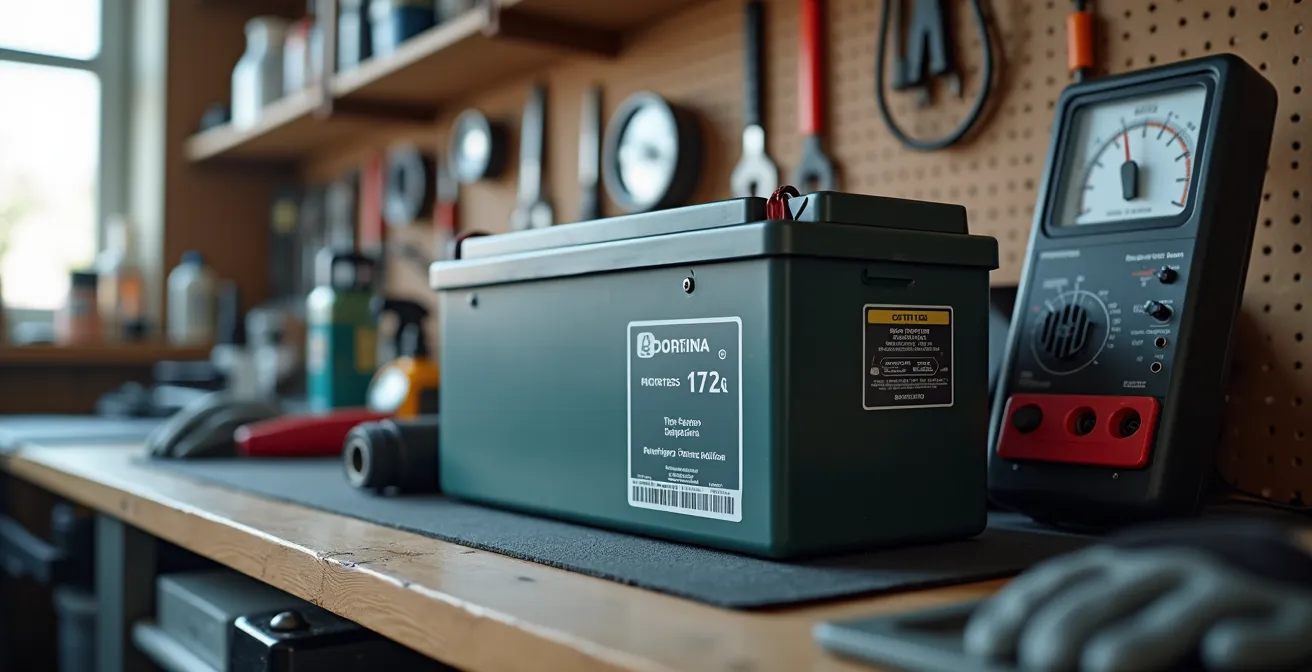
The difference between a 2-year and a 5-year battery life isn’t luck; it’s a deliberate strategy based on understanding its core chemistry.
- Avoid charging to 100% for daily use and never store the battery fully charged or completely empty to prevent accelerated degradation.
- Use shallow discharge cycles (e.g., from 80% down to 40%) to potentially double its functional lifespan compared to full discharges.
Recommendation: Implement a consistent charging, storage, and documentation protocol to maximize your investment’s return and significantly boost its resale value.
The most expensive and critical component of your electric bike is its lithium-ion battery. For many riders, this $500+ investment feels like a ticking clock, with a disappointing lifespan of just two years. It’s a common frustration that leads many to believe frequent and costly replacement is inevitable. Standard advice often includes vague tips like “don’t overcharge” or “avoid heat,” but these are merely symptoms, not the root cause of premature failure.
These platitudes fail to address the underlying electrochemical processes that govern a battery’s health. They treat the battery like a black box, encouraging a ritual of rules without reason. But what if the key to longevity wasn’t just following rules, but understanding them? What if you could actively slow down the chemical aging process inside the cells?
This guide moves beyond generic advice to reveal the scientific principles of battery preservation. We will explore the chemistry of why certain habits are destructive and how others promote long-term electrochemical stability. By understanding the “why” behind the “what,” you can shift from being a passive user to an informed custodian of your investment, effectively transforming your battery from a 2-year consumable into a 5-year asset.
This article will dissect the most critical aspects of battery care, from daily charging routines to long-term storage and how these practices directly translate into measurable financial value. The following sections provide a clear roadmap to mastering your e-bike’s power source.
Summary: A Researcher’s Guide to E-Bike Battery Longevity
- Why Charging to 100% Every Night Kills Lithium Cells Prematurely
- How to Store Your Battery During 3 Months of Winter Inactivity
- Deep Discharge vs Top-Up: Which Strategy Preserves Capacity Best?
- The Error of Using Cheap Fast Chargers on Standard Batteries
- Connect to Wall or Bike First? The Sequence That Avoids Sparks
- Why Only 5% of Lithium Batteries Are Currently Recycled?
- Why Cars Lose Value While Parked and E-Bikes Pay for Themselves
- Reselling Your E-Bike: How Maintenance Records Increase Value by 40%
Why Charging to 100% Every Night Kills Lithium Cells Prematurely
Charging your e-bike to 100% overnight feels intuitive, but from a chemical standpoint, it’s one of the most stressful states for a lithium-ion battery. A fully charged battery holds its highest voltage, which significantly accelerates a process of slow, irreversible decay known as parasitic reactions. Think of it as electrochemical “rust” that consumes the lithium inventory and thickens the internal layers, increasing resistance and permanently reducing capacity.
The high voltage puts extreme stress on the battery’s internal components, particularly the cathode (the positive electrode). To maximize longevity for daily commuting, the goal is to operate within an optimal State of Charge (SoC) window where voltage is lower and the chemistry is more stable. For most lithium-ion batteries, this sweet spot lies between 20% and 80%.
Adopting a strategic charging protocol is the single most effective habit for long-term health:
- Daily Charge Window: For regular use, aim to keep your battery between 20% and 80%. Charge it to 80% and ride until it’s around 20-30% before recharging.
- Balancing Charge: A full 100% charge is necessary every 2 to 4 weeks. This isn’t for the cells, but for the Battery Management System (BMS), allowing it to recalibrate and accurately read the voltage of all cell groups.
- Immediate Use: If you do a full 100% balancing charge, use the bike immediately. Never let a battery sit at 100% for more than a few hours.
- Temperature First: In cold weather, always bring the battery to room temperature (10-25°C) before plugging it in. Charging a frozen battery can cause permanent damage.
Using a simple wall outlet timer or a smart plug is an excellent way to automate this process, ensuring the charger shuts off once it reaches the 80-90% mark, preventing prolonged exposure to high-voltage stress overnight.
How to Store Your Battery During 3 Months of Winter Inactivity
Long-term storage is where many well-intentioned owners unknowingly inflict irreversible damage. According to real-world failure analysis from manufacturers, improper storage is a leading cause of premature battery death. The core principle is avoiding the two extremes: a full charge and a complete discharge. Storing a battery at 100% exposes it to months of high-voltage stress, accelerating capacity loss. Conversely, storing it empty is even more dangerous.
A battery naturally self-discharges over time. If it starts near empty, its voltage can drop below a critical threshold, triggering a deep discharge state. In this state, internal copper components can begin to dissolve, leading to short circuits and permanent failure. The ideal storage condition is a state of electrochemical stability, which for lithium-ion chemistry is a State of Charge between 50% and 60%. At this level, the voltage is low enough to minimize stress, yet high enough to provide a safe buffer against self-discharge.
The visual below illustrates the ideal environment for winter hibernation, focusing on both charge level and physical conditions.

To ensure your battery emerges from winter in optimal health, follow a strict hibernation protocol. Store it in a cool, dry location, ideally between 10-20°C (50-68°F), away from direct sunlight and combustible materials. Every 1-2 months, check the charge level and top it back up to the 50-60% range if it has dropped. This simple check-up prevents it from ever entering a dangerous deep-discharge state.
Deep Discharge vs Top-Up: Which Strategy Preserves Capacity Best?
A common misconception, inherited from older battery technologies, is that lithium-ion batteries need to be fully discharged and recharged to prevent a “memory effect.” This is not only false but actively harmful. The longevity of a lithium-ion battery is measured in charge cycles, but not all cycles are equal. The key metric to understand is Depth of Discharge (DoD)—the percentage of the battery’s capacity used up in a single cycle.
Research and testing clearly show that frequent, shallow discharges (or “top-ups”) are significantly less stressful on the battery than infrequent, deep discharges. Each deep cycle puts a heavy strain on the anode and cathode, causing micro-fractures and accelerating the degradation process. In contrast, using only 20-50% of the battery’s capacity before recharging imposes a much lighter load, drastically increasing the total number of cycles the battery can endure.
The following table, based on data from technical analyses, starkly illustrates how cycle life is inversely proportional to the depth of discharge. As a comparative analysis of battery life shows, the benefits of shallow cycling are not linear but exponential.
| Depth of Discharge | Estimated Cycles | Total Energy Throughput | Relative Battery Life |
|---|---|---|---|
| 100% (Full cycles) | 500-700 | 500 kWh | Baseline (1x) |
| 80% DoD | 800-1200 | 640 kWh | 1.3x longer |
| 50% DoD | 2000-3000 | 1000 kWh | 2x longer |
| 20% DoD (Top-ups) | 5000+ | 1000+ kWh | 2x+ longer |
As the data reveals, performing five 20% discharge cycles is far gentler than one 100% cycle, effectively doubling the battery’s useful life while delivering the same total energy. This is a powerful testament to the benefits of a top-up strategy. The TTGO E-Bike Technical Team confirms this in their maintenance guide:
Frequent partial charging (e.g., 20% per day) is better than full cycles. Five 20% charges equal one full cycle—this is easier on the battery than one deep cycle.
– TTGO E-Bike Technical Team, Battery Maintenance Guide for European Climate
The Error of Using Cheap Fast Chargers on Standard Batteries
Not all chargers are created equal. While a cheap, unbranded fast charger might seem like a bargain, it can be a silent killer for your battery. A quality charger operates on a sophisticated two-stage algorithm: Constant Current (CC) followed by Constant Voltage (CV). It charges rapidly during the CC phase and then, as the battery nears full, it meticulously slows down in the CV phase to gently top off the cells without exceeding a safe voltage.
Cheap chargers often cut corners on this critical CV phase. They may fail to regulate the voltage precisely, effectively overcharging the cells and holding them in a high-stress state. Furthermore, they often lack proper thermal management, leading to excessive heat during charging. Heat is a battery’s worst enemy, as it acts as a catalyst for the very parasitic reactions we seek to avoid, permanently degrading the battery’s chemistry with every charge.
The image below contrasts the robust build of a quality charger with the compromises often found in cheaper alternatives, hinting at the internal quality differences.
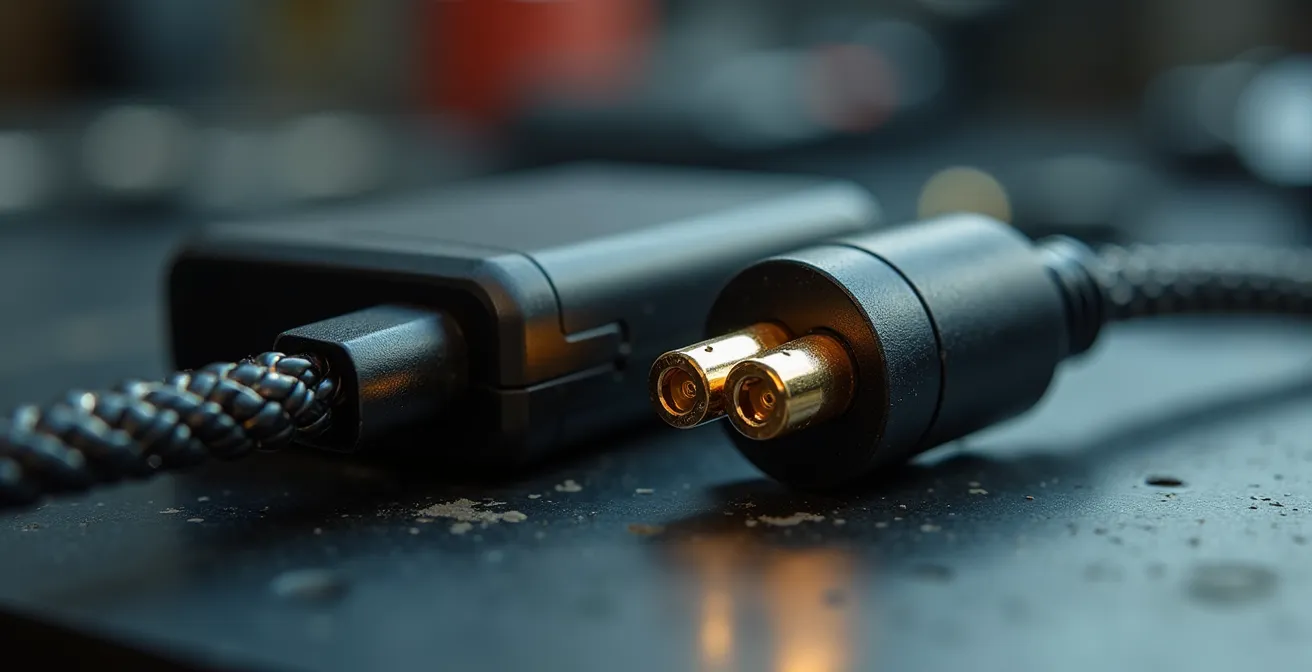
The quality of the internal cells and the charging protocol form a single system. As case studies on premium batteries show, high-grade cells are designed to last, but only when paired with a charger that respects their chemical limits. Using a high-quality charger supplied by the manufacturer is not an upsell; it’s an essential part of ensuring the battery can actually reach its designed lifespan of up to 1000 charge cycles. Using a cheap charger on a premium battery is like putting low-grade fuel in a high-performance engine—it undermines the entire investment.
Connect to Wall or Bike First? The Sequence That Avoids Sparks
A small but significant detail in battery care is the sequence of connection when charging. You may have noticed a small spark or “arc” when plugging the charger into the battery port. This is not a benign event. This spark is caused by a rapid inrush of current from capacitors within the charger, and it slowly degrades the metal contacts on both the charger and the battery’s charging port.
Over time, this repeated arcing causes pitting and carbon buildup on the connectors. This leads to a poor connection, which increases electrical resistance. A high-resistance connection generates heat during charging, can cause intermittent charging failures, and in worst-case scenarios, can become a safety hazard. Preventing this is simple and requires adopting a strict, deliberate sequence every time you charge.
The correct, spark-free procedure is as follows:
- Charger to Battery First: Connect the charger’s output plug to the battery’s charging port. Ensure it is seated firmly.
- Charger to Wall Second: Only after the battery is connected should you plug the charger’s power cord into the wall outlet.
- Disconnect in Reverse: When charging is complete, always unplug the charger from the wall outlet first, then disconnect it from the battery.
This sequence ensures that the electrical circuit is fully established before power is introduced, eliminating the damaging inrush current. As the engineering team at Juiced Bikes emphasizes, this is a critical safety and longevity practice:
The safest way to charge is by first connecting the charger to the battery and THEN plugging it into the wall. This helps you get a proper connection before electricity starts flowing and prevents arcing.
– Juiced Bikes Engineering Team, 7 Tips to Extend Your E-Bike Battery’s Life
Additionally, it is best practice to wait at least 30 minutes after a ride before charging. This allows the battery cells to cool down, ensuring they are in an optimal state to accept a charge without added thermal stress.
Why Only 5% of Lithium Batteries Are Currently Recycled?
The low recycling rate for lithium-ion batteries is a complex issue, often misunderstood. It stems not just from a lack of effort, but from a combination of economic, logistical, and technological factors. Recycling lithium batteries is a hazardous, energy-intensive process, and the value of the raw materials recovered often doesn’t cover the cost. However, a more compelling reason is emerging: a well-maintained e-bike battery doesn’t need to be recycled for a very long time.
With proper care, a quality e-bike battery can last far longer than the commonly accepted two years. As extensive testing from manufacturers like EVELO demonstrates, a well-maintained battery can achieve a lifespan of 5-7 years or 700-1000 charge cycles. When a battery reaches the end of its “first life” in an e-bike—typically when its capacity drops to around 80% of its original rating—it is far from useless.
The Rise of “Second-Life” Applications
Instead of heading to a recycler, these retired e-bike batteries are becoming increasingly valuable for less demanding “second-life” applications. As highlighted in a comprehensive guide from eBikes.org, a battery that can no longer provide the peak power for an e-bike is perfectly suited for stationary energy storage. They are repurposed for home solar power systems, emergency power backups (UPS), or off-grid lighting solutions. This second life extends the battery’s utility by several more years, delaying the need for recycling and maximizing the value of the resources used to create it. This growing trend is a major reason why the direct-to-recycling pipeline remains small.
Therefore, the question shifts from “why aren’t we recycling?” to “how can we maximize a battery’s entire useful life?” The focus on maintenance to achieve a 5-year primary lifespan, followed by a transition to a second-life application, is a far more sustainable and economically sound model than premature recycling.
Why Cars Lose Value While Parked and E-Bikes Pay for Themselves
A car begins depreciating the moment it leaves the dealership. An e-bike, when viewed as an investment in transportation, follows a different economic model. Its value is not just in its resale price, but in the money it saves and the utility it provides. The key to unlocking this value lies in maximizing the life of its most expensive component: the battery. The difference between poor and optimal maintenance isn’t just a matter of convenience; it’s a hard financial calculation.
By extending a battery’s life from two years to five, you are more than doubling its utility and dramatically lowering your cost-per-mile. This is the core of its return on investment (ROI). Proper care directly translates into fuel savings, reduced public transit costs, and deferred replacement expenses, allowing the e-bike to effectively “pay for itself” over its extended lifespan.
This is clearly demonstrated in a cost analysis from Magnum Bikes. Their data, presented below, quantifies the financial impact of different maintenance strategies on a typical $500 battery over its life, assuming an average of 2,500 miles ridden per year.
The illustration captures the essence of this principle: a rider taking meticulous care of their investment, preserving its value through hands-on maintenance.

As this cost-per-mile analysis by Magnum Bikes illustrates, the savings are substantial.
| Maintenance Strategy | Battery Lifespan | Total Miles | Cost per Mile | 5-Year Savings |
|---|---|---|---|---|
| Poor maintenance | 2 years | 5,000 miles | $0.10/mile | – |
| Basic maintenance | 3.5 years | 8,750 miles | $0.057/mile | $215 |
| Optimal maintenance | 5 years | 12,500 miles | $0.04/mile | $375 |
Moving from poor to optimal maintenance cuts your battery-related running costs by 60%. Over five years, this equates to $375 in direct savings on a single component. When scaled across the entire cost of ownership, the e-bike proves itself as a depreciating asset that simultaneously generates significant financial returns through utility.
Key Takeaways
- Operate within the 20-80% State of Charge (SoC) window for daily use to minimize voltage stress and prolong cell life.
- Shallow discharge cycles (e.g., 20-50% Depth of Discharge) can more than double a battery’s total lifespan compared to frequent deep cycles.
- For long-term storage (1+ month), maintain a 50-60% charge level in a cool, dry environment to achieve maximum electrochemical stability.
Reselling Your E-Bike: How Maintenance Records Increase Value by 40%?
When it comes time to sell your e-bike, the single biggest point of concern for any savvy buyer is the health of the battery. An e-bike with an unknown battery history is a gamble; one with a documented history of proper care is a certified investment. This is where all the disciplined habits of charging, storage, and maintenance pay their final and most significant dividend. A comprehensive maintenance log acts as a certificate of health, removing uncertainty for the buyer and justifying a premium price.
Industry experts, including the testing teams at Consumer Reports, confirm that while a battery can last for five years, its actual lifespan is entirely dependent on its treatment. In their guide on e-bike longevity, they state that “a lot will depend, of course, on how often you use the bike, where you store it, and how often you charge it.” A maintenance log is the verifiable proof that these factors have been managed correctly. This documentation can easily increase the resale value of an e-bike by up to 40% compared to an identical model with no battery history.
Creating this documentation is straightforward and should begin from day one of ownership. It transforms an abstract history into a tangible asset.
Action Plan: Building Your Battery Health Portfolio
- Start a Logbook: From day one, record the purchase date, initial charge, and then log every charging session or at least weekly summaries. Note storage periods and the pre-storage charge level.
- Document Balancing: Specifically record the date of each full 100% balancing charge you perform (ideally, monthly or bi-monthly). This shows you understand and manage BMS health.
- Keep Receipts: Retain the receipt for the original, manufacturer-approved charger and any high-quality maintenance supplies. This proves you haven’t used damaging, cheap accessories.
- Perform Voltage Checks: Occasionally use a multimeter to check the voltage after a long storage period. Documenting that your 48V pack still reads ~38V after two months of winter storage is powerful proof of its health.
- Get a Professional Diagnostic: For maximum credibility before a sale, consider getting a professional battery health report from a local e-bike shop. This provides an undisputed, third-party validation of your claims.
This portfolio of evidence tells a story of meticulous care, assuring the next owner that they are not inheriting a liability. It proves your e-bike is not just “used,” but “well-maintained,” justifying a price that reflects the true remaining value of your investment.
Start implementing these chemical-aware protocols today. By treating your battery not as a disposable commodity but as a sophisticated piece of technology, you directly control its destiny, ensuring it remains a powerful and valuable asset for years to come.