
Choosing the right e-bike motor for hills is less about brand and more about understanding the mechanical trade-offs that impact your wallet and safety.
- Mid-drive motors offer superior climbing efficiency but introduce significant, often-overlooked maintenance costs on the drivetrain.
- Hub motors are simpler, but their performance can be inadequate for heavier riders or very steep terrain, creating safety and usability issues.
Recommendation: Prioritize a torque sensor for a natural ride feel and predictable power, and always match the motor’s torque output to your total system weight, not just the bike’s.
The moment of truth for any commuter e-bike arrives not on a flat, open road, but on the steepest hill of the daily route. It’s here, as the bike groans and the rider pedals furiously, that the choice between a hub motor and a mid-drive system becomes starkly clear. For first-time buyers navigating a world of technical jargon, the common advice often feels too simple: “mid-drives for hills, hubs for flats.” While not entirely wrong, this platitude dangerously overlooks the real-world implications of your decision.
The choice is not merely about where the motor is placed; it’s a fundamental decision about long-term ownership. It dictates your maintenance budget, your safety in stop-and-go traffic, and the very feel of the ride. The “wrong” motor for your specific needs—your weight, your cargo, and the grade of your hills—has tangible, mechanical consequences that extend far beyond the initial purchase price. It’s a choice between a system that works in harmony with the bicycle’s components and one that simply powers a wheel, for better or worse. An e-bike is a system, and in hilly terrain, a weak link in that system will inevitably reveal itself.
This guide moves beyond the basics. We will dissect the critical mechanical differences from a mechanic’s perspective. By examining how each motor type handles safety, noise, maintenance, and power delivery under load, you will gain the technical understanding needed to select a system that is not only capable but also sustainable for your hilly commute.
To navigate these critical considerations, this article is structured to address the most pressing questions a prospective buyer faces. The following summary outlines the key areas we will dissect, providing a clear roadmap to making an informed and confident decision.
Summary: A Mechanic’s Breakdown of Hub vs. Mid-Drive Motors
- Why Your Motor Should Stop When You Stop Pedaling: Safety Basics
- How to Choose a Silent Motor for Peaceful Morning Commutes?
- Mid-Drive Maintenance: The Hidden Chain Wear Costs You Must Expect
- The Mistake of Buying Low Torque Motors for Riders Over 200 lbs
- When to Shift Gears on a Mid-Drive to Prevent Drivetrain Snapping?
- Why a Software Update Might Make Your Bike Feel Slower Off the Line?
- How to Climb Hills Efficiently Without Draining the Battery in Minutes?
- Why Torque Sensors Justify the Extra Cost for Serious Commuters?
Why Your Motor Should Stop When You Stop Pedaling: Safety Basics
The single most important safety feature on an e-bike is its ability to stop providing power the instant you intend it to. This is especially critical in hilly, urban environments where you might need to make a sudden stop on an incline or navigate a tight space. The difference lies in the sensor technology. Many entry-level hub motors use a simple cadence sensor, which turns the motor on after a pedal rotation or two. The problem is, it also takes a rotation or two to turn off, creating a dangerous “ghost pedaling” phenomenon where the bike continues to push forward even after you’ve stopped pedaling.
High-quality systems, typically found on mid-drives, use a torque sensor. This technology measures your pedaling *force* and provides proportional assistance. When you stop pushing, the power cuts off instantly. This responsiveness is essential for control. According to research from leading manufacturers, mid-drive motors with torque sensors provide instant power cutoff, which is crucial for navigating tight urban spaces and preventing lurching at slow speeds. This immediate response builds rider confidence and prevents the kind of low-speed accidents common with delayed-cutoff systems.
Beyond the sensor, the motor’s placement also impacts stability. A mid-drive motor’s low and central position contributes to better load balancing and a more stable center of gravity, making the bike feel more predictable and secure during both climbs and descents.
Your Action Plan: Verifying Motor Cutoff Safety
- Points of Contact: Identify all motor disengagement triggers on the bike—typically the brake levers (which should have electronic cutoffs) and the pedal sensor (cadence or torque).
- Static Test: While stationary, pull a brake lever just enough to activate the brake light or feel a click, then try to engage the motor with the throttle or by turning the pedals. The motor must not activate.
- Dynamic Lag Test: While riding in a safe, open area, pedal to engage the motor, then stop pedaling abruptly. The motor assistance must cut out in less than one second. Any longer is a sign of a slow cadence sensor.
- Incline Stress Test: Stop pedaling mid-climb on a gentle slope. The bike should not lurch or push forward. A proper system provides a controlled stop, not a delayed surge of power.
- Integration & Inspection: Monthly, visually inspect the wiring from the brake levers to the controller. Check for frays, kinks, or loose connections that could delay or prevent the cutoff signal, and schedule a check-up if any issues are found.
How to Choose a Silent Motor for Peaceful Morning Commutes?
The dream of a peaceful, early morning commute can be quickly shattered by the whine of a loud e-bike motor. Motor noise is a factor many first-time buyers overlook, but it significantly impacts the riding experience. The noise level and its character depend almost entirely on the motor’s internal design, with a clear distinction between hub and mid-drive types.
The quietest motors on the market are typically direct-drive hub motors. These have no internal gears, operating on a principle of magnets, which results in a nearly silent ride with only a faint hum at speed. Their main drawback is a lack of torque for steep hills and larger size. The next step up in noise is the geared hub motor. These use internal planetary gears to increase torque from a smaller, lighter motor. This gearing produces a noticeable but generally low-level mechanical whine. Finally, mid-drive motors are often the loudest. Their complex internal gearing, designed to generate high torque, produces a distinct gear-mesh sound that is more pronounced at higher cadences.

As the visual suggests, a silent motor can transform a commute into a more serene experience. While a performance-oriented rider on a mountain trail might not mind the sound of a powerful mid-drive, a commuter in a quiet suburban neighborhood will likely place a higher value on silence.
This table breaks down the typical noise profiles, helping you match a motor type to your tolerance for sound.
| Motor Type | Noise Level (dB) | Sound Characteristic | Best Use Case |
|---|---|---|---|
| Direct-Drive Hub | 35-40 | Near silent, slight hum | Quiet neighborhoods |
| Geared Hub | 45-55 | Low mechanical whine | Mixed urban/suburban |
| Mid-Drive | 50-65 | Distinctive gear mesh sound | Trail/performance riding |
Mid-Drive Maintenance: The Hidden Chain Wear Costs You Must Expect
The primary advantage of a mid-drive motor on hills is also its greatest liability for your wallet: it leverages the bike’s drivetrain. By applying power directly to the crank, it allows you to use the bike’s gears to multiply torque, making steep climbs feel easy. However, this also means that all the motor’s force, combined with your own, is concentrated on a single point: the chain. This creates immense drivetrain stress that hub motors, which power the wheel directly, completely avoid.
The result is dramatically accelerated wear of your chain and cassette. From a mechanic’s perspective, this is the most significant hidden cost of owning a mid-drive e-bike for hilly commuting. While a hub motor user might get thousands of miles from a drivetrain, a mid-drive user on the same terrain will be replacing components far more frequently. Technical testing confirms this reality; data shows that mid-drive commuters replace chains every 1,500 miles, compared to over 3,000 miles for those using hub motors. At a typical cost of over $150 for a new chain and cassette plus labor, this can add a significant, recurring expense to your commute.
To combat this, some advanced mid-drive systems like Shimano’s EP8 incorporate shift detection technology. This feature momentarily reduces motor power during a gear shift, softening the “crunch” and preventing the immense stress that occurs when the chain is trying to move between cogs under full load. This technology can significantly extend the life of your components, but it’s a premium feature not found on all mid-drive bikes. For systems without it, the responsibility falls entirely on the rider to master proper shifting technique.
The Mistake of Buying Low Torque Motors for Riders Over 200 lbs
Torque, measured in Newton-meters (Nm), is the twisting force that gets you moving from a standstill and pulls you up a hill. For riders in hilly areas, especially those with a higher body weight or who carry cargo, torque is not just a performance metric—it’s a critical component of usability and safety. An underpowered motor will struggle, overheat, and fail to provide the necessary assistance on steep gradients, potentially leaving you stranded or forcing you into a dangerously low speed in traffic.
A common mistake for first-time buyers is to focus on a motor’s watt rating, but for climbing, torque is king. The total system load (rider weight + bike weight + cargo) dictates the amount of torque required. A 150 lb rider can get by with a 50 Nm motor on moderate hills, but a 220 lb rider on the same hill will need significantly more force to maintain momentum and avoid straining the motor. When the load is too high for the motor’s torque output, it operates inefficiently, generating excessive heat and draining the battery at an alarming rate.
Industry analysis provides clear guidelines for this. For challenging terrain, an 85 Nm minimum torque is recommended for riders over 200 lbs to ensure adequate climbing performance and motor longevity. Choosing a motor below this threshold for a heavy rider in a hilly area is a recipe for frustration and premature component failure. Before buying, it’s crucial to consider your total system weight and choose a motor with sufficient grunt for the job.
- Calculate total system weight: Your weight + bike’s weight + typical cargo (backpack, groceries) = total load.
- Add a 20% torque buffer: If your calculations and routes suggest a 65 Nm motor is adequate, aim for a motor with at least 80 Nm to handle unexpected steep sections and prevent strain.
- Test ride on your steepest route: The only way to know for sure is to test the bike on the most challenging part of your actual commute before you buy.
- Verify motor cooling capacity: Heavier loads generate more heat. Check reviews or manufacturer specs for information on how the motor dissipates heat during sustained climbs.
- Check warranty for weight limits: Some manufacturers may void the motor’s warranty if used by a rider exceeding a specified weight limit.
When to Shift Gears on a Mid-Drive to Prevent Drivetrain Snapping?
If you’ve ever heard a sickening “CRUNCH” while shifting gears on a hill, you’ve experienced the destructive force of a mid-drive motor applied at the wrong moment. On a traditional bike, you naturally ease up on the pedals to shift smoothly. On a mid-drive e-bike, forgetting this simple action can have catastrophic consequences. Shifting under full motor load is, as professional mechanics often warn, “the best way to rip your chain in two.” The combined torque from your legs and the motor is simply too much for a chain that is halfway between two cogs.
The solution is a technique called the “soft pedal pause.” It requires consciously easing off your pedal pressure for a split second (about 0.5 seconds) right as you shift gears. This brief pause is enough to unload the drivetrain, allowing the chain to move smoothly to the next cog without the violent stress that causes wear and tear, or even outright failure. Mastering this technique isn’t just good practice; it’s an essential skill for any mid-drive owner who wants to avoid costly roadside repairs and extend the life of their drivetrain. Studies show that this simple action can reduce chain stress by over 70%.
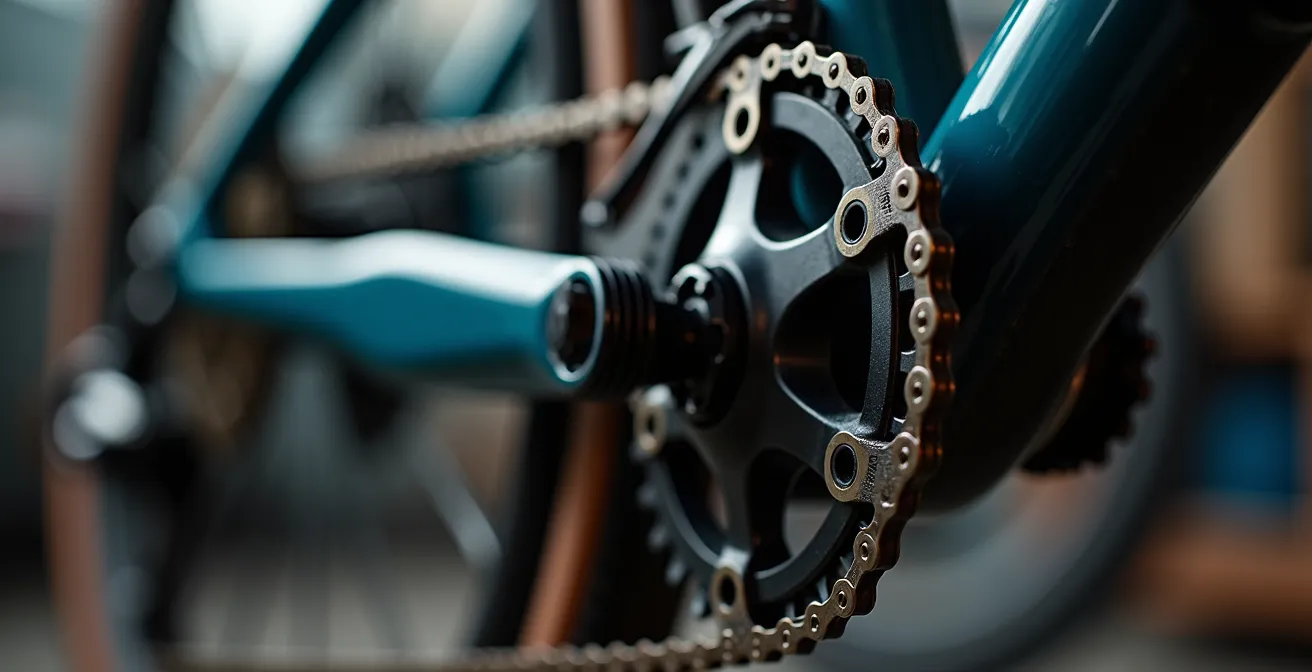
To make this second nature, especially before a climb, a proactive strategy is needed. Don’t wait until you’re already struggling on an incline. Anticipate the hill and shift into an easier gear *before* the gradient begins.
- Scan ahead: Always look 50-100 meters down the road or trail to identify gradient changes before you’re on them.
- Pre-shift into an easier gear: It’s better to be in a gear that’s too easy for a few seconds than to be in one that’s too hard and have to shift under load.
- Maintain a high cadence: Aim to keep your pedals spinning at 80-90 RPM. This is the most efficient range for both you and the motor.
- Never shift under full power: Be aware of your assistance level. If you’re in “Turbo” mode, it’s even more critical to use the soft pedal technique.
- Practice the pause: Make the 0.5-second pressure release a deliberate action on every shift until it becomes an automatic part of your riding.
Why a Software Update Might Make Your Bike Feel Slower Off the Line?
You take your e-bike for a service, it gets a firmware update, and suddenly it feels… different. It might seem less aggressive from a standing start, less “punchy.” This isn’t a bug; it’s often a deliberate feature of the updated software. Manufacturers constantly refine their motor control algorithms, and these updates often prioritize long-term goals over raw, instantaneous acceleration. The new power delivery curve may be designed to be smoother and more gradual.
The primary reasons for this change are drivetrain longevity and battery efficiency. A sharp, high-torque spike from a standstill puts enormous stress on the chain, cogs, and internal motor gears. By smoothing out this initial power delivery, manufacturers reduce the likelihood of premature wear and component failure. While this might reduce the initial “kick” by a small margin, say 15%, it can significantly improve the overall health of the drivetrain over thousands of miles.
Furthermore, these updates often improve the motor’s efficiency. A smoother application of power is more synergistic with the bike’s gears and the rider’s input, which translates directly into longer range. An update that sacrifices a bit of off-the-line thrill might extend your battery range by as much as 20%, a trade-off most commuters would gladly accept, especially on a long, hilly route. Modern firmware also increasingly allows for more personalization, offering user-selectable power maps so you can choose between an aggressive feel or a more efficient ride profile depending on your needs for the day.
How to Climb Hills Efficiently Without Draining the Battery in Minutes?
Climbing a steep hill on “Turbo” mode can feel exhilarating, but watching your battery meter plummet by 20% in five minutes is not. Efficient hill climbing is a skill that blends motor technology with rider technique. The key is to maintain momentum and operate the motor in its most efficient range, which requires active use of both your gears and the assistance levels.
This is where mid-drive motors have a distinct advantage. Because they work through the bike’s gears, they can maintain an optimal motor RPM even as the bike’s speed decreases on a climb. This synergistic efficiency allows them to operate in their sweet spot, generating torque without overheating or drawing excessive power. Market analysis shows that, on average, mid-drive motors can be up to 15% more energy efficient than hub motors on inclines. A hub motor, by contrast, is locked into the speed of the wheel. As you slow down on a steep hill, its RPM drops out of its efficient range, causing it to strain, generate more heat, and consume significantly more battery power to produce the same force.
To maximize your range, you need to think like a pilot managing resources, not a driver with their foot to the floor. The goal is to use the lowest assistance level possible while maintaining a comfortable and efficient pedaling cadence (around 80-90 RPM).
- Start climbs in a low-assist mode (Eco/Tour): Only increase the assistance level if your cadence starts to drop below 70 RPM and you can’t maintain it by shifting to an easier gear.
- Use your gears actively: Shift down early and often to keep your pedal speed high. This is more efficient than asking the motor to do all the work.
- Avoid “Turbo” for sustained climbs: Reserve the highest power setting for short, very steep pitches (e.g., under 30 seconds) where you need a quick burst of power.
- Monitor motor temperature: If your display has a temperature warning, pay attention to it. An overheating motor is an inefficient motor and is a sign you’re asking too much of it.
- Plan for regeneration: If you have a direct-drive hub motor with regenerative braking, use long, gentle descents to recover a small percentage (often 5-10%) of your battery.
Key Takeaways
- Mid-drive motors multiply torque through the bike’s gears, making them superior for steep hills but also causing accelerated chain and cassette wear.
- Motor torque (Nm) is critical, especially for riders over 200 lbs. A minimum of 85 Nm is recommended for hilly terrain to avoid overheating and poor performance.
- Proper shifting technique on a mid-drive (easing off pedal pressure) is not optional; it’s essential to prevent catastrophic drivetrain failure like a snapped chain.
Why Torque Sensors Justify the Extra Cost for Serious Commuters?
For the serious commuter in a variable landscape, the single feature that elevates an e-bike from a simple motorized vehicle to an intuitive extension of the body is the torque sensor. Unlike a basic cadence sensor that provides a crude on/off switch, a torque sensor modulates power in direct proportion to how hard you are pressing on the pedals. This creates a natural, predictable, and ultimately more efficient riding experience that justifies its higher cost.
The difference is most apparent in stop-and-go traffic or on rolling hills. With a torque sensor, a gentle push on the pedal yields a gentle assist, perfect for filtering through traffic. A hard push for a steep climb delivers maximum power instantly. This seamless integration of human and machine power feels intuitive and eliminates the jerky, unpredictable surges common with cadence-based systems. This intuitive control is becoming the industry standard for quality e-bikes; recent market data reveals that over 61.3% of premium e-bikes now feature torque sensors, a clear indicator of their perceived value.
Beyond the superior ride feel, this technology has a direct impact on your battery life. Because the motor only delivers the power you actually need for a given moment, it is far more efficient. In urban environments with frequent stops and starts, a torque-sensing system can reduce battery consumption by 20-30% compared to a cadence-based system that often provides full power when only a little is needed. For a commuter, this translates to longer range, more confidence in the battery meter, and a more enjoyable, less stressful ride.
To make the best decision for your specific commute, test ride both systems on a hill you ride regularly. Pay attention to the motor’s response, noise, and how the bike feels under you. Ask the shop about the expected maintenance schedule and costs for the drivetrain to get a full picture of your long-term investment.