
The idea that e-bikes are “cheating” for fitness is a myth; they are a sophisticated tool for more effective and sustainable fat-burning workouts.
- E-bike assistance helps you consistently maintain your heart rate in Zone 2, the optimal state for fat oxidation.
- The “fun factor” and reduced strain lead to longer, more frequent rides, significantly increasing your total weekly calorie expenditure.
Recommendation: Instead of focusing on maximum effort, use an e-bike to strategically manage your effort, ride more often, and achieve superior, long-term fitness results.
You’ve felt it. You’re grinding up a hill on your traditional bicycle, heart pounding, legs burning, when someone on an electric bike glides past with a serene smile. The immediate thought for many is, “That’s cheating.” This sentiment is common among fitness skeptics and those worried that an e-bike is just too easy to provide a real workout, especially for weight loss. The conventional wisdom is that more sweat and more pain always equal better results.
This perspective, however, overlooks the complex physiology of exercise and energy expenditure. The question isn’t whether e-biking is easier—it is. The real question is whether that “easiness” can be leveraged for a smarter, more effective, and more sustainable approach to fitness. What if the key to burning fat wasn’t just raw, anaerobic effort, but the ability to precisely control your exertion level over a longer period?
This article dismantles the “cheating” myth by looking at the science. We will explore the physiological mechanisms that make e-bikes a powerful tool for fat loss, joint-friendly exercise, and building a strong aerobic base. By the end, you will understand how managing your effort with an electric motor can lead to a higher overall calorie burn and better fitness outcomes than you might expect.
To understand how an e-bike can transform your fitness routine, this article breaks down the science behind the workout. We will cover the core concepts, from fat-burning heart rate zones to the real-world impact on your total weekly energy burn.
Summary: Is It Cheating? Why You Still Burn 300 Calories an Hour on an E-Bike?
- Why Staying in Zone 2 Is Easier on an E-Bike and Better for Fat Loss?
- How “Fun” Motivation Leads to 3x More Miles Ridden per Week?
- Acoustic vs Electric: Why E-Bikers Often Have Higher Daily Calorie Expenditure?
- The Error of Pushing High Gears That Damages Knees on Hills
- When to Turn the Motor Off: Intervals for Strength Building?
- Cadence vs Torque: Which Sensor Promotes Better Leg Strength?
- Human Power vs Electricity: Is Eating More Food More Carbon Intensive?
- Building Base Fitness: How to Use E-Assist to Ride for 3 Hours Without Bonking?
Why Staying in Zone 2 Is Easier on an E-Bike and Better for Fat Loss?
The most misunderstood aspect of exercise for weight loss is the role of intensity. While high-intensity workouts are excellent for cardiovascular health, the most effective state for burning stored body fat is a lower-intensity aerobic state known as Zone 2. This is typically 60-70% of your maximum heart rate. In this zone, your body preferentially uses fat for fuel. In fact, your body’s potential energy reserves are vast; research shows we have approximately 70,000 calories from fat stores compared to only about 2,000 from carbohydrates (glycogen).
On a conventional bike, it’s difficult to stay in Zone 2. A steep hill can instantly spike your heart rate into Zone 4 or 5, forcing your body to burn readily available sugars instead of fat. This is where an e-bike becomes a powerful training partner. By providing just enough assistance to flatten the hills, the motor allows you to keep your heart rate steady and within the optimal fat-burning zone for the entire duration of your ride.

As you can see, the goal is consistency. An e-bike’s motor isn’t a replacement for pedaling; it’s a tool for effort management. It smooths out the peaks and valleys of exertion that would otherwise push you out of your target fat-burning zone, turning your entire ride into a highly efficient, fat-oxidizing session. This sustained, moderate effort is the secret to tapping into your body’s largest energy reserve.
How “Fun” Motivation Leads to 3x More Miles Ridden per Week?
The best workout is the one you actually do. This simple truth is often overlooked in fitness debates. While a traditional road bike might offer a more intense workout per hour, the perceived effort, physical strain, and logistical barriers (like daunting hills) can be significant deterrents. E-bikes dramatically lower these barriers, making cycling more accessible and, critically, more fun. This “fun factor” is not a trivial point; it is a primary driver of consistency and frequency.
When an activity is enjoyable, you are intrinsically motivated to do it more often. Removing the dread of a challenging climb or the fear of not being able to keep up means you’re more likely to choose the bike over the car for an errand or go for a longer weekend ride. This isn’t just theory; studies show that e-bike owners spend over 60% more time riding their bikes compared to when they only had conventional bikes. They ride more frequently and for longer distances.
This increased volume is where the calorie-burning magic happens. As fitness expert James Bourne noted in a National Geographic study, the appeal is undeniable:
There is a sense of freedom in being able to get out in the fresh air without feeling limited by terrain or distance.
– James Bourne, National Geographic – E-bike Health Benefits Study
A 30-minute, high-intensity ride three times a week (90 minutes total) may be surpassed in total energy expenditure by five enjoyable, 45-minute e-bike rides (225 minutes total). The focus shifts from the intensity of a single session to the Total Energy Expenditure (TEE) over the entire week. By making exercise less of a chore and more of a joy, e-bikes promote the very consistency that is essential for sustainable weight loss and fitness improvement.
Acoustic vs Electric: Why E-Bikers Often Have Higher Daily Calorie Expenditure?
It’s a common assumption: a traditional “acoustic” bike must burn more calories than an e-bike. On a minute-by-minute basis, at maximum effort, this is true. However, this comparison is flawed because it ignores how people use these bikes in the real world. A fitness skeptic might do a 45-minute intense ride on a traditional bike, pushing their heart rate into anaerobic zones, and burn 500 calories. They might feel exhausted afterward and not ride again for two days.
In contrast, an e-bike rider might go for a 90-minute ride using a low-assist “Eco” mode. Because the effort is moderate and enjoyable (staying in Zone 2 or 3), they cover more ground and ride for longer. They might burn 350 calories per hour, for a total of 525 calories, and feel energized enough to ride again the next day. Real-world testing by Rad Power Bikes showed riders burning as much as 650 calories per hour at the lowest assist level. It’s the cumulative effect that matters.
This table illustrates how different activities compare, not just in hourly burn, but in typical duration, which is key to understanding total expenditure.
| Activity Type | Calories Burned/Hour | Heart Rate Zone | Typical Duration |
|---|---|---|---|
| E-bike with Eco Mode | 300-400 | Zone 2-3 | 60-90 min |
| E-bike with High Assist | 200-250 | Zone 1-2 | 90-120 min |
| Traditional Bike (moderate) | 400-600 | Zone 3-4 | 45-60 min |
| Walking | 200-300 | Zone 1-2 | 60 min |
The data from a recent comparative analysis highlights a crucial point: a longer, moderate-intensity e-bike ride can easily burn more total calories than a shorter, high-intensity conventional ride. When you factor in the increased likelihood of riding daily, the e-biker’s total weekly calorie expenditure can often surpass that of the sporadic acoustic cyclist.
The Error of Pushing High Gears That Damages Knees on Hills
One of the most common mistakes cyclists make, especially on hills, is “mashing” the pedals—pushing a high gear at a very low pedal speed (cadence). This approach puts immense strain on the knee joints, particularly increasing patellofemoral stress. It’s an inefficient way to generate power and a fast track to injury. The ideal cadence for both efficiency and joint health is typically between 80 and 90 revolutions per minute (RPM).
On a traditional bike, maintaining this optimal cadence on a steep incline is incredibly difficult. As the grade increases, riders are forced to shift to easier gears, and eventually, they may run out of gears, forcing them into a low-cadence grind. An e-bike completely solves this problem. The motor provides the extra torque needed to keep the pedals turning smoothly, allowing the rider to maintain a high, joint-friendly cadence regardless of the terrain. You can spin up a hill instead of grinding.
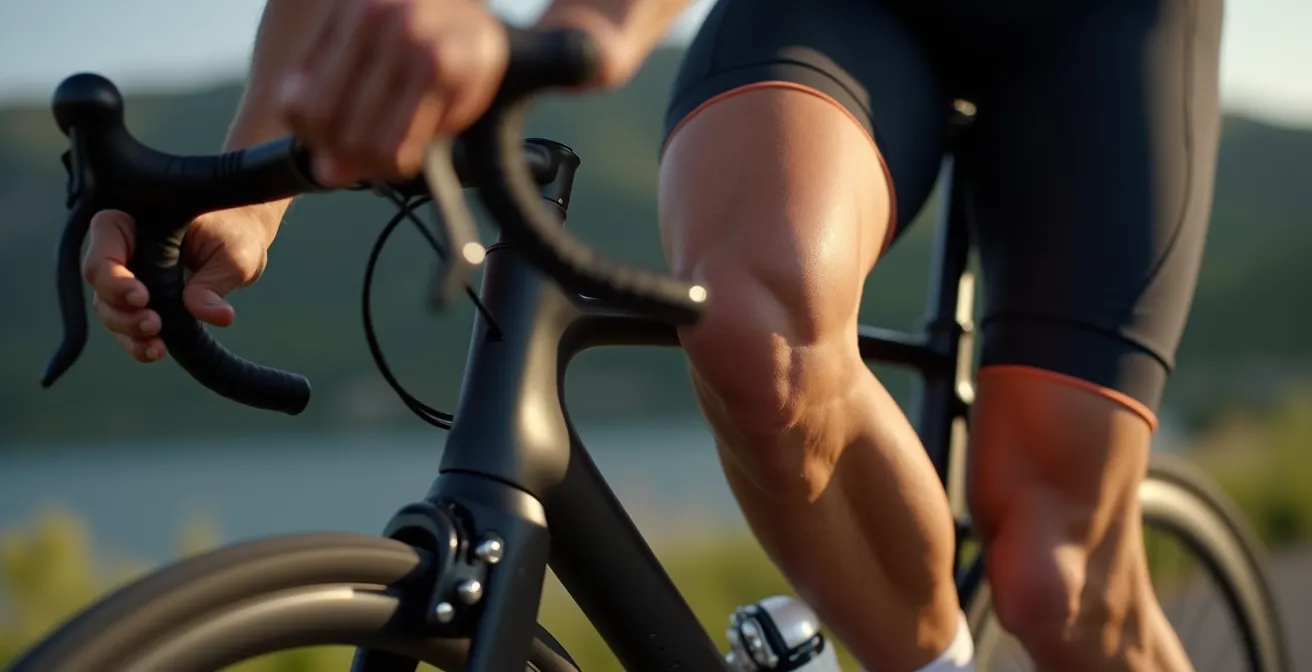
This isn’t “cheating”; it’s biomechanically smart training. It allows you to get a great cardiovascular workout without compromising the long-term health of your knees. By preventing your cadence from dropping below 70 RPM, the e-bike encourages proper form and makes your workout safer and more sustainable. This is particularly beneficial for people returning to exercise, those with previous injuries, or heavier riders who place more absolute force on their joints.
Action Plan: Knee-Protective Cycling Guidelines
- Maintain a cadence between 80-90 RPM on all terrains by using your gears and assist levels appropriately.
- Set your saddle height to allow for a 25-30° knee flexion at the bottom of the pedal stroke.
- Use the e-bike’s assist to prevent your cadence from dropping below 70 RPM, especially on hills.
- Anticipate inclines by shifting to an easier gear before you start climbing to maintain smooth pedaling.
- Monitor your knee angle during the pedal stroke, avoiding excessive flexion that increases joint stress.
When to Turn the Motor Off: Intervals for Strength Building?
The idea that an e-bike motor must always be on is a misconception. An e-bike’s variable assist levels, including the option to turn it off completely, make it an incredibly versatile tool for advanced training methods like High-Intensity Interval Training (HIIT). HIIT involves short bursts of maximum effort followed by periods of active recovery, and it’s a proven way to boost metabolism and cardiovascular fitness.
Here’s how it works with an e-bike: you can perform your high-effort “sprint” intervals with the motor turned off or on the lowest setting, forcing your body to work at its absolute maximum. This could be a 30-second, all-out effort up a short hill. Then, for the recovery period, instead of coasting or stopping, you switch the assist to a higher level. This allows you to keep spinning your legs easily, flushing out lactic acid and preparing your muscles for the next interval without your heart rate dropping too low.
This method can be superior to HIIT on a traditional bike, where recovery can be challenging on varied terrain. If your sprint interval ends at the bottom of a hill, your “recovery” becomes another strenuous effort. An e-bike gives you complete control over your workout, ensuring your work periods are truly maximal and your recovery periods are genuinely restorative. This structured approach allows for more productive and repeatable intervals, leading to greater gains in anaerobic power and strength.
Cadence vs Torque: Which Sensor Promotes Better Leg Strength?
Not all e-bikes are created equal. The type of sensor that activates the motor plays a huge role in the quality of your workout. The two main types are cadence sensors and torque sensors, and understanding the difference is key for any fitness skeptic. A cadence sensor is a simple on/off switch. It detects if you are pedaling and delivers a fixed amount of power based on your chosen assist level. This can lead to “ghost pedaling,” where you can spin the pedals with minimal effort while the motor does most of the work.
A torque sensor, in contrast, is far more sophisticated. It measures how hard you are pushing on the pedals and delivers a proportional amount of assistance. If you push lightly, you get a little help. If you push hard to accelerate or climb a hill, you get more help. This creates a natural, intuitive riding experience that feels like an extension of your own power. Crucially, it rewards effort. The harder you work, the faster you go, which incentivizes you to push yourself and actively engage your muscles. This directly contributes to building better leg strength.
For anyone serious about fitness, an e-bike with a torque sensor is the clear choice. It ensures you are always contributing a significant amount of the effort, turning the ride into a true partnership between you and the motor. The exercise you get is quantifiable; scientific studies show e-biking produces MET values between 3.7 and 8.5. A MET, or Metabolic Equivalent of Task, is a standard measure of exercise intensity. A value of 3-6 is considered moderate-intensity exercise, proving that e-biking is far from a passive activity.
Human Power vs Electricity: Is Eating More Food More Carbon Intensive?
An interesting, often-overlooked angle in the e-bike debate is the environmental and caloric cost of power. Critics might point to the electricity required to charge an e-bike battery as a hidden environmental cost. While producing electricity has a carbon footprint, it’s important to compare it to the alternative: the “fuel” for a traditional cyclist is food.
Let’s consider the numbers. An average e-bike ride might consume approximately 150 Watt-hours (Wh) of electricity. To generate that same 150Wh of power through pedaling, a human body, which is only about 25% efficient, must burn roughly 600Wh of energy, equivalent to about 520 food calories. The carbon footprint of producing those 520 calories—through modern agriculture, processing, transportation, and refrigeration—is often significantly higher than the footprint of generating 150Wh of electricity, especially as power grids become greener.
This is not to say that riding a traditional bike is bad for the environment. Far from it. Both are vastly superior to driving a car. However, it does challenge the simplistic notion that using electricity is inherently “cheating” or less pure. From a strict energy-in, energy-out perspective, leveraging the efficiency of the electrical grid to supplement your own power is a remarkably effective system. It reframes the e-bike not as a compromise, but as a highly efficient human-electric hybrid vehicle.
Key takeaways
- The primary benefit of an e-bike for fat loss is its ability to help you maintain a steady Zone 2 heart rate.
- Increased ride frequency and duration, driven by the “fun factor,” often leads to greater total weekly calorie burn than shorter, intense workouts.
- Using an e-bike to maintain proper cadence protects your joints from the strain of “mashing” high gears, enabling a more sustainable fitness routine.
Building Base Fitness: How to Use E-Assist to Ride for 3 Hours Without Bonking?
One of the greatest advantages of an e-bike for fitness is its ability to help you build a strong aerobic base. Base fitness is developed through long, steady, low-to-moderate intensity rides. These rides teach your body to become more efficient at using fat for fuel, sparing your limited glycogen stores. However, for many people, a 3-hour ride on a traditional bike is an intimidating prospect, with the risk of “bonking”—running out of energy completely—being very real.
An e-bike is the perfect tool for extending your endurance. You can plan a long ride and use the assist strategically to manage your energy reserves. For example, you might ride the first hour in Eco mode, using minimal assistance while you’re fresh. As you enter the second hour, you could switch to a medium “Tour” mode to maintain your pace as fatigue begins to set in. For the final, most challenging hour, you can use a higher “Sport” mode to help you get home strong, without your form collapsing or your heart rate spiking uncontrollably.
This strategy allows you to accumulate the “time in the saddle” necessary for building a deep aerobic base without the risk of overexertion. You get the full cardiovascular and metabolic benefits of a long-duration workout, but the motor acts as a safety net, ensuring you can complete the ride and recover effectively. It transforms the daunting 3-hour ride from an impossibility into a regular, achievable part of your training week.
Stop thinking of it as cheating and start seeing the e-bike as your personal training partner. Evaluate how managing your effort, not just maximizing it, can unlock your fitness potential today.
Frequently Asked Questions about E-Bike Fitness
Does e-biking count as doctor-recommended physical activity?
Yes, studies point to e-biking meeting WHO-recommended intensity levels, with a 2021 study finding that a 3-mile e-bike commute met healthy physical activity recommendations.
How much exercise is needed to see health benefits?
Modest activity of 30 minutes daily helps with enhanced physical fitness, improved cardiovascular function, muscle strengthening, reduced inflammation, and better mental health.
Can e-bikes help with anxiety and depression?
Yes, the combination of natural pedaling and battery assistance can ease anxiety and depression while improving cognitive functioning and strengthening the immune system.