
The greatest risk for e-bike riders isn’t a speeding ticket; it’s unknowingly crossing the legal line where your bike is reclassified as an uninsured, unregistered motor vehicle.
- Modifying your e-bike’s speed limiter or using a high-powered, non-compliant model can instantly void all homeowners and auto liability insurance coverage.
- State and federal laws are based on kinetic energy and predictability; Class 3 e-bikes are often banned from multi-use paths because they carry significantly more force than traditional bikes.
Recommendation: Before you ride, you must audit your bike’s classification and your insurance policy to confirm you are not exposed to catastrophic financial liability in the event of an accident.
The rise of the electric bicycle has revolutionized personal mobility, offering a powerful, efficient, and enjoyable way to navigate our cities and trails. However, this surge in popularity has outpaced public understanding of the complex legal framework that governs these machines. Many riders operate under the dangerously false assumption that an e-bike is just a bicycle with a small helper motor. This misunderstanding is a significant liability.
From a legal and insurance perspective, the line between a “bicycle” and an illegal “motor vehicle” is razor-thin and frighteningly easy to cross. The common advice to “check local laws” is insufficient because it fails to address the underlying legal doctrine. It’s not just about speed limits; it’s about vehicle classification, insurance liability, and the specific rules governing throttles, pedal-assist, and access to public lands. A simple modification or riding in the wrong jurisdiction can have consequences far beyond a simple fine, including vehicle impoundment and total loss of liability coverage in an accident.
But the true key to safe and legal riding isn’t memorizing a list of statutes. It is understanding the legal logic behind the regulations. The law is primarily concerned with managing risk, and the primary risk factor is kinetic energy. By understanding why these rules exist—to protect pedestrians, manage traffic flow, and ensure rider predictability—you can make informed decisions that protect both your physical safety and your financial future. This guide moves beyond a simple recitation of rules to provide an authoritative framework for assessing your risk and ensuring compliance.
This article will dissect the critical legal distinctions that every e-bike owner must understand. We will explore the specific regulations governing different e-bike classes, the severe insurance ramifications of modifications, and the practical realities of navigating a patchwork of state and local laws to help you stay compliant and protected.
Summary: A Legal Guide to E-Bike Speed and Classification
- Why Class 3 E-Bikes Are Banned on Most Multi-Use Paths?
- How Modifying Speed Limits Voids Your Liability Insurance Coverage?
- Throttle or Pedal Assist: Which Is Legal in National Parks?
- The Risk of Riding High-Speed E-Bikes Without Registration Plates
- Crossing Borders: How E-Bike Laws Change from State to State?
- When to Choose a NTA-8776 Speed Pedelec Helmet Over a Road Helmet?
- Sidewalk or Street: Where Should a 20mph E-Bike Be in a Neighborhood?
- Surviving Rush Hour: Defensive Riding Tactics for New Urban Cyclists
Why Class 3 E-Bikes Are Banned on Most Multi-Use Paths?
The restriction of Class 3 e-bikes (which provide assistance up to 28 mph) from shared-use paths is not an arbitrary rule; it is a legal decision rooted in physics and public safety doctrine. The core issue is kinetic energy—the force an object carries due to its motion. This energy, which must be dissipated in a collision, increases exponentially with speed. As a result, the potential for serious injury to pedestrians, other cyclists, and the rider themselves rises dramatically at higher velocities.
To put this into perspective, traffic engineers have calculated the risk. As one analysis explains, a 75 lb e-bike traveling at 28 mph carries three times more kinetic energy than a traditional 30 lb bicycle traveling at a brisk 15 mph. This disparity in force is the legal justification for separating higher-speed vehicles from more vulnerable path users. Lawmakers and park authorities see this not as a ban on e-bikes, but as a necessary measure to prevent bicycle-class paths from effectively becoming moped-class thoroughfares, for which they were not designed.
This has led to a vigorous debate in many jurisdictions. For example, legislative proposals in Oregon have sought to manage this risk by restricting Class 3 e-bikes from certain paths. The debate centers on whether a blanket ban is the correct approach, or if a more nuanced solution, such as enforcing a 15-20 mph speed limit on all vehicles on these paths, would be more effective. However, until such measures are widely adopted, the default legal position remains: higher speed classes are often relegated to on-street bike lanes or the road itself to mitigate the inherent risk their velocity creates.
How Modifying Speed Limits Voids Your Liability Insurance Coverage?
One of the most significant and misunderstood risks associated with e-bikes lies not on the road, but in your insurance contract. Many riders assume their homeowners or renters policy will cover them in case of an accident. While this is often true for conventional bicycles, the moment an e-bike is modified to exceed legal speed limits, that coverage is likely nullified. Insurance policies are contracts based on a defined level of risk, and they contain specific exclusions for “motorized vehicles.”
A standard, compliant e-bike (Class 1, 2, or 3) is typically defined as a bicycle. However, by “chipping” or “unlocking” your bike to go faster than the 20 mph or 28 mph legal limit, you have unilaterally altered its legal definition. In the eyes of your insurer, you are no longer riding a bicycle; you are operating an uninsured and unregistered motor vehicle. An interview with an insurance expert on BikeLaw.com clarifies this, stating that most homeowners and rental insurance policies offer protection for injuries or damage caused while riding a regular bicycle, but this coverage evaporates when the vehicle falls into a grey area.
If you cause an accident on a modified e-bike, you could be held personally and completely liable for property damage and medical bills, which can easily amount to hundreds of thousands of dollars. To avoid this catastrophic financial exposure, riders must either keep their e-bikes strictly compliant or secure a separate, dedicated e-bike insurance policy. These specialized policies are designed for the unique risks of e-bikes, and as a leading insurer notes, liability coverage for e-bikes starts as low as $75/year—a small price to pay for financial protection.
Action Plan: Insurance Verification for E-Bike Owners
- Classify Your Bike: Determine if your e-bike meets the federal and state definitions for Class 1, 2, or 3, and ensure it has not been modified to exceed these limits.
- Review Homeowner’s Policy: Read your policy documents carefully to see if “motorized vehicles” or vehicles with motors are explicitly excluded from liability coverage.
- Check Auto Policy: Verify if your auto insurance policy provides any coverage for vehicles with fewer than four wheels; most do not.
- Secure Dedicated Insurance: If any coverage gaps exist, immediately seek out and purchase a dedicated e-bike insurance policy that covers your specific class of bike.
- Confirm Modification Clause: Ensure you understand how any modifications, even if they don’t increase speed, could affect your coverage and legal compliance.
Throttle or Pedal Assist: Which Is Legal in National Parks?
Navigating e-bike regulations on federal lands, such as National Parks, requires particular attention to detail, as the rules are specific and strictly enforced. While a 2019 policy change opened many trails to e-bikes, it did not grant unrestricted access. The primary legal distinction in this context often comes down to the mode of power delivery: pedal-assist versus a throttle.
In general, National Park Service (NPS) regulations permit Class 1 e-bikes (pedal-assist only, up to 20 mph) in the same places traditional bicycles are allowed. The logic is that a pedal-assist bike behaves more like a traditional bicycle, requiring rider effort to engage the motor. Class 2 e-bikes, which feature a throttle that can power the bike without pedaling, are more complex. Initially, there were concerns that throttle use could lead to trail damage and user conflict, as it more closely resembles a pure motorized vehicle.
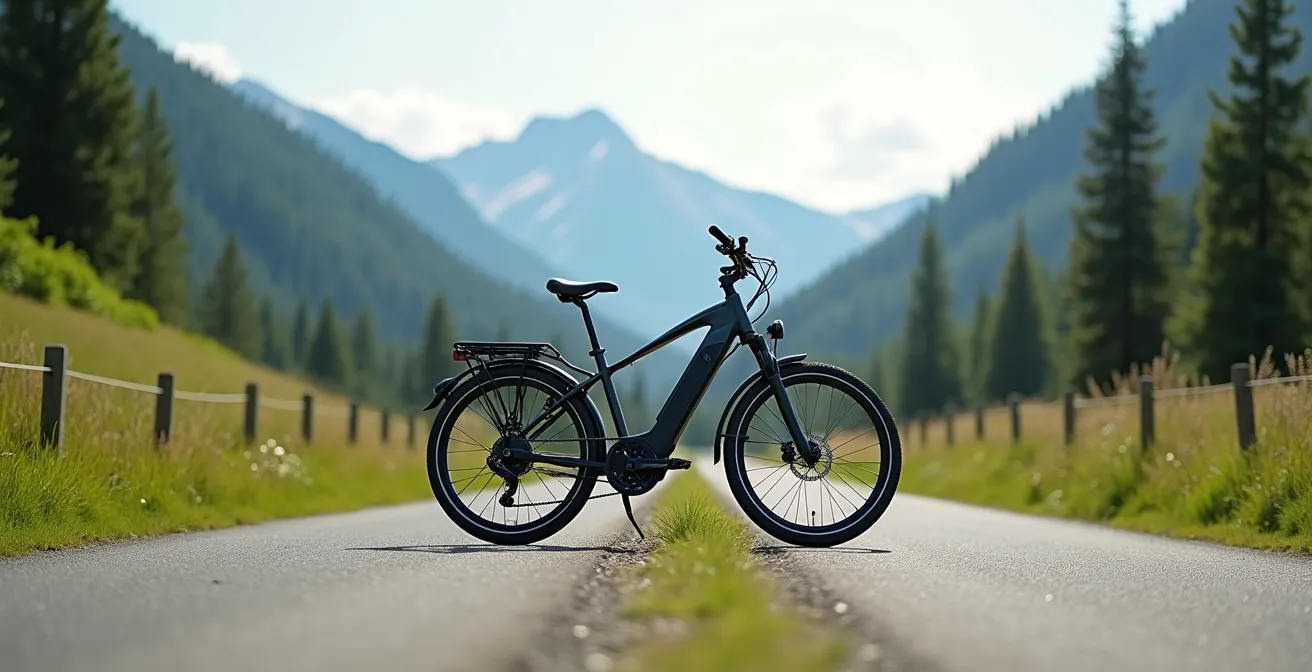
The illustration below symbolizes this divide, where e-bike access is often limited to developed paths, separate from more sensitive, unpaved hiking trails.
To address this, the NPS issued a revised final rule in 2020. This rule does not issue a blanket ban on Class 2 e-bikes. Instead, it prohibits the use of the throttle for an extended period of time. This nuanced approach allows a Class 2 rider to use the throttle for a brief initial boost or to get through a difficult patch, but prevents them from riding it like a motorcycle continuously. This policy attempts to strike a balance, ensuring that e-bike use remains “consistent with traditional, non-motorized bicycles” while still offering the benefits of the technology.
The Risk of Riding High-Speed E-Bikes Without Registration Plates
When an e-bike is modified or manufactured to travel beyond the legal 28 mph threshold of a Class 3 e-bike, it crosses a critical legal boundary. At this point, it is no longer considered an “electric bicycle” under most state laws. Instead, it is deemed a moped or motorcycle, a classification that comes with a host of legal requirements that most of these bikes cannot meet, including registration, license plates, and mandatory insurance.
Riding one of these high-speed, non-compliant bikes on public roads is functionally equivalent to driving an unregistered car. The consequences are not minor infractions; they often involve significant fines, criminal charges, and immediate vehicle impoundment. Law enforcement agencies are increasingly cracking down on this issue as the vehicles proliferate. For instance, data from New York City shows that illegal e-bike confiscation can result in towing and storage fees that quickly escalate, with general vehicle impoundment costing hundreds of dollars.
Case Study: Santa Monica’s Impoundment of Illegal “E-Dirt Bikes”
In a targeted operation, the Santa Monica Police Department impounded 12 vehicles that, while resembling e-bikes, were being ridden illegally on city streets. The department’s public statement noted, “These vehicles often exceed 40 mph, lack operable pedals, and are not classified as legal electric bicycles.” According to a report on the incident, this action highlights a clear enforcement trend against bikes that fail to meet basic legal standards. Fines for such offenses start at $100 and escalate to $500 for repeat offenders, in addition to the significant costs and legal hurdles required to retrieve the impounded vehicles. This serves as a stark warning: if your bike has been modified to prioritize raw power over legal compliance, you risk losing it entirely.
The core legal problem is that these bikes exist in a regulatory no-man’s-land. They are too fast to be bicycles, but they lack the VIN, lights, and safety features required for moped or motorcycle registration. This makes them illegal to operate on any public road, transforming a recreational ride into a significant legal and financial gamble.
Crossing Borders: How E-Bike Laws Change from State to State?
For any e-bike rider who travels, it is a critical error to assume that the rules in one state apply in another. The United States does not have a single, unified federal law governing e-bike use on all public roads. While the three-class system provides a common framework that many states have adopted, the specific implementation—including speed limits, age requirements, helmet laws, and path access—varies significantly. This patchwork of regulations creates a “jurisdictional roulette” for riders crossing state lines.
For example, while California and Colorado both set the Class 3 speed limit at 28 mph, New York caps it at 25 mph. More importantly, states impose different restrictions on where these bikes can be ridden. California and Oregon explicitly restrict Class 3 e-bikes from many types of multi-use bike paths, whereas other states may permit them. Similarly, a helmet may be mandatory for all ages in one state but only for riders under 18 in a neighboring one. These differences are not trivial; they represent distinct legal standards that carry real penalties.
The table below illustrates just a few of these key differences, highlighting the necessity of pre-trip research. These inconsistencies mean a perfectly legal ride in one state can become an illegal one simply by crossing a border.
| State | Class 1/2 Limit | Class 3 Limit | Special Restrictions |
|---|---|---|---|
| California | 20 mph | 28 mph | Class 3 banned from bike paths |
| New York | 20 mph | 25 mph | Throttle restrictions apply |
| Colorado | 20 mph | 28 mph | Age 16+ for Class 3 |
| Oregon | 20 mph | 28 mph | Class 3 restricted from multi-use paths |
Therefore, the only prudent approach for an interstate rider is to assume nothing. Before any trip, you must verify the specific regulations for your destination state and any states you will pass through. The most cautious strategy is to configure your bike’s settings to comply with the most restrictive state on your route to ensure you remain street-legal at all times.
When to Choose a NTA-8776 Speed Pedelec Helmet Over a Road Helmet?
As an e-bike rider, your choice of helmet is not just a matter of safety; it’s a decision that should be directly informed by the legal classification and top speed of your bike. Standard bicycle helmets are simply not designed or certified for the higher speeds that Class 3 e-bikes can achieve. Opting for a helmet with the Dutch NTA-8776 certification is a critical measure to protect against the unique risks of high-speed cycling.
The legal and physical rationale is clear. Standard U.S. CPSC-certified bike helmets are tested to withstand impacts equivalent to a fall at approximately 15 mph. A Class 3 e-bike, however, provides motor assistance up to 28 mph. In a crash at that speed, the impact forces are substantially greater, and the trajectory of the rider is different. A standard helmet may not provide adequate protection.
A standard bike helmet is certified to protect you in a 15 mph fall. The NTA-8776 standard requires more coverage for the temples and back of the head, areas more likely to be impacted in a high-speed forward crash.
– Safety Standards Expert, E-Bike Helmet Certification Analysis
The NTA-8776 standard was created specifically for “speed pedelecs” (the European term for high-speed e-bikes). These helmets are built to absorb more impact energy and provide greater coverage to the head, particularly the vulnerable temple and occipital (rear) regions. The illustration below highlights the kind of robust construction and extended coverage that distinguishes these specialized helmets.

From a liability perspective, the choice is crucial. While not yet legally mandated in every U.S. state for Class 3 riders, choosing an NTA-8776 certified helmet demonstrates that you have taken appropriate and reasonable steps to mitigate the foreseeable risks of high-speed riding. In the event of an accident or insurance claim, this can be a powerful piece of evidence showing you were not negligent. Therefore, if you ride a Class 3 e-bike, the decision to upgrade to an NTA-8776 helmet should be considered a legal and safety necessity, not an option.
Sidewalk or Street: Where Should a 20mph E-Bike Be in a Neighborhood?
The question of whether to ride an e-bike on the sidewalk or the street is a frequent point of confusion and a significant legal minefield. The authoritative answer is almost always the street. Even in cities that permit traditional bicycles on sidewalks, e-bikes are typically forbidden due to their increased weight and speed, which pose an unacceptable hazard to pedestrians.
From a legal standpoint, you should assume sidewalk riding is illegal unless a local ordinance explicitly permits it for e-bikes, which is rare. The rationale is based on predictability and speed differential. A 50-75 lb e-bike traveling at 15-20 mph is a formidable presence on a sidewalk designed for 3 mph pedestrian traffic. It creates unpredictable conflicts and dramatically increases the risk of serious injury. Recent enforcement actions in cities like Hoboken, where a crackdown saw 14 e-bikes impounded in just two weeks, demonstrate that municipalities are taking this issue seriously. Fines for illegal sidewalk riding can be steep, ranging from $100 to as much as $500 in cities like New York.
While riding on the street may feel more intimidating for a new rider, it is the legally correct and ultimately safer place to be. On the road, an e-bike rider moving at 15-20 mph becomes a predictable part of the traffic flow. Drivers can anticipate your movements in a way they cannot when you unexpectedly dart out from a sidewalk at a crosswalk. By taking the lane when appropriate and following traffic laws, you establish your right to be there and operate in a way that is visible and expected by surrounding motorists.
Key Takeaways
- Compliance is Not Optional: The three-class system is the legal foundation. Modifying your bike or using a non-compliant model effectively turns it into an illegal motor vehicle, voiding insurance.
- Risk is Based on Energy: Restrictions on speed and path access are based on the physics of kinetic energy. Higher speeds create exponentially greater risk, informing legal separations between user groups.
- Jurisdiction Dictates the Rules: E-bike laws are not universal. Speed limits, helmet laws, and path access change from state to state and city to city, requiring diligent pre-ride research.
Surviving Rush Hour: Defensive Riding Tactics for New Urban Cyclists
Operating an e-bike in dense, urban traffic during rush hour requires more than just knowledge of the law; it demands a proactive and defensive mindset. The higher speeds of e-bikes reduce reaction times for both the rider and surrounding motorists, making vigilance a matter of survival. The fundamental principle of defensive riding is to assume you are invisible and to actively manage the space around you to mitigate potential threats.
Data from the NHTSA underscores the heightened risk, indicating that braking distances can lengthen by 30-50% at 28 mph compared to 20 mph. Furthermore, a staggering number of incidents involve excessive velocity, as an analysis of the data shows that 68% of e-bike injuries involve speeds above legal limits. This highlights the critical need to adapt your riding style to the capabilities of your machine. This means scanning further ahead, anticipating the actions of cars and pedestrians, and always maintaining an escape route.
Effective defensive riding involves specific, practiced techniques. You must be hyper-aware of blind spots, especially around large vehicles and rows of parked cars where doors can open unexpectedly. Using a bell or your voice before entering a driver’s blind spot is not just polite; it’s a crucial defensive maneuver. Most importantly, you must learn to “take the lane” when necessary. When you are traveling at or near the speed of traffic (15-20 mph), riding on the far right edge of the lane can encourage dangerous passes. By positioning yourself in the center of the lane, you become more visible and force drivers to treat you like another vehicle, which, legally, you are.
Checklist: Urban E-Bike Safety for Rush Hour
- Scan Ahead: Continuously scan the road 20-30 feet ahead to anticipate hazards, accounting for higher closing speeds.
- Announce Your Presence: Use a bell or your voice before entering driver blind spots, especially near parked cars where doors may open.
- Brake Early: Initiate your braking process approximately 50% earlier than you would on a traditional, lighter bicycle.
- Take the Lane: When your speed matches the flow of traffic (15-20 mph), confidently occupy the center of the lane to prevent unsafe passing.
- Practice Emergency Stops: Regularly practice hard braking in a safe, empty area to understand your bike’s extended stopping distance.
Ultimately, navigating the world of e-bikes requires a shift in mindset. You are the operator of a vehicle that exists on a spectrum of legal definitions. By understanding the principles of kinetic energy, the severe consequences of non-compliance, and the practical tactics of defensive riding, you move from being a passive user to an informed, responsible operator. This knowledge is your best insurance policy. To reinforce your understanding of where this all begins, it is essential to revisit the foundational safety principles that drive these regulations.
Frequently Asked Questions About E-Bike Laws and Speed
Can I ride my Class 2 e-bike on the sidewalk?
It is highly unlikely. Even in cities that allow traditional bicycles on sidewalks, most have ordinances that specifically restrict e-bikes because of their higher speeds and greater weight. You must assume it is illegal unless you can find a local law that explicitly permits it.
What happens if I’m caught riding on the sidewalk illegally?
The penalties can be significant. Fines typically range from $100 to $500, depending on the municipality. Cities like New York are known to impose fines at the higher end of that range for sidewalk riding violations, in addition to the risk of vehicle confiscation.
Is riding in the street truly safer than the sidewalk?
While it can feel more intimidating, riding on the street is legally correct and makes you a predictable part of the traffic ecosystem. A cyclist on the sidewalk creates unexpected hazards for pedestrians and is often invisible to cars at intersections and driveways. Following traffic laws in the street is the safer, more responsible choice.