Managing e-bike battery safety is not about following a simple checklist; it’s about operating a high-energy system with an engineering mindset, understanding that cell quality, charging environment, and user handling are inextricably linked.
- Generic batteries lack critical internal safety mechanisms (CIDs/PTCs), making them exponentially more vulnerable to internal shorts and fire.
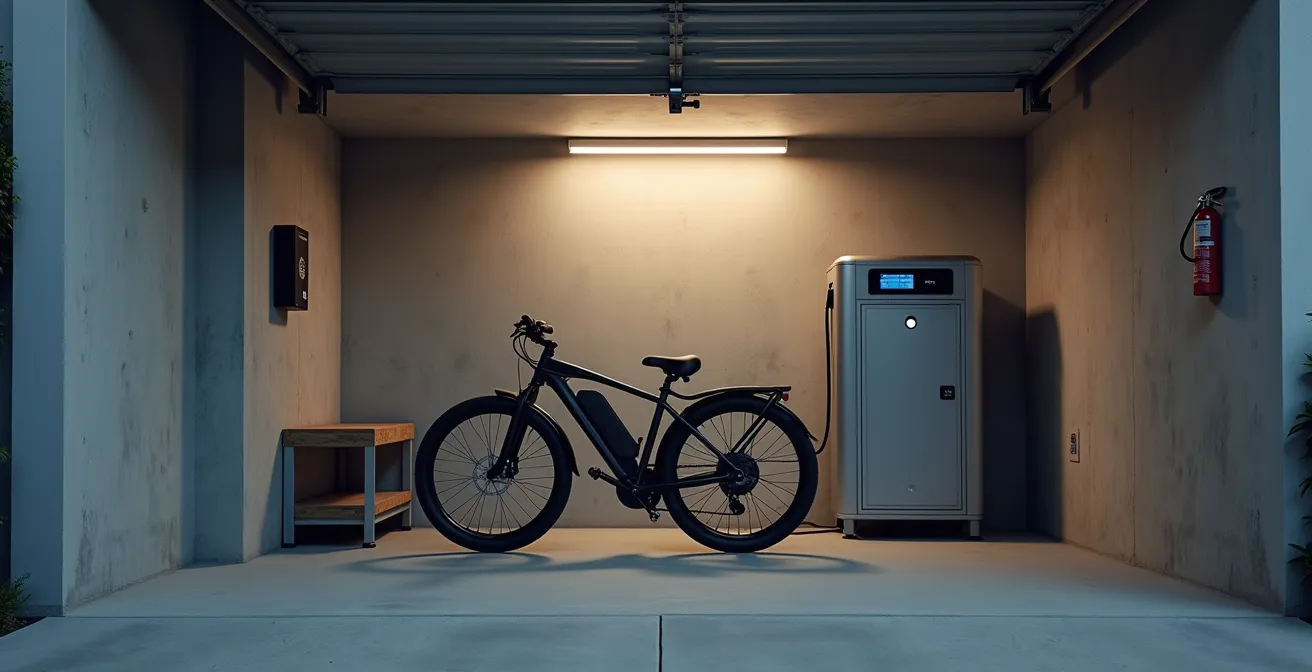
- A dedicated, fire-safe charging station is your single most effective defense, physically containing a potential thermal event and preventing it from spreading.
Recommendation: Immediately audit your current setup. Replace any uncertified batteries and non-original chargers, and establish a designated charging area away from combustibles and escape routes.
The rise of e-bikes has brought incredible freedom and efficiency to personal mobility. Yet, this revolution is shadowed by alarming news reports of catastrophic battery fires. For many owners, a sense of unease now accompanies every charge cycle. You’re told to “not overcharge” or “use the right charger,” but these fragments of advice feel inadequate against the backdrop of surveillance footage showing explosive thermal events. They address the “what” but completely ignore the “why,” leaving you feeling powerless.
The core issue is a misunderstanding of the technology. An e-bike battery isn’t a simple power brick; it’s a dense chemical energy storage system. Treating it as such requires a shift in perspective. The key to safety isn’t a list of rules to be blindly followed, but an engineering mindset focused on managing risk at every stage. It’s about understanding the physics of failure, from the microscopic level of a single battery cell to the macro environment of your garage.
This guide departs from simplistic advice. We will dissect the mechanisms of thermal runaway, expose the critical differences between quality-controlled cells and their dangerous generic counterparts, and provide systematic protocols for creating a robustly safe ecosystem for your e-bike. By understanding the principles of failure, you gain the power to prevent it. This is not about fear; it’s about control.
The following footage is a sobering, real-world reminder of the speed and intensity of a lithium-ion fire. It underscores why the engineering-based protocols detailed in this guide are not optional for any responsible e-bike owner.
To systematically address these risks, this guide is structured to build your understanding from the ground up. We will begin by identifying the primary source of danger, then move through creating safe environments, understanding component quality, and implementing correct handling procedures. This structured approach will equip you with a comprehensive safety framework.
Summary: A Systematic Approach to E-Bike Battery Safety
- Why Cheap Generic Batteries Are a Fire Hazard in Apartment Buildings?
- How to Set Up a Fire-Safe Charging Station in Your Garage?
- Samsung vs Generic Cells: Is the 30% Price Difference Worth It?
- The Error of Using a Dropped Battery That Could Be Internally Damaged
- When to Bring Your Battery Inside: Temperature Limits for Lithium-Ion?
- Why Only 5% of Lithium Batteries Are Currently Recycled?
- The Error of Using Cheap Fast Chargers on Standard Batteries
- Riding in the Rain: Protecting Sensitive Electronics from Moisture Damage
Why Cheap Generic Batteries Are a Fire Hazard in Apartment Buildings?
The single greatest risk factor in the e-bike battery crisis is the proliferation of cheap, generic, and counterfeit batteries. These units are the primary culprits in the majority of fire incidents, and their danger is magnified exponentially in multi-unit dwellings like apartment buildings. In New York City alone, there were 277 fires caused by lithium-ion batteries in 2024, with 6 fatalities, a direct consequence of these substandard products in a dense urban environment. The risk is compounded by user behavior; a study by UL Solutions revealed that a staggering 49% of riders charging at home block their fire exits, unaware of how quickly a thermal event can make escape impossible.
From an engineering perspective, these generic batteries are ticking time bombs because they omit critical, non-negotiable safety components. A quality battery cell from a reputable manufacturer like Samsung or Panasonic is built with multiple layers of protection. In contrast, a generic battery is a stripped-down, cost-cut version that prioritizes price over safety. They are fundamentally different products at a chemical and structural level.
Key safety features consistently missing in generic or counterfeit batteries include:
- Current Interrupt Devices (CIDs): A mechanical fuse inside the cell that permanently disables it if pressure builds up from overcharging or overheating.
- Positive Temperature Coefficient (PTC) switches: A material that dramatically increases resistance when it gets too hot, effectively choking off current flow to prevent a thermal event.
- Manufacturing Consistency: Premium cells have incredibly low and consistent internal resistance (IR), meaning they generate minimal waste heat. Generic cells have high, variable IR, causing hot spots that can initiate failure.
- Structural Integrity: Poor assembly, the use of recycled “B-grade” cells, and the absence of a robust Battery Management System (BMS) create a system prone to electrical imbalances and internal shorts.
In an apartment building, a single battery fire can block hallways, fill corridors with toxic smoke, and endanger dozens of residents. The combination of a fundamentally unsafe product and a high-density living environment creates a perfect storm for tragedy. This is why the first and most important safety protocol is to reject these batteries entirely.
How to Set Up a Fire-Safe Charging Station in Your Garage?
Assuming you are using a certified, high-quality battery, the next layer of defense is controlling the charging environment. Never charge a battery unattended in a living space. The garage is a suitable location, but only if you create a dedicated, purpose-built charging station. The principle here is defense-in-depth: creating multiple barriers to contain and mitigate a potential failure. Your goal is to create a “safety cell” where a thermal event, however unlikely with a good battery, can be contained without spreading to the rest of your home.
This station is not merely a designated outlet; it’s an engineered system. The foundation must be a non-combustible surface like a concrete floor or a sturdy metal shelf. All flammable materials—cardboard boxes, gasoline cans, cleaning supplies, wood—must be kept a minimum of three feet away, creating a clear zone. This space should be near the main garage door to allow for rapid ventilation and emergency access if an issue arises.
To move from a basic setup to a truly robust one, consider specialized containment solutions. While a modified metal ammo box with ventilation holes offers a baseline level of protection, engineered products provide significantly more safety. An analysis of available options shows a clear hierarchy of protection.
| Solution Type | Protection Level | Key Features | Cost Range |
|---|---|---|---|
| Metal Ammo Box (Modified) | Basic | Ventilation holes added, portable | $30-50 |
| Bat-Safe Charging Box | Intermediate | Fire-resistant materials, venting system | $150-300 |
| Genius BSK-1 Case | Advanced | Non-flammable housing, explosion protection, PyroBubbles® filling | $400-600 |
| Raclan System | Professional | Active extinguishing, smoke filtration, exhaust management | $1000+ |
Building a truly resilient station involves more than just physical containment. It requires monitoring and active safety measures. This checklist outlines the essential components for a comprehensive fire-safe charging setup.
Your Fire-Safe Charging Station Blueprint:
- Place charging station on a concrete floor or metal shelf, never on wood or cardboard.
- Install a heat alarm rated for garages, interconnecting it with home smoke alarms if possible.
- Use only one charging device per wall outlet; strictly avoid extension cords and power strips.
- Maintain a minimum three-foot clearance from all combustible materials around the charging area.
- Position the station near the garage door for optimal ventilation and emergency access.
Finally, install an ABC-rated fire extinguisher at the entry point between your garage and house. While you should never attempt to fight a lithium-ion fire yourself (evacuate and call 911), it can be crucial for clearing a safe escape path. Using a smart plug or timer to prevent continuous overnight charging adds another layer of automated safety.
Samsung vs Generic Cells: Is the 30% Price Difference Worth It?
The choice between a battery pack using premium cells (from manufacturers like Samsung, LG, or Panasonic) and one using generic, unbranded cells is the most critical safety decision an e-bike owner can make. While a generic battery might be 30% cheaper upfront, that saving comes at the cost of safety, performance, and longevity. From an engineering standpoint, the price difference is not just justified; it is an absolute necessity for safe operation.
The most immediate difference is in lifespan. Technical comparisons show that premium cells can reliably deliver 800-1000 full charge and discharge cycles while maintaining most of their capacity. Generic cells, by contrast, often degrade significantly after just 200-300 cycles. This means you would need to buy three or four generic batteries to match the lifespan of a single premium one, erasing any initial cost savings and multiplying your risk exposure with each replacement.
More importantly, this longevity is a direct indicator of superior internal chemistry and manufacturing precision. These factors are what prevent thermal runaway. The economic incentive for a factory to use cheaper cells is immense. According to industry analyses, the temptation is very strong for the supplier to substitute batteries from the local market, where costs can be 2-4 times lower. These substituted cells almost always lack the stringent quality control, material purity, and built-in safety features (like CIDs and PTCs) of their premium counterparts. This lack of precision leads to high internal resistance, which causes the cells to generate excessive heat during charging and discharging—the primary trigger for fires.
A high-quality Battery Management System (BMS) is essential for any pack, but its effectiveness is dictated by the cells it manages. A good BMS paired with premium cells creates a harmonious system that optimizes performance and safety. When that same BMS is paired with inconsistent generic cells, it struggles to balance them, leading to overcharging of some cells and over-discharging of others, dramatically increasing stress and fire risk. Therefore, the 30% “premium” is not for a brand name; it’s an investment in manufacturing consistency, material purity, and redundant safety systems that simply do not exist in the cheaper alternatives.
The Error of Using a Dropped Battery That Could Be Internally Damaged
One of the most insidious dangers with lithium-ion batteries is latent damage. A battery that has been dropped, even from a modest height, may show no external signs of damage but could be a catastrophic failure waiting to happen. The energy density that makes these batteries so powerful also makes them incredibly sensitive to physical shock. Using a dropped battery without a strict quarantine and inspection protocol is a gamble with severe consequences.
Inside a battery pack, dozens of individual cells are separated by ultra-thin polymer membranes. An impact can cause these separators to tear or fracture at a microscopic level. This creates an internal short-circuit. Initially, this short may be tiny, causing only a minute increase in self-discharge. However, with each charge cycle, a process called dendrite growth can occur, where metallic lithium structures “grow” across the breach, slowly but surely worsening the short. This process can take days or even weeks, but eventually, the short becomes large enough to allow a sudden, massive discharge of energy, initiating thermal runaway.
This is why the absence of visible cracks, swelling, or leaking after a drop is not a sign that the battery is safe. The real damage is often invisible. Any battery that has sustained an impact must be treated as compromised until proven otherwise. A mandatory quarantine and observation protocol is the only responsible course of action.
The following post-drop protocol should be executed immediately for any battery that has been dropped:
- Immediate Isolation: Place the battery in a fire-safe location outdoors on a non-combustible surface like concrete. It must remain there, away from any flammable materials, for a minimum of 24-48 hours.
- Observation: During the quarantine period, periodically and carefully check for any signs of swelling, deformation, leaking fluid, or heat generation. Do not touch it if it feels warm.
- Auditory Check: After the initial quarantine, gently shake the battery and listen for any rattling sounds, which could indicate loose internal components.
- Supervised Test Charge: If it passes all previous checks, perform a single, fully supervised test charge within your fire-safe charging station. Do not leave it unattended for a second.
- Monitor for Heat: During this test charge, constantly monitor the battery for any abnormal heat. A battery should get slightly warm during charging, but it should never become hot to the touch.
- Professional Disposal: If the battery shows any abnormality at any stage of this protocol—swelling, heat, noise, or charging errors—do not use it. It is compromised. Take it to a designated hazardous waste or battery recycling facility for professional disposal.
Ignoring a drop is a common but grave error. The potential for a delayed, catastrophic failure is too high to justify the risk. The integrity of the internal structure is paramount to safety.
When to Bring Your Battery Inside: Temperature Limits for Lithium-Ion?
A battery’s environment is as critical to its safety as its internal components. Lithium-ion chemistry is highly sensitive to temperature, and operating or charging a battery outside its designated safe temperature range can cause irreversible damage and significantly increase the risk of fire. Storing your e-bike in a cold garage or a hot shed is a common mistake with serious safety implications.
The most critical danger is charging at low temperatures. According to extensive research from institutions like Battery University, charging below 0°C (32°F) causes lithium plating on the anode. This is a process where the lithium ions, instead of intercalating smoothly into the anode’s structure, deposit on its surface as metallic lithium. This not only permanently reduces the battery’s capacity but also creates the risk of these metallic deposits growing into dendrites, which can puncture the separator and cause an internal short—the direct precursor to thermal runaway. The battery will appear to charge normally, but you are silently and invisibly damaging it.
Conversely, high temperatures accelerate the degradation of all components within the battery. Heat increases internal resistance, causing the battery to work harder and generate even more heat, creating a dangerous feedback loop. Storing or charging a battery above 45°C (113°F) can trigger exothermic reactions within the cells, breaking down the electrolyte and compromising the entire system’s stability.
Because of these chemical realities, you must manage your battery’s temperature actively. It should not be treated as a passive component left on the bike. The following table breaks down the operational temperature ranges and the risks associated with exceeding them.
| Operation Type | Safe Temperature Range | Risk if Exceeded | Required Action |
|---|---|---|---|
| Charging | 0°C to 45°C (32°F to 113°F) | Lithium plating below 0°C, thermal runaway above 45°C | Wait for acclimatization before charging |
| Discharging | -20°C to 60°C (-4°F to 140°F) | Reduced capacity, increased internal resistance | Limit discharge rate in extreme temps |
| Storage | -20°C to 25°C (-4°F to 77°F) | Accelerated aging, electrolyte degradation | Store at 30-50% charge in cool, dry place |
The practical takeaway is simple: if your garage or storage area is below freezing or hotter than a warm room, you must bring the battery inside to a temperature-stable environment. Allow it to acclimate to room temperature for at least an hour before charging. This single habit prevents the invisible damage of lithium plating and is one of the most effective safety protocols you can adopt.
Why Only 5% of Lithium Batteries Are Currently Recycled?
The challenge of e-bike battery safety extends to the end of the product’s life. The fact that a vanishingly small percentage of lithium-ion batteries are recycled creates a significant downstream risk. When old, damaged, or degraded batteries have no clear, accessible, and affordable disposal path, they often end up stored indefinitely in garages, sold on second-hand markets, or improperly discarded, creating a distributed and untracked fire hazard.
The primary reason for the low recycling rate is economics. The complex hydrometallurgical and pyrometallurgical processes required to safely disassemble a battery and recover valuable materials like lithium, cobalt, and nickel are, at present, often more expensive than mining virgin materials. This lack of economic incentive has stifled the development of a comprehensive recycling infrastructure. The problem is exacerbated by the fact that most battery packs are not designed for disassembly, making the process labor-intensive and dangerous.
This creates a dangerous bottleneck. Even professionals are not immune to the risks. According to data highlighted by Consumer Reports, as many as 10% of bike shops report thermal runaway incidents in their stores, often involving batteries that customers have brought in for disposal or service. If experts who handle these devices daily are facing these risks, the danger for an average consumer storing a collection of old batteries is even greater. The lack of a circular economy for batteries means that millions of potentially hazardous devices are sitting in a state of limbo, their internal chemistry slowly degrading over time.
As a responsible owner, this means you must be proactive about end-of-life management. Do not let old batteries accumulate. Seek out your local municipality’s hazardous waste disposal programs or retailers like Call2Recycle that offer take-back services. Paying a potential fee for disposal is part of the total cost of ownership and a critical safety investment. The alternative—an aging, chemically unstable battery in your home—is an unacceptable risk.
The Error of Using Cheap Fast Chargers on Standard Batteries
The battery and the charger are two halves of a single system. Using a high-quality, certified battery with a cheap, third-party “fast” charger is like putting discount fuel in a high-performance engine; it compromises the entire system and invites catastrophic failure. This error stems from a misunderstanding of a key engineering concept: the C-rate.
The C-rate defines the speed at which a battery is charged or discharged relative to its total capacity. A standard e-bike battery is typically designed to be charged at a rate of 0.5C. This means a 14-amp-hour (Ah) battery is designed to be safely charged with a 7-amp charger. A charger marketed as “fast” might attempt to force 14 or even 28 amps into that same battery (a 1C or 2C rate). While this will charge the battery faster, the cell’s internal chemistry cannot safely absorb energy at that speed. The excess energy is converted directly into waste heat, which, as we’ve established, is the number one enemy of battery stability and the primary catalyst for thermal runaway.
Furthermore, a certified charger from the original manufacturer is more than just a power supply. It contains intelligent circuitry designed to communicate with the battery’s BMS. This “handshake” allows the charger to monitor the battery’s voltage, temperature, and state of charge, tapering the current as it fills and cutting off completely when it reaches 100%. A cheap charger lacks this intelligence. It often functions as a “dumb” power hose, continuously forcing current even after the battery is full, leading to overcharging, overheating, and eventual failure.
A substandard charger often provides clear sensory warnings that it is stressing your battery. Recognizing these signs is crucial for preventing a fire.
- Excessive Heat: The charger itself or the battery becomes very hot to the touch, not just warm.
- Audible Noise: A high-pitched buzzing or whining sound from the charger is a sign of cheap electronic components operating under strain.
- Sparking or Hot Connectors: Poorly-fitting connectors that spark when plugged in or heat up during use are a major red flag for a fire hazard.
- Failure to Cut-Off: The charger does not automatically shut off or its indicator light does not change when the battery is fully charged.
Using the charger provided by the e-bike manufacturer is a non-negotiable safety rule. It has been specifically designed and certified to work in harmony with your battery’s specific chemistry and BMS.
Key Takeaways
- Cell Quality Is Non-Negotiable: The foundation of safety is a battery pack built with premium, certified cells that have integrated mechanical and electrical protections.
- The Charging Environment Is Your First Line of Defense: A dedicated, fire-safe charging station contains risk and prevents a battery failure from becoming a house fire.
- System Integrity Is Paramount: The battery, charger, environment, and user handling are an interconnected system. A weakness in one area compromises the safety of the whole.
Riding in the Rain: Protecting Sensitive Electronics from Moisture Damage
The final element of the safety system is protecting the battery from environmental hazards during use, with moisture being a primary concern. While many e-bikes are marketed as “water-resistant,” this term can be misleading. Water ingress into the battery casing or, more critically, the charging port and connectors, can lead to short circuits, corrosion, and long-term damage that compromises the battery’s integrity.
A bike’s resistance to water is defined by its Ingress Protection (IP) rating. This is a standardized system that classifies the degree of protection provided against intrusion from foreign objects and moisture. Most e-bikes carry a rating of IPX4 or IPX5. An IPX4 rating means the system is protected against splashing water from any direction, making it suitable for light rain on paved surfaces. An IPX5 rating protects against low-pressure water jets, meaning it can handle heavy rain. However, neither of these ratings means the bike is waterproof. They cannot handle being submerged, such as when riding through deep puddles, or being cleaned with a high-pressure washer.
Moisture can cause immediate short circuits if it bridges the high-voltage contacts in the battery connector. More insidiously, it can lead to gradual corrosion of the delicate pins and electronics within the connector and BMS. This corrosion increases electrical resistance, which in turn generates heat during charging and discharging. Over time, this corrosion-induced heat can be sufficient to damage the battery or even initiate a thermal event. Therefore, a strict post-ride protocol after any wet ride is a critical safety habit.
If you are caught in the rain or ride through wet conditions, implement the following dry-out protocol before storing or charging your battery:
- Towel Dry: Immediately and thoroughly dry the exterior of the battery casing, paying close attention to the seams and connector ports.
- Remove and Air-Dry: If your battery is removable, take it off the bike and bring it inside to a warm, dry, low-humidity environment to air-dry for several hours.
- Inspect Ports: Carefully inspect the charging port on both the battery and the bike for any visible moisture. Use a can of compressed air (from a safe distance) to gently blow out any water droplets. Never insert a metal object into the port.
- Mandatory Waiting Period: Wait a minimum of 2-3 hours after any potential water exposure before you attempt to charge the battery. This allows any hidden moisture to evaporate.
- Future Protection: Once fully dry, apply a small amount of dielectric grease to the connector terminals. This non-conductive grease helps seal out moisture and prevent future corrosion.
Treating your e-bike’s electronics with the same care as any other sensitive device is crucial. Proactive protection against moisture is a simple but effective way to ensure the long-term safety and reliability of your battery system.
Frequently Asked Questions on E-Bike Battery Safety
Why do Samsung cells charge faster than generic alternatives?
Samsung lithium-ion cells typically support faster charging than LG. This makes them convenient for riders needing quick top-ups during daily use or high-intensity commuting.
What is Internal Resistance (IR) and why does it matter?
High-quality cells have very low and consistent IR, meaning they generate less waste heat when charging and discharging. Generic cells have high, variable IR, which is a direct indicator of inefficiency and higher fire risk.
How does the BMS interact differently with premium vs generic cells?
A high-quality Battery Management System (BMS) is crucial regardless of Samsung or LG cells because it safeguards against overcharging, overheating, and deep discharge, optimizing cell health and safety. The BMS also governs charging speed, thermal management, and power delivery, directly influencing battery lifespan and rider experience. Different e-bike manufacturers implement diverse BMS solutions, affecting the practical use of both Samsung and LG battery packs.
What is C-rate and why does it matter?
C-rate is the rate of charge relative to battery capacity. A standard battery designed for 0.5C charge receives stress and heat damage when a ‘fast charger’ forces 1C or 2C rates.
Can I use any charger with the same voltage?
A manufacturer must obtain certification that states that the lithium-ion battery can be charged below 32°F without causing lithium plating issues. A smart charger must also be designed that will monitor the battery’s current charge and keep the voltage as well as current at a safe limit.
Should I always use fast charging?
No. Lower charge rates (0.5C or less) significantly extend battery life and reduce fire risk, even if charging takes longer.