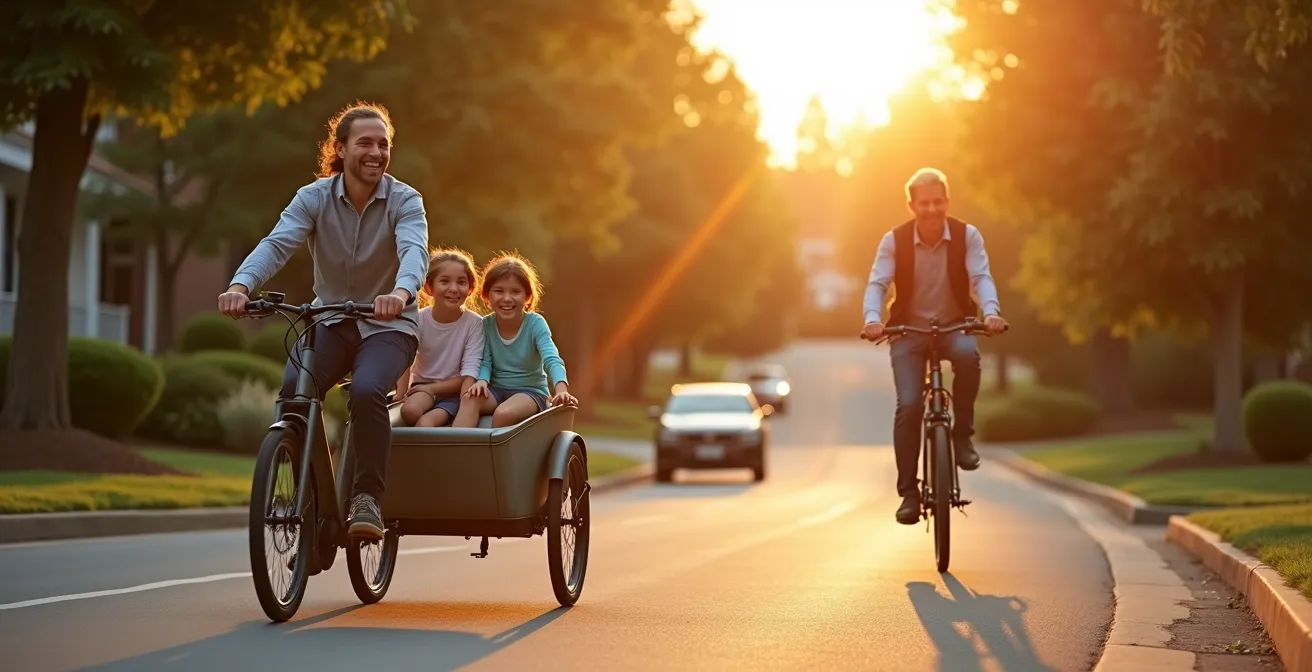
Successfully replacing a second car with an e-bike is less about the bike and more about building a robust logistical system around it.
- Modern cargo e-bikes can handle weekly groceries and multiple kids, rivaling a car’s utility for most local trips.
- Creating dedicated routines for charging, gear, and route planning eliminates daily friction and makes riding the default choice, not the exception.
Recommendation: Start by analyzing your family’s weekly travel patterns to identify which car trips are most easily replaceable, then build your e-bike system around solving those first.
The familiar rhythm of suburban life often sounds like a car engine. The morning school run, the mid-day dash for groceries, the after-school shuttle to soccer practice—it all adds up to a seemingly unbreakable dependence on the family minivan or SUV. The idea of swapping one of those cars for an electric bike can sound like a pleasant but ultimately fanciful dream. We hear about the “e-bike smile,” the environmental benefits, and the joys of fresh air, but for a busy parent juggling schedules and a mountain of responsibilities, these feel like luxuries, not practical solutions.
The conversation often stalls on the perceived trade-offs: what about rain? How could I possibly carry a week’s worth of groceries? Isn’t it just faster to take the car? These are valid questions, but they start from the wrong premise. They treat the e-bike as a simple, one-for-one substitute for a car, expecting it to fit perfectly into a car-centric lifestyle. This is the fundamental misunderstanding that dooms most attempts before they even begin.
But what if the key isn’t finding the perfect bike, but building a new, smarter logistical system for your family? This isn’t about giving up convenience; it’s about redefining it. It’s about creating a workflow for your daily life where the e-bike becomes the most logical, efficient, and even joyful tool for the job. It’s a shift from a weekend toy to a daily workhorse.
This guide will walk you through the practical, real-world systems needed to make that transition. We will move beyond the theoretical benefits and dive into the nitty-gritty of cargo management, all-weather riding, charging routines, and financial calculations. We’ll explore how to build a framework that makes the e-bike not just a possibility, but the preferred choice for your family’s daily transportation needs.
Summary: A Suburban Parent’s Roadmap to E-Bike Logistics
- Why the “E-Bike Smile” Reduces Work Stress Levels by 30%?
- How to Carry a Week of Groceries on Two Wheels Without Breaking Eggs?
- Door-to-Door Speed: Why E-Bikes Beat Traffic in Rush Hour Zones?
- The Error of Waiting for Perfect Weather That Kills Your Riding Habit
- Creating a Seamless Charging Routine: Where to Plug In at Work and Home?
- Why E-Bikes Allow Grandparents to Keep Up with Teenagers?
- When to Go “Car-Lite”: Keeping One Car vs Two for a Family of Four?
- Backpack vs Panniers: Which Carry Method Protects Your Laptop and Posture?
Why the “E-Bike Smile” Reduces Work Stress Levels by 30%?
The “e-bike smile” is a well-known phenomenon, but it’s more than just a fleeting moment of joy. For suburban parents, it represents a fundamental shift in the daily commute, turning a source of stress into a moment of release. Sitting in stop-and-go traffic, worrying about being late for school pickup, and fighting for parking spots all contribute to a low-grade, chronic stress that defines the start and end of many workdays. The e-bike commute actively dismantles this stress by replacing passive frustration with active engagement and predictable travel times.
Instead of the sealed-off environment of a car, the e-bike provides mild physical activity and sensory input—the feeling of the wind, the sounds of the neighborhood—that have a proven calming effect. It’s a form of built-in mindfulness. This isn’t just a feel-good theory; the positive impact is tangible and extends beyond dense urban centers. Consider the experience of a family in rural Pennsylvania, who turned their daily 18-mile school run over hilly country roads into an adventure their kids nicknamed the “Party Bus.” What was once a routine chore became a source of family connection and enjoyment.
This experience is echoed by commuters who find their e-bike journey more relaxing than being behind a wheel. According to one daily e-bike commuter in San Francisco, the experience is not only less stressful but often faster than cars, even high-end Teslas, stuck in the same traffic. The electric assist removes the physical strain, so you arrive at work or home feeling refreshed and clear-headed, not drained and agitated. This transformation of the commute from a battle to a break is a primary driver in successfully replacing a car.
How to Carry a Week of Groceries on Two Wheels Without Breaking Eggs?
The weekly grocery haul is often seen as the ultimate test for any car-replacement strategy. The image of juggling flimsy plastic bags on handlebars is enough to dismiss the idea entirely. However, this concern comes from thinking about a standard bicycle, not a purpose-built cargo e-bike. Modern cargo e-bikes are the minivans of the two-wheeled world, engineered specifically for heavy lifting. Mastering the art of “Cargo Tetris” is the key to making grocery runs efficient and even enjoyable.
The secret lies in the specialized equipment. Longtail cargo bikes or “box bikes” offer a combination of rear racks, front baskets, and panniers that create a stable and high-capacity logistical platform. For example, some high-end models like the Urban Arrow FamilyNext Pro can carry up to 550 lbs, with a massive front box that can easily swallow a week’s worth of groceries, sports gear for two kids, and a picnic basket simultaneously. The strategy is to distribute the weight logically: heavy, durable items like drinks and canned goods at the bottom, and fragile items like eggs and bread on top or in a separate front basket.
Beyond just capacity, the e-bike offers a unique advantage at the destination. Instead of circling the parking lot looking for a spot, you can often roll right up to the entrance of the farmers market or grocery store. This front-row “parking” eliminates the long walk back to the car, laden with bags. With large, reusable bags and a well-designed cargo system, you can navigate busy crowds and load your bike with a speed and ease that car-bound shoppers can only envy. The entire process becomes a streamlined, door-to-door operation.
Door-to-Door Speed: Why E-Bikes Beat Traffic in Rush Hour Zones?
When considering a switch to an e-bike, parents often worry about adding time to their already packed schedules. It’s a logical concern, but it’s based on a flawed measurement: comparing a car’s top speed on an open road to a bike’s. The reality of suburban travel, however, is not the open road; it’s a series of choke points, traffic lights, and parking lot jungles. The e-bike’s advantage lies in what we can call “time arbitrage”—winning back the minutes and seconds lost to car-based friction.
In congested areas, the e-bike excels. While cars are lined up at a standstill, an e-bike can often utilize bike lanes or safe shoulders to maintain a steady pace. This ability to bypass jams can have a dramatic effect on commute times. In many urban and suburban settings, it’s not uncommon for this to turn a 20-minute car ride into a 10-minute bike ride during peak hours. The electric assist ensures you can maintain a consistent speed of 15-20 mph without breaking a sweat, making your travel time highly predictable.
The time savings extend beyond just the ride itself. Consider the “last mile” problem at both ends of the trip. A car journey includes time spent finding parking, walking from the far end of the lot, and then repeating the process at your destination. An e-bike eliminates this entirely. You can park it right by the door of the school, the office, or the store. Over a year, one commuter reported that their e-bike replaced about 15% of their annual car mileage, demonstrating a significant shift in travel habits. This door-to-door efficiency is what makes the e-bike a surprisingly fast and reliable tool for a busy parent’s daily logistics.
The Error of Waiting for Perfect Weather That Kills Your Riding Habit
One of the most common reasons for an e-bike to gather dust in the garage is what can be called the “perfect weather fallacy.” Many aspiring riders wait for a sunny, 70-degree day with no wind, a condition that rarely aligns with a Tuesday morning school run in October. A successful transition to a car-lite lifestyle requires shifting from a weather-dependent mindset to a gear-and-preparation mindset. The question isn’t “Is the weather good enough to ride?” but rather “Do I have the right gear for today’s weather?”
Modern e-bikes and cycling apparel are designed to handle a wide range of conditions. High-quality waterproof panniers keep your laptop and groceries dry, while fenders prevent road spray from soaking your clothes. For the rider, a good waterproof jacket, pants, and shoe covers can make a rainy day ride surprisingly comfortable and dry. The electric motor is a key ally here, as it reduces the physical effort, meaning you generate less body heat and sweat, which helps you stay warmer and drier under your rain gear. Furthermore, many modern e-bikes are specifically designed to withstand high-pressure water splashes, so you don’t have to worry about damaging the electronics in a downpour.
Adopting this mindset transforms the e-bike from a fair-weather toy into a reliable, year-round vehicle. It creates resilience in your transportation system. As one dedicated e-bike commuter puts it, the shift becomes so complete that the car becomes the secondary vehicle, not the other way around.
I make sure to drive my car once weekly to keep the tires ok, but other than that, my e-bike has pretty much replaced my car.
– E-bike commuter, CalBike #ebikestories
This level of commitment doesn’t come from lucking into perfect weather; it comes from investing in the right equipment and making the conscious decision that riding is the default, not the exception.
Creating a Seamless Charging Routine: Where to Plug In at Work and Home?
Just like your smartphone, an e-bike’s usefulness depends on its battery being charged and ready when you need it. The fear of running out of power mid-errand is a significant barrier for many parents considering the switch. The solution is not to obsess over battery range, but to build a frictionless charging routine that makes keeping the bike powered an automatic, thought-free process. This turns your garage or entryway into a home “logistical hub.”
The beauty of modern e-bikes is the flexibility of their charging systems. Most batteries are easily removable, meaning you don’t have to park the entire bike next to an outlet. You can park the bike in the garage, unlock the battery with a key, and carry it inside to charge overnight in the kitchen or office. This convenience is key. The goal is to establish a habit: ride ends, battery goes on the charger. This simple rule ensures you start every day with a full charge, which for most batteries provides a reliable range of 25-45 miles, more than enough for typical suburban errands.
This routine is not only easy but also incredibly cost-effective. Powering an e-bike is drastically cheaper than fueling a car. Data from the California Bicycle Coalition shows that a full e-bike recharge can cost less than $0.10 for 30 miles of travel. For parents commuting, a simple setup at work—a second charger kept under the desk—can eliminate range anxiety for longer trips. By integrating charging into your daily home and work life, the e-bike is always ready to go, making it as reliable and grab-and-go as a car.
Action Plan: Your E-Bike Charging Best Practices
- Establish a Charging Zone: Designate a specific, convenient spot in your home (e.g., near the door, in the garage) with easy outlet access to create a consistent charging habit.
- Charge After Every Major Ride: Don’t wait for the battery to be empty. Topping it off after your daily commute or school run ensures it’s always ready for an unexpected trip.
- Know Your Commute’s Needs: If your round-trip commute uses more than 50% of your battery, consider getting a second charger to leave at your workplace for a mid-day top-up.
- Charge the Battery Off-Bike: Get in the habit of removing the battery to charge it indoors. This protects it from extreme temperatures in the garage and makes charging more convenient.
- Check Your Charge Before You Leave: Just as you’d glance at a car’s fuel gauge, make it a 5-second habit to check the battery’s charge level on its display before heading out.
Why E-Bikes Allow Grandparents to Keep Up with Teenagers?
One of the most surprising benefits of integrating an e-bike into family life is its ability to bridge generational gaps. A common family scene involves active kids or teenagers setting a pace on bikes that parents or grandparents struggle to match. This can lead to shorter family outings or separate activities. The e-bike acts as a great equalizer, empowering every member of the family to ride together, regardless of their individual fitness levels.
The electric assist is the magic ingredient. For a grandparent, it means being able to easily join for the school pickup or a weekend ride on a bike trail without fear of being left behind or becoming exhausted. The motor flattens hills and neutralizes headwinds, allowing them to keep pace with the most energetic teenager. This isn’t just about a single ride; it’s about fostering more frequent, shared experiences and creating lasting memories. It turns transportation into quality time.
This multi-generational sharing is made possible by the thoughtful design of many modern cargo e-bikes. For instance, the Tern GSD features a “one-size-fits-most” frame with quick-release adjustments for the seat and handlebars. This design allows the same bike to be comfortably ridden by family members ranging from 5 feet to 6 feet 6 inches tall. A grandparent can use the bike for a morning errand, a parent can use it for the school run, and a teenager can use it to get to a friend’s house, all with just a few seconds of adjustment. This shared utility maximizes the value of the investment, making it a true family vehicle, and the financial benefits of replacing just 10 miles of daily driving can save over $580+ per year, further justifying the purchase.
Key takeaways
- An e-bike shift is a lifestyle system change, not just a vehicle swap; success depends on building new routines for cargo, weather, and charging.
- Modern cargo e-bikes have the capacity, power, and features to realistically handle the majority of suburban family tasks, from grocery hauls to school runs.
- The financial savings and mental health benefits (less stress, more family time) are substantial and compound over time, making the initial investment highly valuable.
When to Go “Car-Lite”: Keeping One Car vs Two for a Family of Four?
For most suburban families, going completely car-free is a daunting leap. A more realistic and achievable goal is to become “car-lite”—transitioning from a two-car household to a one-car, one-e-bike household. This approach provides the flexibility of having a car for long trips, extreme weather, or large-scale errands, while using the e-bike for the vast majority of local travel. The primary driver for this decision is often financial, and the numbers are compelling.
The true cost of owning a second car goes far beyond the monthly payment. It includes insurance, fuel, maintenance, taxes, and depreciation. When you add it all up, a seemingly affordable second car can easily cost thousands of dollars per year just to sit in the driveway. An e-cargo bike, by contrast, has minimal running costs. It requires no insurance, pennies for electricity, and far less maintenance. As one parent who made the switch noted, the math is simple and powerful:
I still don’t own a car. The average car payment is $572/month and I honestly cannot imagine fitting that into our household budget.
– Car-free parent, CalBike E-bike Stories
To make an informed decision, it’s helpful to see a direct comparison of the annual costs. The following table breaks down the typical expenses associated with a second car versus a quality e-cargo bike, based on a recent analysis of family vehicle expenses.
| Cost Factor | Second Car | E-Cargo Bike |
|---|---|---|
| Initial Purchase | $15,000-30,000 | $2,000-5,000 |
| Annual Insurance | $1,200-2,000 | $0 |
| Annual Fuel/Electric | $1,500-2,500 | $20-40 |
| Annual Maintenance | $500-1,000 | $100-200 |
| Parking Fees | $300-1,200 | $0 |
The savings are dramatic. Even after the initial purchase, the e-bike costs a fraction of what a second car does annually. For a family of four, this money can be redirected to savings, vacations, or other priorities, all while reducing traffic and environmental impact.
Backpack vs Panniers: Which Carry Method Protects Your Laptop and Posture?
For the parent who is also a commuting professional, the question of how to carry work essentials is critical. Arriving at the office with a sweaty back from a heavy backpack is unprofessional and uncomfortable. This is where moving from a backpack to a pannier or rack-based system is not just a convenience, but a crucial part of making the e-bike a viable work vehicle. It’s about protecting your posture, your laptop, and your professional appearance.
A backpack places the entire load on your shoulders and back, leading to poor posture, strain, and that dreaded sweaty-back syndrome. Panniers, which are bags that clip directly onto a cargo rack on the side of the bike, transfer the weight from your body to the bike’s frame. This has two immediate benefits: it drastically improves your comfort and it lowers the bike’s center of gravity, making it more stable and easier to handle. Dedicated laptop panniers come with padded sleeves and waterproof materials to ensure your expensive electronics are safe from bumps and rain.
The cargo capacity of a rack-and-pannier system is far superior to a backpack. Many e-bike rear racks are rated to hold 90 pounds or more, while a front rack can add another 55 pounds of capacity. A pair of utility panniers can offer 30 liters of space or more, enough for a laptop, a change of clothes, lunch, and documents. This modular system allows you to separate work items from personal gear or groceries. And for ultimate versatility, some longtail cargo bikes are so robust that properly certified models can host up to a 200kg total load, including passengers. This level of utility solidifies the e-bike’s role as a true car replacement.
To begin your family’s transition to a car-lite lifestyle, the next logical step is to map out your weekly trips and identify the first, easiest car journey to replace with two wheels. Starting small builds confidence and allows you to refine your logistical system one trip at a time.