In summary:
- Riding too close to parked cars is the most common rookie mistake; the “door zone” is your biggest threat.
- Assume you are invisible to large vehicles like buses and trucks, and position yourself to be seen, not to be fast.
- Counter-intuitively, busier main roads with bike lanes are often safer than “quiet” side streets with frequent, unpredictable intersections.
- Mastering lane control and using assertive eye contact is more effective for claiming your space than just using hand signals.
You feel it, don’t you? The rumble of a bus behind you, the blur of steel boxes hedging you in. That feeling of being a soft-shelled creature in a world of metal beasts. You’ve been told the basics: wear a helmet, use your lights, follow the signs. That’s the stuff they teach in school. It’s not enough. That advice won’t help you when a driver, scrolling through their phone, decides to make a right turn directly through you. This isn’t a park; this is the urban jungle.
The real rules of the road aren’t written on signs. They’re written in tire marks, near misses, and the hard-won instincts of those who ride these streets for a living. Forget being polite and staying out of the way. Survival in the city is an active, aggressive, and mental game. It’s about reading the road, predicting chaos before it happens, and making drivers see you not as an obstacle, but as a fellow vehicle with an equal right to be there. It’s about transforming from a vulnerable cyclist into a confident, defensive rider who owns their space. This guide isn’t about the law; it’s about the laws of survival.
To navigate the urban environment safely, you need to understand the specific threats and how to counter them. This article breaks down the essential tactics for everything from handling parked cars and blind spots to managing your speed and communicating effectively with drivers.
Summary: Surviving Rush Hour: Defensive Riding Tactics for New Urban Cyclists
- Why Riding Too Close to Parked Cars Is the #1 Rookie Injury Cause?
- How to Stay Visible in a Bus Driver’s Blind Spot at Intersections?
- Direct Roads vs Quiet Side Streets: Which Is Safer for E-Bikes?
- The “Right Hook” Error: How to Predict When a Car Will Cut You Off?
- When to Use Hand Signals vs Eye Contact to Claim Your Lane?
- Sidewalk or Street: Where Should a 20mph E-Bike Be in a Neighborhood?
- How High-Mounted Lights Improve Driver Reaction Time by 2 Seconds?
- Speed Limits and Courtesy: How to Ride E-Bikes in Suburbs Without Angering Neighbors?
Why Riding Too Close to Parked Cars Is the #1 Rookie Injury Cause?
The single most dangerous place on a city street isn’t the middle of a four-way intersection; it’s the three-foot-wide strip next to a line of parked cars. We call this the “door zone.” Rookies love it because it feels “safe” and out of the way of traffic. That’s a fatal illusion. A driver can open their door into your path in a fraction of a second, leaving you with zero time to react. You either hit the door and go flying, or you swerve into moving traffic to avoid it. There are no good outcomes here. This isn’t a rare occurrence; it’s a constant, imminent threat on any urban ride.
Your first mental adjustment as an urban rider is to see that entire lane of parked cars not as a wall, but as a series of spring-loaded traps. You must ride far enough out into the lane that a fully opened car door cannot reach you. This might feel scary at first, as cars will have to slow down and move around you. Good. That’s the point. You are forcing them to acknowledge your presence. You are taking control. The danger of an unexpected door is far greater and more unpredictable than the danger of a car that can see you from a hundred yards away. Staying out of the door zone is the first and most important rule of urban cycling survival.
Here are the non-negotiable rules for navigating parked cars:
- Always maintain at least a car-door’s width of distance when passing parked vehicles.
- Scan through car windows for occupants before you pass. Look for silhouettes, interior lights, or movement.
- Position yourself in the lane where you have room to maneuver if a door suddenly opens.
- Anticipate doors opening without warning and adjust your speed to give yourself more reaction time.
How to Stay Visible in a Bus Driver’s Blind Spot at Intersections?
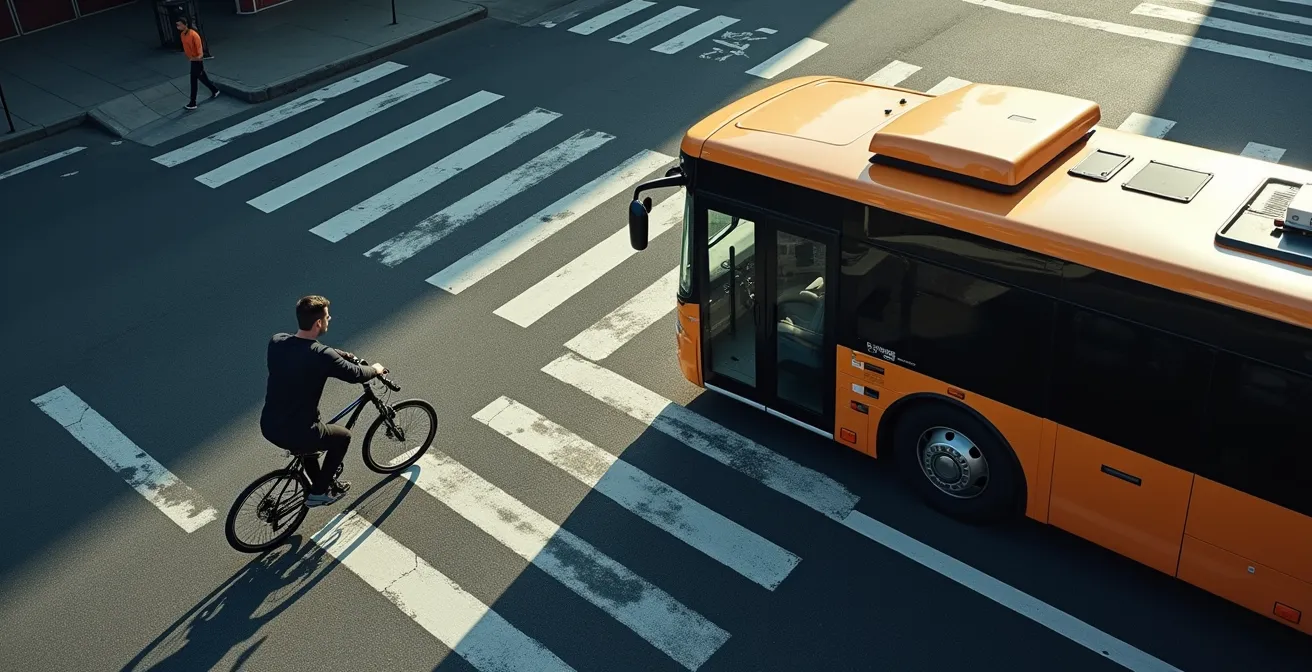
If the door zone is trap number one, the space alongside a large truck or bus is the invisibility cloak. When you ride next to one of these behemoths, you cease to exist. Their blind spots are vast, cavernous voids where a cyclist can disappear completely. The most dangerous time is at an intersection, especially if the bus is turning right. The driver is looking forward and left; they will not see you tucked up against their right side. They will turn, and you will be caught between the bus and the curb.
The rule is simple: never, ever ride alongside a large vehicle. Your job is to position yourself where the driver can make direct eye contact with you through their mirrors. This means either staying well behind them or, preferably, getting in front of them at a stop light. Pull up to the front of the intersection so you are clearly in their forward field of vision. You are not “cutting in line”; you are ensuring your own survival. As the Heidari Law Group points out in their safety tips, you must actively avoid riding in blind spots of buses or large vehicles.
This diagram shows the danger zones around a bus. Your only safe positions are clearly in front or far behind, never alongside.
By positioning yourself correctly, you remove all ambiguity. The driver sees you, you see them, and you can proceed through the intersection without becoming a statistic. Treat every large vehicle as a moving brick wall with zero peripheral vision.
Direct Roads vs Quiet Side Streets: Which Is Safer for E-Bikes?
Here’s a piece of advice that sounds wrong but is proven by the pavement: for an e-bike, the main arterial road is often safer than the “quiet” residential side street. Your intuition tells you to seek sanctuary on roads with less traffic, but this is a misunderstanding of how urban risk works. Main roads are predictable. Traffic flows in one direction, drivers are more alert, and there are often dedicated bike lanes. Your e-bike’s speed of 15-20 mph allows you to better match the flow of traffic, making you a more predictable part of the equation.
Side streets, on the other hand, are a chaotic mess of variables. Intersections are more frequent, often with stop signs that cars roll through. Drivers are less attentive, pulling out of driveways without looking, not expecting a vehicle moving at 20 mph. The speed differential between you and the slow-moving or parked cars creates surprise. A child could run out from between cars, a driver could swing their door open, or someone could back out of a hidden driveway. Main roads have fewer intersections and fewer surprises per mile. The danger you can see and predict is always less risky than the danger that springs on you from a quiet corner.
This comparative analysis from cycling safety advocates highlights the trade-offs, which often favor busier, more predictable routes for capable e-bike riders. As this urban cycling safety guide explains, visibility and predictability are key.
| Factor | Main Roads | Side Streets |
|---|---|---|
| Speed Matching | E-bike speed (15-20mph) better matches traffic flow | Speed differential creates unexpected situations |
| Visibility | Higher – predictable presence in traffic | Lower – unexpected fast cyclist surprises drivers |
| Intersection Frequency | Fewer intersections | Frequent intersections with stop signs |
| Driver Attention | Drivers expect cyclists | Drivers less attentive, not expecting traffic |
| Infrastructure | Often has bike lanes | Rarely has dedicated cycling infrastructure |
The “Right Hook” Error: How to Predict When a Car Will Cut You Off?
The “right hook” is one of the most common and dangerous crashes. It happens when a car passes you and then immediately makes a right turn, cutting directly across your path. They either misjudged your speed or, more likely, they simply didn’t register you as a vehicle they need to yield to. To survive, you can’t rely on them to do the right thing. You have to learn to predict the pivot before it happens by reading the car’s body language.
The key is to take the lane. By positioning yourself in the center of the lane well before an intersection, you make it impossible for a car to pass you and then turn. You are forcing them to get behind you and wait. This single act of claiming your lane is the most effective defense against the right hook.
By riding far enough left to require a lane change, the cyclist encourages drivers to wait and turn after the cyclist has cleared the intersection.
– CyclingSavvy, Road Cycling: Why Do You Ride Like That?
Beyond lane positioning, you need to watch for the tells. A driver planning a right hook will often give themselves away:
- The Left Drift: They drift slightly to the left to give themselves a wider turning radius for the right turn.
- The Wheel Angle: Watch their front tires. You can see them start to angle inward just before the turn begins.
- Sudden Deceleration: The car brakes for no apparent reason. They’re slowing to make the turn they haven’t signaled.
- The Head Turn: The driver glances over their right shoulder, but they’re looking for pedestrians, not you.
When to Use Hand Signals vs Eye Contact to Claim Your Lane?
A hand signal is a request. Eye contact is a confirmation. A hand signal without eye contact is just wishful thinking. In the urban jungle, you can’t assume your signal has been seen or understood. You must actively seek confirmation that the driver behind you has registered your intent. This is a crucial psychological distinction: you are not asking for permission; you are announcing your action and confirming they have received the message.
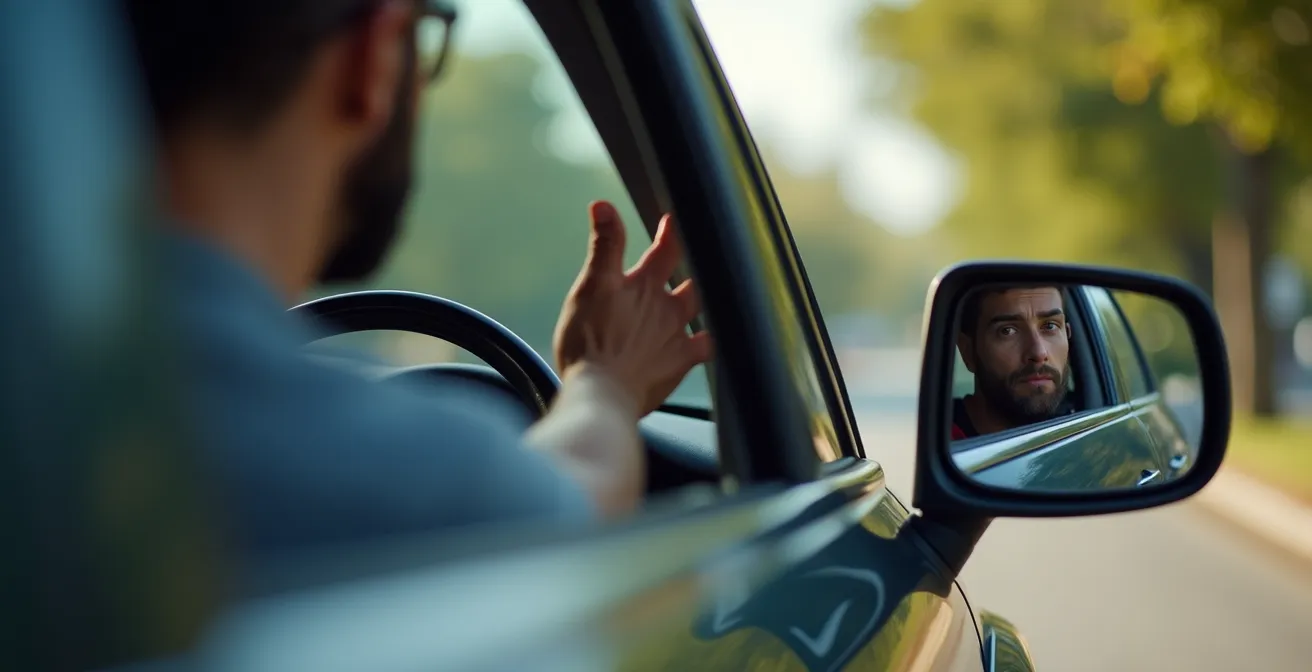
The process is a deliberate dance. Well before you need to change lanes, you check your shoulder, make your signal clear and decisive, and then you look for the driver’s face in their side mirror. You hold that signal until you lock eyes. This is the moment of truth. A simple nod, a flash of their lights, or even just the sustained eye contact is your confirmation. You have gone from being an anonymous cyclist to a human being who has made a direct connection. Now you can move.
This moment of humanization is your most powerful tool. It changes the dynamic from vehicle-vs-object to person-to-person, as this advice for defensive cycling suggests.
Once you’ve locked eyes, you’ve made a contract. You have asserted your presence and they have acknowledged it. Hand signals start the conversation; eye contact closes the deal. If you can’t get eye contact, assume you haven’t been seen and hold your position until it’s safe to move. Never trust a signal alone.
Sidewalk or Street: Where Should a 20mph E-Bike Be in a Neighborhood?
Let’s be clear: a 20mph e-bike does not belong on the sidewalk. Ever. Sidewalks are for pedestrians, dogs on long leashes, and children who make sudden, unpredictable movements. You, on a 40-pound machine moving at the speed of a running greyhound, are a missile in that environment. The speed difference is too great, and the potential for a catastrophic collision is too high. If your e-bike is moving faster than a jogger, it belongs on the street.
In a neighborhood setting, the street is your domain. However, this comes with responsibilities. Your goal is to be a predictable, non-threatening part of the traffic ecosystem. This means moderating your speed to fit the context. Just because your bike *can* do 20 mph doesn’t mean it *should* on a quiet residential street where kids are playing. Match your speed to the environment.
On narrower lanes, don’t hug the curb. That invites drivers to try and squeeze past you unsafely. Take the center of the lane. This is called “controlling the lane.” It clearly signals to drivers that there is not enough room to pass and they must wait behind you until the lane is wider. It is a defensive and assertive act that dramatically increases your safety. Here’s how to position yourself correctly:
- Stay on the street when your speed exceeds 10 mph.
- Use bike lanes when available, but don’t be afraid to move into the main lane to avoid obstacles.
- Slow down significantly when passing pedestrians on any shared-use path.
- Maintain a predictable, straight line of travel. Don’t weave in and out of parked cars.
- Take the center of narrow lanes to prevent unsafe passing maneuvers.
How High-Mounted Lights Improve Driver Reaction Time by 2 Seconds?
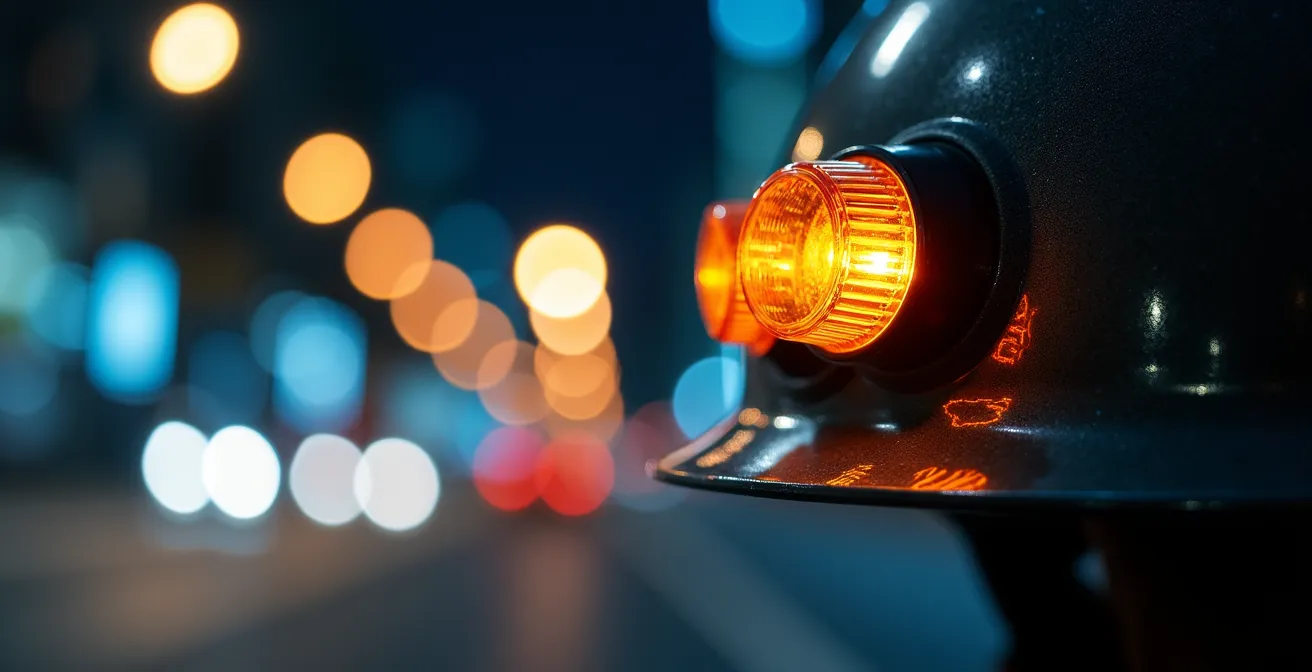
Having lights is basic. Having a smart lighting strategy is advanced. The standard setup is a white light on the front and a red light on the rear. But this only makes you a single, low-to-the-ground point of light. To truly cut through the visual noise of the city, you need to be more strategic. The key is adding a high-mounted light, ideally on your helmet. This creates a “triangle of light” that makes you appear larger, more three-dimensional, and more human.
A helmet-mounted light is a game-changer for two reasons. First, it’s at driver eye-level, making it far more likely to be noticed than a light mounted down by your axle. Second, it moves with your head. When you turn your head to scan an intersection, the light beam sweeps across the driver’s field of vision, an unmistakable signal of a living, aware person. This movement is what separates you from the static background of streetlights and shop signs. While hard data varies, the principle is sound: a more recognizable and dynamic light pattern gives drivers more time to identify you and react. As REI safety experts recommend, white front lights and red rear lights are crucial, and a multi-point strategy is even better.
The high-mounted light is the apex of your visibility pyramid, catching the driver’s eye and communicating your presence long before your other lights are noticed.
Think of it this way: your bike-mounted lights say “something is here.” Your helmet-mounted light says “a person is looking at you.” That’s a much more powerful message. And in the battle for attention on a busy street, you need every advantage you can get.
Key takeaways
- Defensive riding is a mental game of prediction, not just a physical act of pedaling.
- Claiming your lane is an act of safety, forcing drivers to acknowledge you and preventing dangerous maneuvers like the “right hook.”
- Your most powerful safety tools are non-physical: eye contact that confirms you’ve been seen, and strategic positioning that makes you impossible to ignore.
Speed Limits and Courtesy: How to Ride E-Bikes in Suburbs Without Angering Neighbors?
Out in the suburbs, the threats change. The immediate danger of rush-hour traffic is replaced by a social danger: becoming a neighborhood nuisance. An e-bike flying down a quiet cul-de-sac at 20 mph can feel intrusive and dangerous to residents. Every time you ride, you’re not just representing yourself; you are an ambassador for all cyclists. Riding like a jerk creates anger and resentment that can lead to complaints, stricter rules, and a general hostility towards anyone on two wheels.
Courtesy is your camouflage. It’s about blending in with the social fabric of the neighborhood. This means matching your speed to the context. A quiet street with kids playing is a 10 mph zone, tops. Use a friendly bell, not a shout, to announce your presence when approaching pedestrians from behind. A simple ring is a polite “excuse me,” and as Eartheasy notes, it’s often appreciated.
A simple bike bell is an important addition to your biking gear. Just a quick ring alerts pedestrians to your presence. You’ll even notice some people thanking you for the ring as you pass.
– Eartheasy, 6 Tips for Urban Biking Safety
Being a good E-Bike Ambassador means passing people with a wide berth, slowing to a crawl around dogs and children, and giving a friendly wave or nod. It’s about demonstrating that you are a responsible, aware, and considerate member of the community. Every positive interaction you create makes the road safer for the next cyclist who comes along.
Your E-Bike Ambassador Checklist
- Reduce speed to match the social context of quiet streets (under 15 mph).
- Use a friendly bell or verbal announcement (“on your left!”) early when approaching pedestrians.
- Pass with a wide berth around children and dogs, anticipating sudden movements.
- Slow to walking speed (5-7 mph) in areas where children are actively playing.
- Act as a positive representative for the cycling community with every ride.
Stop reading and start riding. The theory is done. Now it’s about pavement time. Get out there, claim your lane, read the road, and ride smart. The street is yours if you have the confidence to take it.