
Replacing short car trips with an e-bike isn’t just a minor improvement; it’s a mathematical lever that can cut your personal annual carbon footprint by over a ton.
- A car’s engine is disproportionately polluting on short trips before its catalytic converter warms up.
- E-bikes are over 10 times more energy-efficient than even electric cars, considering the entire energy chain.
- The “hidden” carbon cost of car infrastructure like parking lots significantly amplifies the emission savings of switching.
Recommendation: Analyze all your trips under five miles—they represent the single largest and most accessible target for massive personal emission reductions.
The daily dilemma is familiar for many suburban residents: the quick trip to the bakery, the post office run, the short drive to a friend’s house. The SUV or sedan, designed for highways, is often the default choice. We instinctively know it’s overkill, but the precise environmental cost remains abstract. Conventional wisdom suggests vague solutions like “driving less” or “combining errands,” but these tips fail to capture the staggering inefficiency of using a two-ton machine for a one-mile journey.
The problem lies in a fundamental misunderstanding of automotive pollution. We tend to think of emissions as linear—that a 10-mile trip pollutes ten times more than a 1-mile trip. This is a critical error. The reality is far more dramatic, rooted in the physics of a cold engine and the chemistry of its emission control systems. This is where most environmental arguments stop, failing to provide the concrete numbers needed for real change.
But what if we treated this not as a vague lifestyle choice, but as a quantifiable math problem? The true key to a massive reduction in your personal carbon footprint isn’t just about driving less, but about surgically replacing the *most inefficient* trips. This article will serve as your carbon calculator, breaking down the equation. We will demonstrate mathematically how a strategic modal shift from your car to an electric bike for these short, frequent journeys isn’t a small gesture—it’s the single most powerful action you can take to slash your annual emissions by a metric ton.
We’ll dissect the science behind cold start emissions, compare the true carbon cost of human power versus electricity, and even account for the hidden environmental debt of parking lots. By the end, the path to a one-ton reduction won’t be a mystery, but a clear, calculated strategy.
Summary: The 2-Ton Diet: A Mathematical Guide to Slashing Emissions
- Why the First Mile of a Car Trip Is the Most Polluting?
- Human Power vs Electricity: Is Eating More Food More Carbon Intensive?
- Delivery Vans vs E-Cargo Bikes: Who Wins the Last Mile Carbon War?
- The Error of Ignoring Parking Construction in Carbon Calculations
- When to Go “Car-Lite”: Keeping One Car vs Two for a Family of Four?
- Why Short Trips Are the Primary Cause of Car Engine Wear and Carbon Buildup?
- How to Replace Your Second Car With an E-Bike in 3 Months Without Regret?
- The $9,000 Question: Can an E-Bike Realistically Replace Your Car Lease?
Why the First Mile of a Car Trip Is the Most Polluting?
The first few minutes of any car journey are by far the most damaging to the environment. This isn’t an opinion; it’s a matter of engine chemistry. The primary culprit is the catalytic converter, the device in your exhaust system designed to convert toxic pollutants like nitrogen oxides (NOx) and carbon monoxide (CO) into less harmful gases. However, this device has a crucial limitation: it only works when it’s extremely hot.
For the chemical reactions to occur, most catalytic converters require a “light-off” temperature of around 400°C (750°F). When you start your car from cold, the exhaust gases are not nearly hot enough to activate the converter. For the first five to ten minutes of your drive—often the entire duration of a trip to the local store—your car is essentially operating without its most important emission control system. The result is a burst of raw, untreated pollutants being released directly into the atmosphere.
The scale of this “cold start” problem is staggering. As noted by the AA1Car Technical Library, while normal operating temperatures can reach 1,600°F, the converter is inert below 400°F. Research from institutions like Empa in Switzerland provides a shocking metric: a vehicle can emit more pollutants in the first five minutes after a cold start than during a continuous 1,000 km (over 600 miles) drive with a warm engine. This carbon-intensive inefficiency means that your short, seemingly harmless car trips are disproportionately responsible for your total vehicle emissions.
Every time you choose your car for a short errand, you are operating it in its least efficient, most polluting state. An e-bike, which has zero tailpipe emissions, completely bypasses this entire problem, making it an exponentially cleaner choice for these specific journeys.
Human Power vs Electricity: Is Eating More Food More Carbon Intensive?
A common counter-argument to cycling is that the extra food a rider consumes has its own carbon footprint. This is true, but the mathematics reveal a surprising conclusion: e-bikes are still vastly more efficient. When you compare the carbon cost of producing food calories to the carbon cost of generating electricity, the electric motor wins decisively. It’s a question of metabolic vs. mechanical efficiency.
A study on this topic found that the food-based emissions from a non-motorized bike are 16g CO2e per kilometer, as the human body is only about 25% efficient at converting food into power. In contrast, the emissions from an e-bike, accounting for both the electricity generation and the rider’s slightly increased food intake, are just 6.3g CO2e per kilometer. The electric assist doesn’t just make climbing hills easier; it makes the entire system more carbon-efficient by offloading the heavy work from the inefficient human “engine” to the highly efficient electric motor.
This paragraph introduces the complex idea of food’s carbon footprint. The illustration below helps visualize the varying carbon intensity of different food sources, from lentils to cheese, which is a key factor in these calculations.

As the visual suggests, not all calories are created equal in terms of carbon cost. However, even with a varied diet, the overall efficiency of an electric-assist system remains superior. The data becomes even more compelling when compared to cars. The following table puts these numbers in perspective, highlighting the enormous gap between human-scale transport and automotive transport.
| Transport Mode | CO2e per km |
|---|---|
| Walking | 56g |
| Regular bike | 21g |
| E-bike | 15g |
| Electric car | 128g |
| Conventional car | 271g |
The data is unequivocal. An e-bike is not only more efficient than a regular bike but is in a completely different league from any form of car, with emissions that are nearly 20 times lower than a conventional vehicle. The argument that “eating more” negates the benefit is a mathematical fallacy.
Delivery Vans vs E-Cargo Bikes: Who Wins the Last Mile Carbon War?
The battle for carbon efficiency isn’t just personal; it’s commercial. The “last mile” of delivery—the final step of getting a package from a local hub to your doorstep—is notoriously inefficient and carbon-intensive, often involving large vans making frequent stops on residential streets. This is another area where the mathematical superiority of the e-bike, specifically the e-cargo bike, becomes undeniable.
E-cargo bikes are purpose-built to replace delivery vans for urban and suburban routes. They navigate traffic more easily, require no parking, and completely eliminate cold start emissions. The numbers are decisive: overall, e-bikes produce 92% fewer emissions than conventional cars when comparing their life cycles. When applied to the logistics of last-mile delivery, this efficiency translates into massive collective carbon savings.
This isn’t just a theoretical benefit. Cities and companies are already proving the concept at scale. A study by Portland State University modeled the impact of a widespread modal shift to e-bikes. Their research concluded that if just 15% of urban car trips (many of which are for errands and deliveries) were replaced by e-bikes, overall carbon emissions in those areas would plummet by a remarkable 12%. This demonstrates that the individual choice to use an e-bike, when multiplied across a community, has a powerful network effect on regional air quality and carbon goals.
The success of e-cargo bikes in the commercial sphere provides a robust proof-of-concept for suburban families. If a business can efficiently deliver hundreds of pounds of goods using an e-cargo bike, a parent can certainly manage a week’s worth of groceries. It validates the e-bike as a serious utility vehicle, not just a recreational toy.
The Error of Ignoring Parking Construction in Carbon Calculations
A car’s carbon footprint doesn’t end at its tailpipe. A true accounting must include the vast ecosystem of infrastructure required to support it—most notably, parking. The creation and maintenance of parking spaces represent a significant and almost universally ignored source of embedded carbon. From the energy-intensive production of asphalt and concrete to the deforestation required to clear land, every parking spot has a carbon cost before a single car ever parks on it.
The numbers are startling. According to one analysis, the process to pave asphalt for one parking space emits 176,560 grams of CO2. Multiply that by the estimated 2 billion parking spots in the United States, and the scale of this hidden environmental debt becomes clear. In some cities, the situation is extreme; a study of Arlington, Texas, found that parking lots and garages occupy a staggering 42 percent of the city’s entire land area. This is land that cannot be used for housing, parks, or natural carbon sinks.
Furthermore, the search for parking itself generates direct emissions. The Institute for Transportation and Development Policy (ITDP) offers a powerful insight into this waste:
In the United States alone, an estimated 3.1 billion gallons of gasoline are expended due to congestion each year, with an estimated 30% of fuel wasted due to vehicles navigating in search of parking — the equivalent of 18.6 billion pounds of carbon emissions annually.
By choosing an e-bike, you are opting out of this entire destructive cycle. An e-bike requires no dedicated parking infrastructure. It can be brought inside, parked on a small patch of a sidewalk, or locked to a simple rack. This choice not only eliminates your direct emissions but also reduces the societal demand for carbon-intensive parking, making it a two-fold environmental win.
When to Go “Car-Lite”: Keeping One Car vs Two for a Family of Four?
For many families, the idea of going completely car-free seems impossible. However, the most significant and achievable goal for a suburban family is not necessarily eliminating all cars, but eliminating the *second* car. The two-car household is a modern norm, but often one of those vehicles is a ‘convenience’ car, used primarily for short, overlapping trips that an e-bike could easily handle. Transitioning to a “car-lite” lifestyle by replacing that second car is both financially and environmentally transformative.
The financial mathematics are overwhelmingly in favor of this change. It’s not just about gas and insurance. The total cost of ownership for a car is a constant drain. The Automobile Club of America found that the average cost of owning and maintaining a new car is a staggering $9,660 per year. This figure includes depreciation, financing, maintenance, fuel, and insurance. An e-bike, in contrast, has minimal running costs and can effectively serve the same purpose for most local travel.
Going from two cars to one requires a shift in mindset and logistics, but it’s far from impossible. The key is recognizing that you aren’t replacing a car with a bike; you are replacing a car with a mobility system. This system includes a high-quality e-bike (or two), supplemented by occasional ride-sharing, public transit, or car rentals for the few trips the remaining family car can’t cover. The nearly $10,000 saved annually from the second car provides a massive budget for these alternative services, with plenty left over as pure savings.
This car-lite approach offers a pragmatic and powerful path to reducing both your carbon footprint and your financial stress. It acknowledges the need for a car for longer trips or bad weather while ruthlessly optimizing the short, frequent journeys where the car is most inefficient.
Why Short Trips Are the Primary Cause of Car Engine Wear and Carbon Buildup?
Beyond the dramatic spike in emissions, short car trips inflict direct, physical damage on your vehicle’s engine. The same “cold start” condition that renders the catalytic converter useless also creates the perfect environment for accelerated wear and tear. This mechanical cost is another hidden penalty of using a car for errands it was never designed for.
This issue is particularly relevant given how common these trips are. Data shows that nearly 40% of trips taken in the U.S. are two miles or less—the exact range where engine damage is most pronounced. When an engine is cold, its components have not yet expanded to their optimal operating size. The motor oil is thick and has not fully circulated, leading to increased friction between critical parts like pistons, cylinders, and bearings. This friction is the primary driver of premature engine wear.
The image below provides a symbolic visualization of this process, showing the stark contrast between the cold, moisture-laden parts of a starting engine and the hot, dry conditions required for efficient operation.
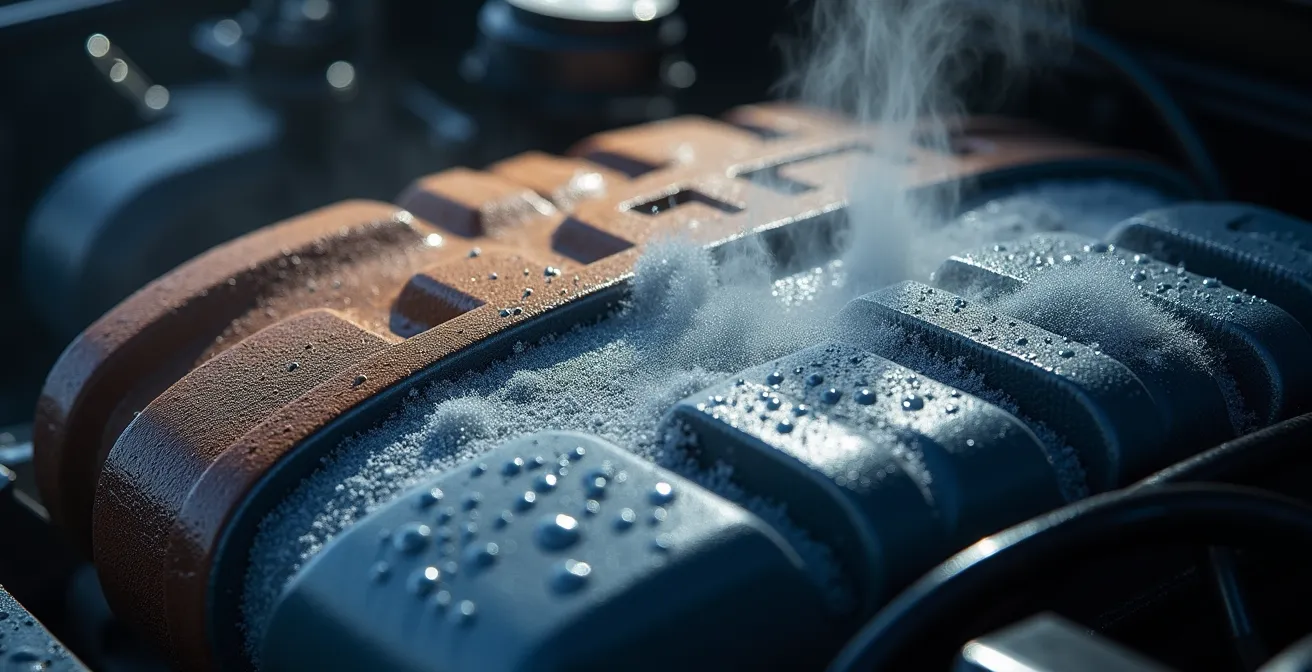
Furthermore, cold engines run on a “rich” fuel mixture, meaning more gasoline is injected than can be efficiently burned. This unburnt fuel can wash lubricating oil off cylinder walls and seep into the crankcase, contaminating the oil and reducing its effectiveness. It also leads to the formation of carbon buildup on valves and pistons, which degrades engine performance and fuel economy over time. In essence, by consistently taking short trips, you are slowly strangling your own engine, leading to costly repairs down the line.
An e-bike has no such issues. Its simple electric motor and battery operate with high efficiency from the moment you turn them on, regardless of trip length. Replacing those damaging short car trips doesn’t just save the planet; it saves your car from a slow, expensive death.
How to Replace Your Second Car With an E-Bike in 3 Months Without Regret?
The decision to ditch a second car can feel daunting, but a structured, gradual approach can make the transition smooth and permanent. The key is not to go cold turkey, but to execute a deliberate three-month modal shift calculus. This gives you time to adapt, acquire the right gear, and build the confidence to make the final leap.
The energy savings alone provide a powerful motivation. An e-bike is an efficiency marvel; as one analysis points out, electric bicycles are over 10x more energy-efficient than even a modern electric car, using just 25Wh/mi on throttle-only. This incredible efficiency multiplier is what drives both the environmental and financial benefits. People who make the switch see dramatic results. One San Francisco woman, for example, estimates she has saved over $50,000 in seven years by replacing her car with an e-bike, proving the long-term viability of the choice.
Making the switch requires a plan. Instead of waking up one day and selling the car, follow a phased program that systematically replaces car dependency with e-bike capability. This process turns an intimidating life change into a series of manageable steps.
Action Plan: Your 3-Month E-Bike Transition
- Month 1 (Audit & Experiment): Track every car trip you make. For one month, identify all non-essential trips under 5 miles. Begin replacing at least half of them with an e-bike. This is your data collection and low-risk experimentation phase.
- Month 2 (Invest & Overcome): Use a fraction of your car savings to invest in essential all-weather gear (rain jacket, waterproof panniers) and robust locks. Intentionally tackle one of your most “difficult” recurring trips, like the weekly grocery run, to prove it can be done.
- Month 3 (Commit & Reallocate): After two months of successful adaptation, sell the second car. Immediately create a new “mobility budget” with the money saved. Allocate funds for public transit, occasional car rentals for long trips, and enjoy the significant remaining savings.
This phased approach minimizes risk and builds confidence, ensuring the decision is not just a temporary experiment but a sustainable and rewarding lifestyle change without a hint of regret.
Key Takeaways
- Cold start inefficiency is the core problem: A car’s catalytic converter is useless for the first 5-10 minutes of a trip, releasing a disproportionate amount of pollution.
- E-bikes are mathematically superior: Even accounting for the carbon cost of electricity and the rider’s food, an e-bike’s emissions per kilometer are a fraction of a car’s.
- A car’s true carbon cost includes embedded carbon from infrastructure like parking lots, a massive hidden factor that e-bikes almost entirely avoid.
The $9,000 Question: Can an E-Bike Realistically Replace Your Car Lease?
We’ve established the environmental and mechanical case for replacing short car trips. But for many, the final decision comes down to a single, powerful question: does the math work financially? The answer is a resounding yes. When you compare the total annual cost of car ownership to that of an e-bike, the savings are not just marginal—they are life-changing, often amounting to the size of a car lease itself.
Let’s start with the most obvious expense: fuel. In 2022, the average American spent around $2,700 on gasoline. By comparison, the annual electricity cost to charge an e-bike, even with daily use, is about $24. That’s a 99% reduction in fuel costs. This single data point already represents a significant saving, but it’s only the tip of the iceberg.
The image below captures the essence of this financial freedom—the ability to integrate an active, healthy, and low-cost mode of transport into your daily life, breaking free from the financial chains of car dependency.

The true financial picture emerges when we look at the total cost of ownership. A car lease or payment is just the beginning. Insurance, registration, parking fees, and exorbitant maintenance costs add thousands more to the annual bill. The following table breaks down a realistic annual comparison, showing how an e-bike isn’t just cheaper, but operates on a completely different financial scale.
| Expense Category | Car | E-bike |
|---|---|---|
| Purchase/Lease | $6,000-8,000/year | $200-400/year amortized |
| Insurance | $1,500/year | $0-100/year |
| Fuel/Electricity | $2,700/year | $24/year |
| Maintenance | $1,200/year | $100-200/year |
| Registration/Parking | $500-2,000/year | $0 |
| Total | $11,900-15,200/year | $324-724/year |
The conclusion is inescapable. The annual savings of replacing a car with an e-bike can easily exceed $10,000. That $9,000 car lease isn’t a barrier; it’s the very prize you win by making the switch. The e-bike doesn’t just replace your car; it replaces its enormous financial burden, freeing up a significant portion of your income.
Stop guessing your impact and start calculating. The math is clear, the savings are real, and the environmental benefit is immense. Your personal journey to a one-ton carbon reduction begins not with a grand gesture, but with a simple audit of your daily travel and the decision to replace your most inefficient trips.