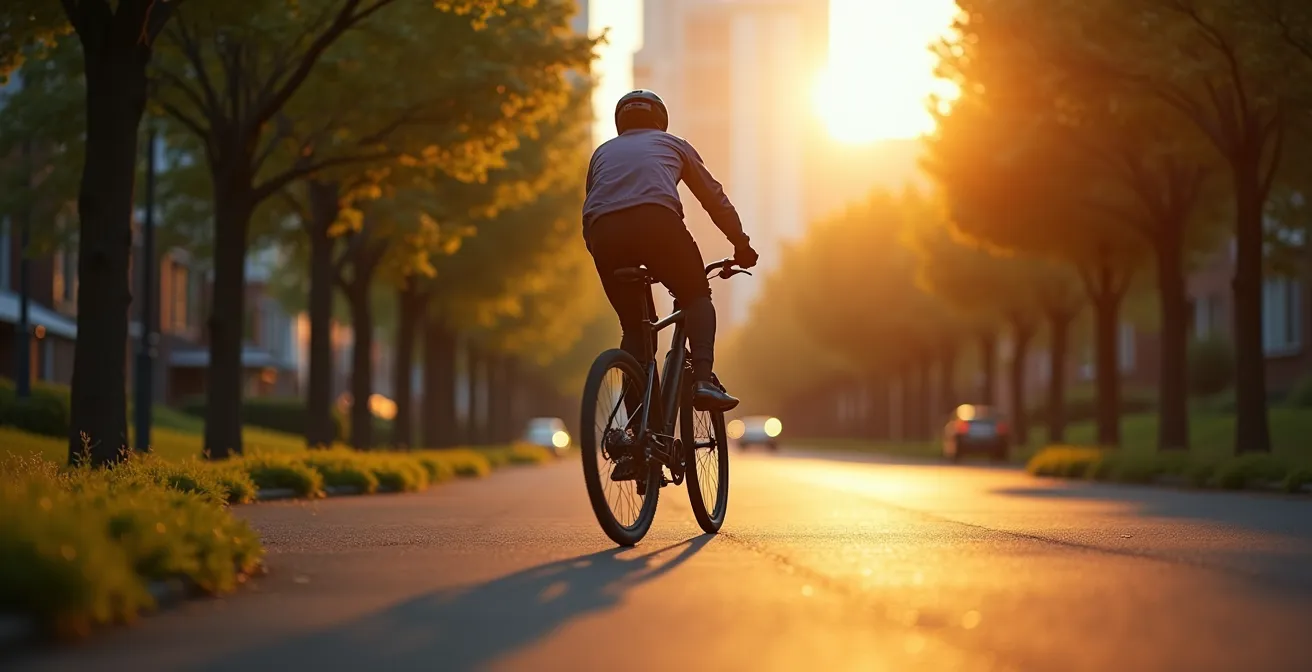
The daily commute isn’t lost time; it’s a powerful and overlooked psychological tool for actively dismantling work stress before you walk through your front door.
- Riding an e-bike restores a sense of control and agency that is systematically eroded by the learned helplessness of sitting in unpredictable traffic.
- The physical act of pedaling triggers a potent neurochemical reset, actively lowering stress hormones like cortisol while significantly boosting brain-derived neurotrophic factor (BDNF).
Recommendation: Intentionally transform your ride home from a simple journey into a daily “decompression commute” ritual to build a resilient mental buffer between your professional and personal life.
The front door clicks shut, but the office doesn’t stay behind. For many stressed professionals, the workday bleeds into personal time, a relentless stream of lingering frustrations, unresolved problems, and mental fatigue. The typical advice—meditate, hit the gym, or simply “switch off”—often feels like another task on an already overloaded to-do list. The journey home, whether spent in a car or on public transport, frequently amplifies this stress, becoming a passive, frustrating container for anxiety rather than a release valve.
But what if the commute itself could be repurposed? What if that transitional period between your work identity and your home identity was the most effective tool for creating a clean mental break? This is the core principle of the “decompression commute.” It reframes the journey not as a logistical necessity, but as a deliberate psychological ritual. It moves beyond the generic wellness tip of “get more exercise” to explore the specific mechanisms that make an e-bike the ideal vehicle for this mental transition.
The true power of this practice lies in a unique combination of neurochemical resets, regained psychological control, and heightened sensory engagement. This isn’t about simply getting from point A to B. It’s about creating a vital buffer zone that allows you to arrive home not just physically, but mentally as well—refreshed, present, and truly disconnected from the pressures of the day. This article will deconstruct the science and psychology behind this transformative ritual, providing a practical guide to reclaiming your commute as the most important part of your mental health routine.
To help you understand how this daily ritual can be a powerful tool for well-being, we’ve included a short, inspiring video that explores the broader human benefits of cycling and how it connects us to our environment and ourselves. It perfectly complements the specific strategies for post-work decompression that we’re about to explore.
To fully grasp how to turn your ride into a powerful tool for mental well-being, we will delve into the specific scientific and psychological principles at play. The following sections break down exactly how e-biking impacts your brain, mood, and habits, offering a clear roadmap to building your own decompression commute.
Summary: The Science of the Decompression Commute
- Why 20 Minutes of Pedaling Lowers Stress Hormones Faster Than Sitting?
- How Morning Sunlight on Your Ride Combats Seasonal Affective Disorder?
- Driving vs Riding: The Impact of Traffic Jam Helplessness on Anxiety
- The Mistake of Riding with Headphones That Blocks the “Flow State”
- When to Take the Scenic Route: Prioritizing Green Spaces Over Speed?
- Why the “E-Bike Smile” Reduces Work Stress Levels by 30%?
- How “Chat Pace” Riding Improves Social Bonds Compared to Movies?
- From Occasional to Daily: How to Build a Cycling Habit That Sticks for 21 Days?
Why 20 Minutes of Pedaling Lowers Stress Hormones Faster Than Sitting?
When you leave a high-pressure work environment, your body is often flooded with cortisol, the primary stress hormone. Sitting in a car or on a train does little to metabolize it; you remain in a passive, stagnant state, stewing in your own stress chemistry. The act of pedaling, even at a moderate pace, initiates a powerful neurochemical reset. It forces your body to switch from a state of mental stress to physical demand, effectively flushing cortisol from your system and replacing it with beneficial neurochemicals.
The most significant of these is Brain-Derived Neurotrophic Factor (BDNF), often described as “Miracle-Gro for the brain.” BDNF is critical for neurogenesis, learning, and mood regulation. Chronic stress depletes it, while exercise is one of the most potent ways to stimulate its production. Research highlights that just six minutes of vigorous cycling can cause a 4 to 5-fold increase in circulating BDNF, a protein crucial for brain health. This spike helps repair the neurological damage caused by a stressful day and builds long-term mental resilience.
This isn’t just a long-term benefit; the effect is immediate. As Travis Gibbons, a lead author on a key study, explains, this kind of activity is uniquely efficient at boosting brain wellness. This simple act of turning the pedals provides a direct, physiological antidote to the mental state you just left behind, making the commute an active part of your recovery, not an extension of your stress.
How Morning Sunlight on Your Ride Combats Seasonal Affective Disorder?
The benefits of a decompression commute aren’t limited to the ride home. A morning cycle to work plays a crucial role in setting your entire day’s psychological tone, especially in combating mood disorders like Seasonal Affective Disorder (SAD). The key factor is early-morning sunlight exposure. When natural light hits your retinas, it sends a powerful signal to your brain to suppress melatonin production and regulate your circadian rhythm, the body’s internal 24-hour clock.
A disrupted circadian rhythm is strongly linked to depression and anxiety. A morning ride, even on a cloudy day, exposes you to far more lux (the measure of light intensity) than you would receive indoors. This natural light therapy kickstarts your alertness, improves focus, and, most importantly, stimulates the production of serotonin. Dr. Emma Hopgood of Shimano Bike Research elaborates on this connection.
Recent reviews indicate that exercising outdoors appears to be more beneficial to mental health over indoor activities. Studies report an increase in Serotonin (your happy hormone) from exposure to daylight improves mood and long-term cognitive performance.
– Dr. Emma Hopgood, Shimano Bike Research
This morning ritual provides a daily dose of mood-stabilizing chemistry. By starting your day with movement and light, you’re not just commuting; you’re pre-emptively arming your brain against the stresses to come, building a foundation of positive neurochemistry that makes you more resilient throughout the workday.

As you can see, this simple act transforms the commute into a therapeutic session. The combination of physical activity and natural light creates a synergy that indoor exercise can’t replicate, making the ride to work as vital as the ride home for overall mental well-being.
Driving vs Riding: The Impact of Traffic Jam Helplessness on Anxiety
One of the most insidious sources of commute-related anxiety is the feeling of powerlessness. Being stuck in a traffic jam is a perfect-storm of psychological stressors: you are trapped, you have no control over the situation, and the outcome is unpredictable. This condition is a classic trigger for what psychologists call “learned helplessness”—a state where repeated exposure to an uncontrollable, aversive event leads to a belief that one is powerless to change their circumstances, resulting in heightened anxiety and passivity.
The car commute is inherently unpredictable. Urban mobility research demonstrates that e-bike commutes maintain remarkably consistent travel times, often with less than 5% variance, while car commutes can fluctuate by up to 50% due to traffic. This predictability is not a minor convenience; it’s a direct antidote to learned helplessness. On an e-bike, you reclaim a sense of agency. You can navigate past gridlock, choose different paths, and have a high degree of confidence in your arrival time. You are an active participant in your journey, not a passive victim of it.
This psychological shift from helplessness to empowerment is a cornerstone of the decompression commute. It fundamentally changes your relationship with the journey, transforming it from a source of anxiety into an experience of freedom and control. The following study illustrates this effect perfectly.
Case Study: The Australian E-Bike Commuting Trial
A 12-week study in regional Australia provided e-bikes to 20 previously inactive individuals. The results were profound. A core finding from the analysis of participants’ mental well-being was a significant reduction in anxiety. Participants specifically cited the autonomy and predictability of their e-bike commute as key stress-reducing factors. By eliminating the uncertainty and frustration of their previous car commutes, they regained a sense of control that positively impacted their overall mental health.
The Mistake of Riding with Headphones That Blocks the “Flow State”
In an attempt to escape the stress of the day, many commuters plug in headphones, hoping to drown out the world with music or podcasts. While well-intentioned, this practice is a critical mistake that sabotages the core benefit of the decompression commute: achieving a “flow state.” Flow is a state of deep immersion and energized focus, where you are fully absorbed in an activity. It’s a powerful antidote to the ruminating, scattered thoughts that often follow a stressful workday.
Achieving this state on a bike requires sensory engagement with your environment. It’s about feeling the subtle shift in the wind, hearing the hum of your tires on the pavement, noticing the changing light, and responding to the dynamic world around you. This constant feedback loop between you, your bike, and your surroundings pulls your attention into the present moment. Mental health researchers have found that these benefits stem from a combination of exercise-induced alertness with increased sensory input, which in turn reduces excessive, cyclical thinking.
Headphones create a sensory deprivation bubble. They sever this connection to the environment, encouraging your mind to remain disengaged and wander back to the day’s stressors. Instead of processing the ride, you’re passively consuming audio content, missing the opportunity for a true mental reset. To fully unlock the decompression benefit, you must allow your brain to focus on the rich, multi-sensory experience of riding. Ditching the headphones is the first step toward transforming your ride from a distraction into a moving meditation.
Your Action Plan: The Headphone-Free Commute Challenge
- Week 1: Begin with just one headphone-free ride. Your only goal is to notice the ambient sounds of your route—the wind, birds, traffic patterns, the sound of your own bike.
- Week 2: Increase to three audio-free rides. During these rides, practice simple breath awareness: notice your inhale and exhale as you pedal.
- Week 3: Commit to an entire week of audio-free commutes. At the end of each ride, take 30 seconds to note any changes in your mental state upon arrival at home.
- Week 4: Introduce ‘sound scanning’. On each ride, consciously try to identify and name five distinct environmental sounds you hadn’t noticed before.
- Week 5 and beyond: Maintain the practice as your default. Reserve headphones for purely recreational rides, preserving your commute as a dedicated time for mental decompression.
When to Take the Scenic Route: Prioritizing Green Spaces Over Speed?
Not all stress is created equal, and your decompression commute shouldn’t be a one-size-fits-all routine. After a moderately stressful day, a direct ride home might be sufficient. But after a truly draining or high-pressure day, the most efficient route is rarely the most effective one for your mental health. This is when you must consciously choose to prioritize attention restoration over speed by taking the scenic route, particularly one that includes green spaces.
Exposure to nature, even in small urban parks, has a profound restorative effect on the brain. “Attention Restoration Theory” suggests that natural environments allow our directed attention, which is heavily taxed during the workday, to rest. The soft fascinations of nature—the rustling of leaves, the movement of water—effortlessly capture our involuntary attention, giving our cognitive resources a chance to replenish. A 10-minute detour through a park can do more to dismantle stress than a 5-minute-faster ride through dense traffic.
The key is to learn to self-assess your mental state as you leave work and prescribe the right “dose” of nature for your commute. An e-bike makes this choice practical, as the motor assist minimizes the extra physical effort of a longer, hillier scenic route, removing a major barrier to choosing the path your mind truly needs. You can think of it as a flexible prescription for your mental well-being.
To make this decision more systematic, you can use a simple framework to match your route to your stress level. The following guide provides a clear way to make this choice intentional and effective.
| Work Stress Level (1-10) | Recommended Route Type | Additional Time Needed | Mental Health Benefit |
|---|---|---|---|
| 1-3 (Low) | Direct route acceptable | 0 minutes | Basic decompression |
| 4-6 (Moderate) | Partial green detour | 5-10 minutes | Attention restoration |
| 7-8 (High) | Full scenic route | 15-20 minutes | Significant stress reduction |
| 9-10 (Critical) | Extended nature route | 25-30 minutes | Complete mental reset |
Why the “E-Bike Smile” Reduces Work Stress Levels by 30%?
Anyone who has ridden an e-bike, especially for the first time, is familiar with the “e-bike smile”—that involuntary, joyful grin that appears when the motor kicks in and effortlessly propels you forward. This isn’t just a fleeting moment of fun; it’s a powerful neurochemical event with a direct, stress-reducing impact. The phenomenon is rooted in a psychological principle known as a “positive violation of expectation.”
Your brain is a prediction machine. When you approach a hill or start pedaling from a stop, your brain anticipates a certain level of physical effort. The e-bike’s assistance shatters that expectation. The effort you predicted is replaced by a surprising and delightful sense of ease and speed. This positive surprise triggers a release of dopamine, the neurotransmitter associated with pleasure, reward, and motivation. It’s a genuine, neurologically-induced hit of happiness.
This dopamine rush serves as a direct chemical antidote to the frustrations of a difficult workday. It breaks the cycle of negative thoughts and replaces it with an immediate, positive physical and emotional sensation. Dr. Ryan McCorkle, a researcher in the field, provides a clear explanation of this powerful effect.
The smile comes from the brain’s surprised delight when the expected effort is met with joyful ease from the motor. This positive violation of expectation triggers a dopamine hit that is the direct neurochemical antidote to a frustrating workday.
– Dr. Ryan McCorkle, Juiced Bikes Mental Health Research
This effect doesn’t wear off after the first ride. Every time the motor assists you in a way that feels surprisingly helpful, you get a small micro-dose of this positive neurological feedback. It systematically counteracts the feelings of struggle and friction that often define a stressful day at work, making the ride home a genuinely joyful experience.
How “Chat Pace” Riding Improves Social Bonds Compared to Movies?
While the solo decompression commute is powerful, riding with a partner or friend can offer a different but equally important mental health benefit: enhanced social connection. An e-bike’s motor equalizes effort, allowing two people of different fitness levels to ride comfortably side-by-side at a conversational “chat pace.” This dynamic is fundamentally different from other shared leisure activities like watching a movie, which are passive and isolating.
Riding together fosters what is known as social synchrony. Research shows that as people exercise together, their bodies often non-verbally attune to one another, subconsciously syncing heart rates and breathing patterns. This primal synchrony enhances feelings of rapport and connection. Furthermore, the side-by-side orientation of cycling is less confrontational than a face-to-face conversation, which can encourage more open and vulnerable communication. You are sharing an experience and a view, rather than being the focus of each other’s direct gaze.
A study that provided e-bikes to individuals found that a major theme in post-intervention interviews was the positive social impact. Participants reported that e-biking created more opportunities for authentic social contact within their community. They noted that the shared discovery of new routes and the easy, side-by-side conversations created stronger bonds than passive entertainment. This shared, active experience builds connection through mutual effort and discovery, a far cry from the silent, parallel consumption of media.
Key Takeaways
- Neurochemical Reset: Cycling actively flushes the stress hormone cortisol and boosts BDNF, the brain’s growth and repair protein, creating an immediate and lasting anti-stress effect.
- Psychological Agency: Unlike the ‘learned helplessness’ of being stuck in traffic, e-biking restores a sense of control and predictability, which is a direct antidote to anxiety.
- Mindful Engagement: Ditching headphones and prioritizing sensory input allows you to achieve a ‘flow state’, a form of moving meditation that pulls your focus into the present moment and away from work-related rumination.
From Occasional to Daily: How to Build a Cycling Habit That Sticks for 21 Days?
Understanding the benefits of the decompression commute is one thing; integrating it into your life as a consistent habit is another. The key to building any lasting habit is to lower the barrier to entry as much as possible. This is where the “e” in e-bike becomes your greatest ally in behavior change. Traditional cycle commuting can be daunting due to hills, distance, the fear of arriving sweaty, or simple end-of-day fatigue—all significant barriers to consistency.
An e-bike systematically dismantles these barriers. The motor assist flattens hills, extends your comfortable range, and reduces the physical exertion required, ensuring you can complete your commute without feeling exhausted. This isn’t “cheating”; it’s strategic barrier removal. By making the activity more accessible and consistently pleasant, the e-bike dramatically increases the likelihood that you will choose to ride, especially on days when you feel tired or unmotivated. This consistency is the foundation of habit formation.
The data backs this up. Research shows that the easier an activity is, the more we do it. According to Bosch eBike Systems research, once people switch, e-bikers ride 3 times more often and travel further than on conventional bikes. They aren’t just replacing car trips; they are riding more in total because the experience is more enjoyable and less demanding. The 21-day challenge to form a habit becomes far more achievable when the daily task is something you genuinely look forward to, rather than a chore you have to force yourself to do.
Your journey home is no longer a stressful epilogue to your workday; it’s a non-negotiable prescription for mental clarity and well-being. By embracing these principles, you’re not just changing how you commute—you’re redesigning your relationship with stress. Begin your first decompression ride today and feel the difference for yourself.