
Mastering a long-distance multimodal commute is a logistics challenge, where the right equipment and strategy save more time and stress than raw speed.
- The critical failure point is often not the ride, but the transition: a bike that’s too heavy for stairs or too large for rush hour rules negates all other benefits.
- Optimizing for folded size and a weight-to-mobility ratio under 30 lbs is more important than top speed or battery range for daily station navigation.
Recommendation: Prioritize a lightweight, ultra-compact folding e-bike and a station with secure, covered parking, even if it adds a few minutes to your initial ride.
For the super-commuter facing a 20+ mile journey, the dream of a seamless, eco-friendly trip often crashes into reality. The common advice—”get an e-bike”—is simplistic. It ignores the complex logistics of navigating a system not built for this hybrid model. You’re not just a cyclist or a train passenger; you’re the manager of a personal, daily supply chain, and every component matters.
Generic tips about checking transit rules or buying a good lock are table stakes. They don’t address the real-world friction points: the crowded train car, the three flights of stairs at your transfer station, or the gnawing anxiety of leaving a $3,000 investment chained to a public rack. The true challenge isn’t just covering distance; it’s optimizing the entire system for efficiency, security, and sanity.
This guide reframes the problem. We will move beyond the basics and analyze the commute as a series of strategic trade-offs. The key to success isn’t finding the fastest bike or the cheapest train pass. It’s about designing a resilient, repeatable system where the bike and train work in perfect concert, turning a grueling commute into a streamlined, and even enjoyable, part of your day.
We will dissect the critical decisions you need to make, from choosing the right class of folding bike to evaluating the real-world security of station lockers and determining the financial break-even point for your multimodal setup. This is your blueprint for conquering the super-commute.
Summary: A Logistician’s Guide to the 20+ Mile E-Bike and Train Commute
- Why Full-Size E-Bikes Are Often Banned During Rush Hour Trains?
- How to Choose a Folding E-Bike That Actually Fits Under a Bus Seat?
- Secure Lockers vs On-Board: Is It Safe to Leave Your $3k Bike at the Station?
- The Error of Buying a 60lb Bike You Can’t Lift Up Station Stairs
- When to Buy a Monthly Train Pass vs Riding the Whole Way?
- E-Bike vs Public Transport: Which Is Faster for Commutes Under 5 Miles?
- How to Ride in a Suit or Skirt Without Wardrobe Malfunctions?
- Replacing a Second Family Car With an E-Bike: Is It Realistic for Suburban Parents?
Why Full-Size E-Bikes Are Often Banned During Rush Hour Trains?
The primary barrier to a seamless train-bike commute is the issue of space and safety during peak travel times. Transit authorities are tasked with moving the maximum number of people in the shortest time, and a full-size e-bike is a significant spatial impediment. It’s not a bias against cyclists; it’s a logistical reality. During rush hour, every square foot of floor space is premium real estate. A standard bike can obstruct aisles, block doorways, and create a safety hazard during an emergency evacuation. This logistical conflict is why a staggering 90% of major transit agencies restrict full-size bikes during peak hours, typically defined as the 7-9 AM morning rush and the 4-6 PM evening rush.
These restrictions are the system’s way of prioritizing passenger density over individual convenience. While some lines may have designated bike cars or offer exceptions for end-of-line stations with lower passenger volume, relying on these is a risky strategy for a daily commuter. A single train car change or a last-minute schedule adjustment can leave you and your full-size bike stranded on the platform.
The strategic takeaway is clear: for a reliable, repeatable commute, a full-size bike is a non-starter. The system is designed to penalize its presence during the very hours you need it most. The only way to consistently bypass these restrictions is to use a tool that the system no longer recognizes as a “bike”—a properly folded compact bicycle, which is almost universally treated as standard luggage. This isn’t just a recommendation; it’s the foundational requirement for building a resilient multimodal commuting plan.
How to Choose a Folding E-Bike That Actually Fits Under a Bus Seat?
The term “folding bike” is dangerously broad. The difference between a model that streamlines your commute and one that complicates it comes down to a critical metric: folded volume. A standard bi-fold bike collapses in half, resulting in a flat but long and wide object that’s cumbersome to carry and impossible to store in tight spaces. For the true super-commuter, the goal is not just to fold, but to disappear. This is where tri-fold designs, famously pioneered by Brompton, offer a decisive advantage. They create a compact, box-like package that is fundamentally more manageable in a crowded transit environment.
The ultimate test is whether the bike can fit under a standard bus or train seat, effectively vanishing from the aisle. As a real-world test comparing models shows, a Brompton’s tri-fold design can create a package roughly 2 feet square, meeting this benchmark, while many standard bi-folds cannot. The key is to look at the final folded dimensions (L x W x H) rather than just the wheel size. A 20-inch wheel bike might feel zippier to ride, but its larger folded footprint can be a daily logistical nightmare. Your choice should be dictated by the most constrained part of your journey, which is often the space under your seat.
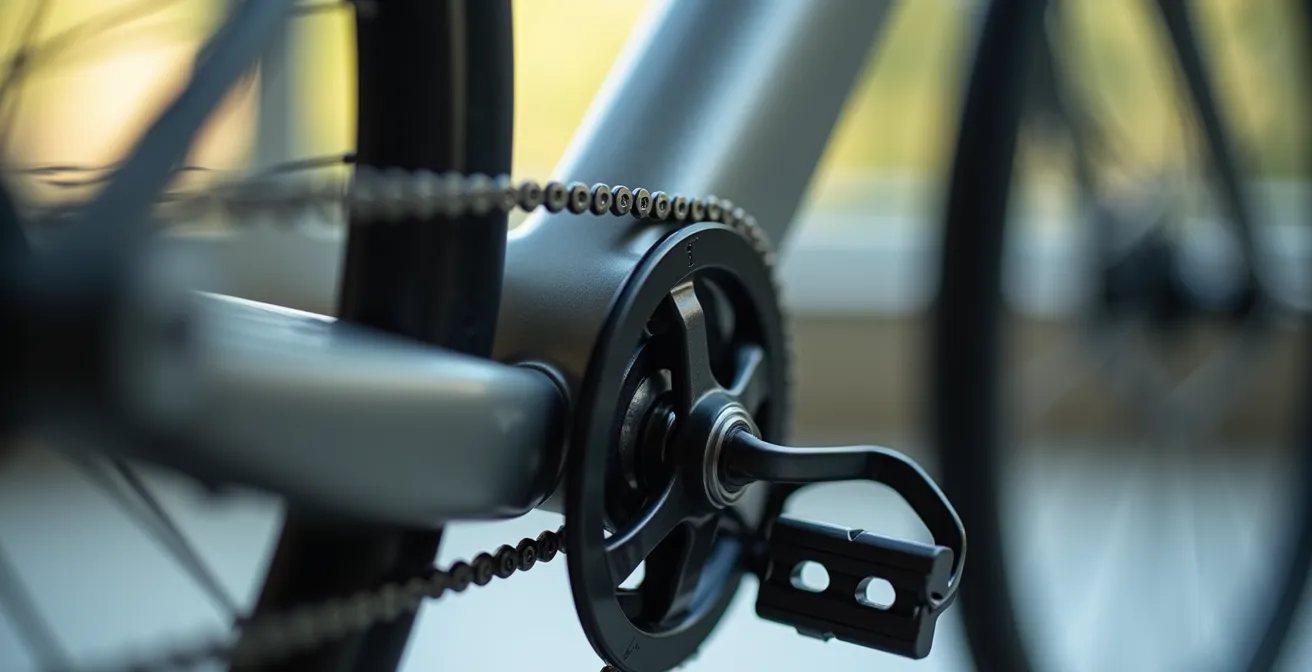
This macro-level engineering detail directly translates into micro-level convenience. A smaller folded volume not only allows for under-seat storage but also makes it easier to navigate station turnstiles, crowded platforms, and office elevators. The data below provides a clear, quantitative comparison of how different folding philosophies translate into real-world dimensions and weights.
The following table, based on common specifications, outlines the critical trade-offs between popular folding bike types. As demonstrated in a comprehensive guide to train and bike commuting, these numbers directly impact transit acceptance and daily usability.
| Bike Type | Folded Size | Weight | Fold Time | Transit Acceptance |
|---|---|---|---|---|
| Brompton Electric | 23″ x 22″ x 11″ | 37 lbs | 20 seconds | All times |
| Tern Vektron | 33″ x 24″ x 16″ | 48 lbs | 10 seconds | All times |
| Standard 20″ folder | 32″ x 28″ x 14″ | 35 lbs | 15 seconds | All times |
Secure Lockers vs On-Board: Is It Safe to Leave Your $3k Bike at the Station?
Leaving a high-value asset like a $3,000 e-bike at a public train station introduces the most significant risk into your commuting equation: theft. The decision is not simply about locking it up; it’s a strategic choice within a security-vs-convenience matrix. Your options range from maximum convenience (bringing the bike on board) to maximum risk (a standard outdoor rack). The data on bike theft at transit hubs is sobering. For example, historical data from one major transit authority showed bike thefts at stations nearly tripled in under a decade, highlighting that stations are prime targets for thieves.
In response, some transit agencies have invested in high-security solutions like “Pedal and Park” cages. These offer a compelling middle ground. A case study of the MBTA’s implementation shows these cages, which feature security cameras, enhanced lighting, and controlled access via a registered transit card, significantly reduce theft rates. However, “significantly reduced” is not zero. Occasional thefts still occur, and these facilities are not available at every station. This leaves the commuter with a calculated risk assessment.
The most secure option is always to keep the bike with you, a strategy enabled by an ultra-compact folding bike. This eliminates theft risk entirely. If you must leave the bike, a dedicated, access-controlled bike cage is the next best choice. A private bike locker is even better. A standard, open-air bike rack, even in a well-lit area with a high-quality lock, should be considered a last resort for a high-value e-bike used for a daily commute. The financial and logistical pain of a stolen bike far outweighs the daily inconvenience of seeking out more secure options.
The Error of Buying a 60lb Bike You Can’t Lift Up Station Stairs
In the world of multimodal commuting, an e-bike’s weight is not a static specification; it’s a dynamic obstacle. The single biggest mistake a new train-and-bike commuter can make is underestimating the physical toll of the “in-between” moments: lifting the bike up a flight of stairs, hoisting it onto a train, or carrying it across a crowded platform. A 60 lb e-bike might feel effortless to ride, but it becomes a logistical nightmare the moment your feet hit the ground. This is the weight-to-mobility ratio in action, and it’s a crucial factor that marketing materials often ignore.
Many stations, particularly older ones, lack elevators or functional escalators, making stairs an unavoidable part of the journey. Trying to haul a heavy, unwieldy bike up multiple flights of stairs every day is not just exhausting; it’s unsustainable and unsafe. This is where the theoretical benefit of an e-bike collides with the harsh reality of infrastructure. A bike that is too heavy to be comfortably carried for 30-50 feet is, for all practical purposes, the wrong bike for a multimodal commute, regardless of its battery life or motor power.
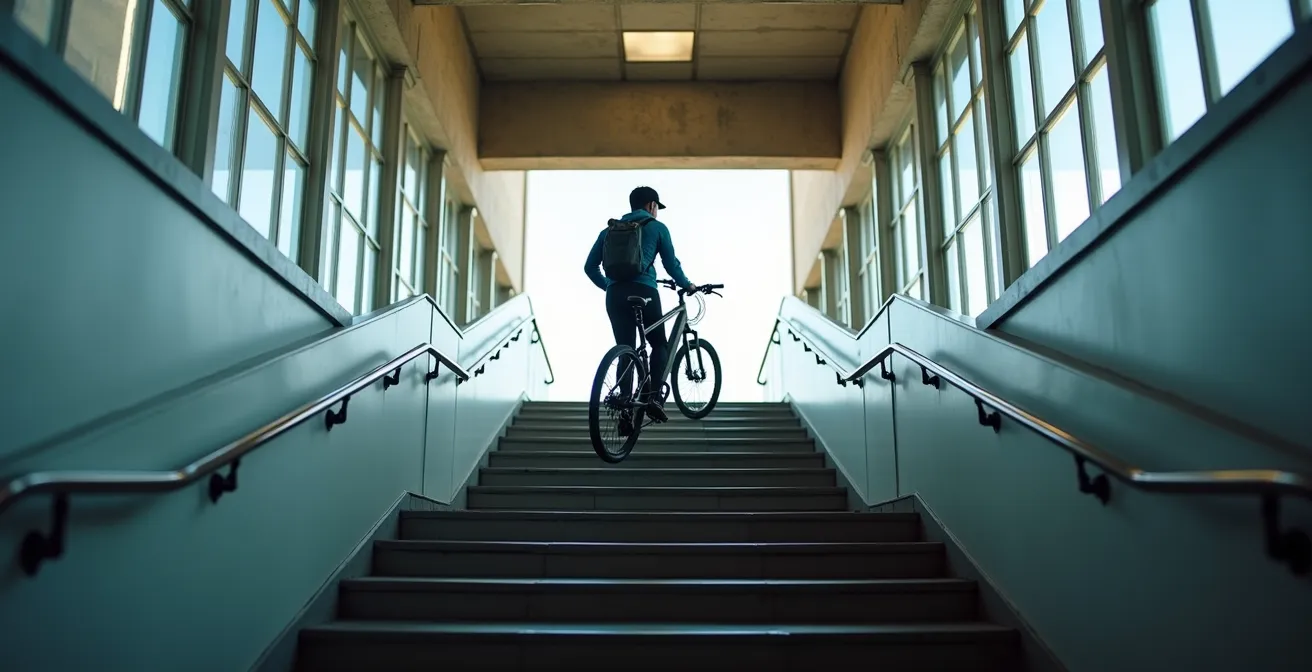
The solution is a two-pronged strategy: choosing the right equipment and mastering the right techniques. Aim for a total weight (bike + battery) under 40 lbs, and ideally closer to 30 lbs. Every pound saved is a significant gain in daily usability. Secondly, learn how to manage the weight you do have. This includes planning routes around accessible stations and practicing efficient carrying methods. Your commute’s success hinges on these physical logistics.
Your Action Plan: E-Bike Weight Management Strategies
- Weight Audit: Before buying, confirm the bike’s weight is under 25kg (55 lbs) as a hard limit; train crews are not permitted to assist with lifting. Aim for much less.
- Accessibility Mapping: Use your transit agency’s accessibility maps to proactively identify stations with elevators and ramps, and build your route around them.
- Technique Practice: Master the “balance point lift.” Find the bike’s center of gravity and practice lifting and carrying it horizontally to minimize strain.
- Component Shedding: If your bike has a removable battery, take it out before tackling stairs. This can instantly reduce lifting weight by 5-8 lbs.
- Ramp Utilization: Actively look for and use the small metal ramps (runnels) often installed alongside station stairs. They are designed for this exact purpose.
When to Buy a Monthly Train Pass vs Riding the Whole Way?
The decision to combine cycling with rail travel is fundamentally a financial and temporal calculation. For the super-commuter, the question is not simply “which is cheaper?” but “which combination provides the optimal blend of cost, time, and reliability?” The analysis must go beyond comparing a single train ticket to the cost of gasoline. It involves a cost-per-mile analysis that accounts for all variables: the price of a monthly pass, bike maintenance, and the intangible value of your time.
The financial argument for a multimodal commute is compelling. A cost analysis shows that a commuter can achieve $1,300 in annual savings by combining a bike and train for a 30-mile daily trip compared to driving. This calculation captures savings on fuel, parking, and vehicle wear and tear. However, this is only part of the story. The true value often lies in time savings and stress reduction. A real-world case study of a Toronto commuter showed that using a folding e-bike with GO Transit cut a 2-hour car commute down to 1.5 hours. Crucially, it eliminated the stress of hunting for station parking and navigating crowded subway transfers.
The break-even point for a monthly pass depends on frequency. A simple rule of thumb: if you plan to use the train for more than 70-80% of your commutes in a month, the monthly pass is almost always the more economical choice. For days with favorable weather or a lighter schedule, having the option to ride the entire way provides valuable flexibility. The ultimate strategy is to view the train pass not as a fixed cost, but as an investment in reliability and a guarantee against bad weather, fatigue, or mechanical issues.
E-Bike vs Public Transport: Which Is Faster for Commutes Under 5 Miles?
For short commutes under five miles, the complex logistics of a train-bike system may be overkill. In dense urban environments, the equation shifts. The primary obstacle is no longer distance, but congestion and the “first/last mile” problem of getting from a transit stop to your final destination. Here, the e-bike is not a partner to public transport, but a direct competitor. A head-to-head “commute race” over 12 miles in the UK found that a cyclist on a folding bike combined with a train was competitive, but the winning strategy was often dependent on the train’s punctuality. Train delays, a common variable, could easily tip the scales in favor of a solo bike ride.
The determining factor in these shorter urban commutes is average travel speed. In cities like Bristol, peak-hour driving speeds can drop to a crawl. The bike, unimpeded by traffic and able to take more direct routes, often emerges as the fastest door-to-door option. The time spent walking to a bus stop, waiting for the bus, and then walking from the destination stop often exceeds the time it would take to simply cycle the entire route.
The potential for cycling is massive, yet underutilized. For instance, Department for Transport statistics reveal that less than 5% of UK commuters choose bikes, while a staggering 68% still opt for driving, even for short trips. For commutes under 5 miles, the strategic choice is often to simplify. An e-bike offers a one-seat ride, eliminating transfer times, wait times, and dependency on transit schedules. The multimodal strategy is a powerful tool, but it’s essential to apply it only when the distance truly warrants the complexity.
How to Ride in a Suit or Skirt Without Wardrobe Malfunctions?
The logistical challenge of a multimodal commute extends to your professional attire. Arriving at the office drenched in sweat or with grease on your trousers is a non-starter. The key is to separate the “commute” from the “workday” through strategic preparation. For those riding in professional clothes like a suit or skirt, the solution involves a combination of bike modifications and riding technique.
First, equip your bike for the task. A full chain guard and fenders are not optional accessories; they are essential infrastructure for protecting your clothes from road grime and chain grease. For skirt-wearers, a skirt guard or “net” on the rear wheel prevents fabric from getting caught in the spokes. Second, moderate your effort. Use the “eco” or “tour” mode on your e-bike. The goal is not to set a speed record but to arrive fresh. The electric assist should be used to eliminate perspiration, not to win a race. Consider a “Dutch” style upright riding position, which is less aggressive and more forgiving on formal wear.
However, the most effective strategy, for those with the option, is to treat the commute as a separate activity entirely. As one expert advises, this reframes the journey from a simple transit to a health benefit.
If you can shower once at work, turn your commute into a training session. Leave your work stuff at your desk or in a locker, and cycle home unencumbered.
– Simon von Bromley, BikeRadar
This approach involves leaving a “work uniform” (a suit, shoes, etc.) at the office. You commute in dedicated athletic wear, take a quick shower, and change. This completely solves the wardrobe problem and allows you to use the commute as a valuable workout session. It transforms the problem into an opportunity.
Key Takeaways
- For long-distance multimodal commutes, the bike’s folded size and weight are more critical than its top speed or range.
- Theft is a primary risk; the most secure option is an ultra-compact folder you can keep with you, with secure station lockers as the next best alternative.
- A bike over 50 lbs is a significant logistical liability in stations without consistent elevator access, potentially negating the benefits of an e-bike.
Replacing a Second Family Car With an E-Bike: Is It Realistic for Suburban Parents?
For a suburban family, the idea of replacing a second car with an e-bike and a train pass is the ultimate test of multimodal logistics. It moves beyond a personal commute to a family-level transportation strategy. The challenge is immense; research indicates the average suburban round-trip commute is 55 miles, often involving multiple stops like school drop-offs or grocery runs. A simple folding e-bike is insufficient for this task. The conversation must shift to a more robust solution: the cargo e-bike.
Is it realistic? Yes, but it requires a complete paradigm shift and significant investment in the right system. A longtail cargo e-bike, like a Yuba Mundo, can be outfitted with seats for two children and panniers for groceries, effectively acting as a minivan replacement for local trips. When combined with a train pass for the longest leg of a parent’s commute, a functional system begins to emerge. However, the plan must be resilient, with built-in contingencies.
A successful transition involves a phased approach and careful planning. You cannot simply sell the car and buy a bike. The process should include:
- Capability Testing: Evaluate different cargo e-bikes and trailer options to ensure they can handle your family’s specific needs, from the weight of your children to the volume of your weekly shopping.
- Contingency Planning: Develop clear, pre-planned protocols for bad weather, sick children, or unexpected emergencies. This might involve a car-sharing membership or a standing arrangement with a neighbor.
- Financial Calculation: Go beyond the bike’s sticker price. Calculate the total cost of ownership, including specialized insurance for a high-value cargo bike, a robust maintenance schedule, and necessary accessories.
- Phased Rollout: Start by committing to replacing the car for two or three days a week. Use this period to identify and solve friction points in your system before going fully car-free.
Ultimately, transforming your commute from a daily chore into a strategic advantage requires a shift in mindset. Start by analyzing your route not as a single line, but as a series of logistical nodes and links, and select the most efficient tool for each segment. This systematic approach is the key to unlocking a faster, cheaper, and more resilient journey.