
For trips under three miles, your car is almost certainly the slower, more damaging, and less efficient option.
- Short car trips cause disproportionate engine wear and pollution because the engine never reaches its optimal operating temperature.
- The time “saved” by driving is consistently lost searching for parking and walking from the car to the destination, a friction e-bikes completely eliminate.
Recommendation: Audit your weekly trips. For any journey under three miles, switching to an e-bike will save you time and significantly reduce wear on your vehicle, turning frustrating errands into simple, efficient tasks.
That quick one-mile drive to the grocery store or post office feels like a smart use of time. It’s just a few minutes, right? For decades, suburban and urban life has been built around the convenience of the car for every errand, no matter how small. The default solution to car inefficiency has always been to “combine trips” or “plan better,” but this advice misses the fundamental problem: cars are profoundly ill-suited for the very micro-trips they are most often used for.
The common debate pitches e-bikes against cars on broad terms like environmental impact or fuel savings. While true, these points barely scratch the surface. They overlook the hidden costs—the “system frictions”—that accumulate with every short journey. These frictions aren’t just about money; they are about mechanical wear, wasted minutes, and a narrowed perception of your own neighborhood. We instinctively reach for the car keys without considering the cumulative damage and time loss baked into that decision.
But what if the entire premise was flawed? The real key isn’t optimizing bad trips, but replacing them with a tool designed for the job. This article dismantles the “convenience” of using a car for errands by focusing on the “Under 3 Mile Rule.” We will dissect the hidden penalties of short car trips, from the mechanical stress on your engine to the time you unknowingly waste circling a parking lot. By understanding these inefficiencies, you’ll see why an e-bike isn’t just a fun alternative, but a pragmatic and superior tool for reclaiming your time and redefining your local travel.
This guide will walk you through the core inefficiencies of using a car for short trips and demonstrate the practical, time-saving advantages of switching to an e-bike for your daily errands. Explore the sections below to understand the mechanics behind this efficiency revolution.
Summary: The “Under 3 Mile” Rule: Why E-Bikes Are Faster Than Cars for Errands?
- Why Short Trips Are the Primary Cause of Car Engine Wear and Carbon Buildup?
- Why the First Mile of a Car Trip Is the Most Polluting?
- How Parking at the Door Saves 10 Minutes per Errand?
- Walking vs Riding: Expanding Your “Local Neighborhood” Radius by 4x
- When to Use a Basket vs Backpack for a Quick Milk Run?
- The Error of Locking Your Bike in the Shed Instead of Ready-to-Go
- E-Bike vs Public Transport: Which Is Faster for Commutes Under 5 Miles?
- How Switching to E-Mobility Saves $2,000 Annually in City Centers?
Why Short Trips Are the Primary Cause of Car Engine Wear and Carbon Buildup?
The most significant damage to your car’s engine doesn’t happen on long highway drives; it happens in the first few minutes after you turn the key. An engine is designed to operate efficiently within a narrow temperature band, typically between 195-220°F (90-104°C). On a short errand—like a one-mile trip to the store—the engine never reaches this optimal temperature. This leads to a cascade of damaging effects that drastically shorten its lifespan.
During a cold start, the engine’s computer injects extra fuel into the combustion chambers to ensure it runs smoothly. Because the metal components are cold and haven’t expanded to their ideal size, this unburnt fuel can seep past the piston rings and contaminate the engine oil. This process not only dilutes the oil, reducing its lubricating properties, but also leads to the formation of engine sludge and carbon buildup on valves and pistons. This is the “cold start penalty” in action, a hidden tax on your vehicle’s health.
The mechanical wear is even more alarming. According to automotive engineering research, a significant amount of an engine’s total lifetime wear occurs during cold starts before the oil is warm enough to circulate effectively. In fact, some studies suggest that up to 20 times more wear occurs during these initial moments compared to when the engine is at normal operating temperature. Furthermore, short trips are brutal on your car’s battery, as the alternator doesn’t have enough time to fully recharge the power used to start the engine. Each short trip is a net loss for the battery, accelerating its decline.
In essence, using a car for a quick errand is like asking a world-class sprinter to run a 10-meter dash over and over without ever warming up. It’s an inefficient, damaging process that causes disproportionate harm for minimal gain. The car is simply the wrong tool for the job.
Why the First Mile of a Car Trip Is the Most Polluting?
The damage caused by short car trips extends beyond the engine bay and directly into the air we breathe. The same “cold start penalty” that causes mechanical wear is also responsible for a disproportionate amount of pollution. During the first few minutes of operation, the car’s emission control systems are not yet effective, turning your vehicle into a surprisingly potent source of air pollution.
A key component, the catalytic converter, is designed to convert harmful pollutants like carbon monoxide and nitrogen oxides into less harmful substances like carbon dioxide and water. However, this device only works efficiently once it reaches a very high temperature—typically over 500°F (260°C). On a trip of only a mile or two, the exhaust system often fails to reach this critical temperature. As a result, the catalytic converter operates at a fraction of its intended efficiency, or not at all, releasing untreated exhaust directly into the atmosphere.
This issue is compounded by the fact that a cold engine runs “rich,” meaning it pumps extra fuel into the combustion chambers. This leads to incomplete combustion, producing higher levels of carbon monoxide and hydrocarbons. So, that first mile of your trip is by far the most polluting. The emissions per mile can be several times higher than when the car is fully warmed up on a highway. For a suburbanite making multiple short trips a day, their local air quality impact is far greater than they might assume from the short distances traveled.
An e-bike, by contrast, has zero tailpipe emissions. Its impact is localized to the generation of the electricity used to charge it, which is vastly more efficient and less polluting per mile than a cold-running internal combustion engine. By switching to an e-bike for that quick errand, you’re not just preventing engine wear; you’re preventing a concentrated burst of pollution in your own neighborhood.
How Parking at the Door Saves 10 Minutes per Errand?
The illusion of speed is one of the car’s most compelling features. You’re moving at 30 mph, so a one-mile trip should take two minutes. But this calculation ignores one of the biggest time sinks in modern travel: parking. The actual measure of efficiency is not top speed but door-to-door velocity, and this is where the car’s advantage completely evaporates on short errands.
Think about a typical trip to a busy grocery store or strip mall. The process involves:
- Navigating the parking lot entrance.
- Slowly circling the aisles, waiting for other cars and pedestrians.
- Finding a suitable spot, which is rarely near the entrance.
- Walking from your parking spot to the store’s front door.
On the return trip, you repeat the process in reverse. This “last 500 feet” problem can easily add five to ten minutes to each end of your journey. Research from INRIX found that Americans spend, on average, 17 hours per year searching for parking. For those living in dense suburban or urban areas, this figure is often much higher.
This is a form of “micro-friction” that an e-bike eliminates entirely. With an e-bike, you ride directly to the entrance of your destination. You can use a bike rack right by the door or lock your bike to a sturdy post. The time spent “parking” is measured in seconds, not minutes. The walk from your vehicle to the door is reduced to a few steps.
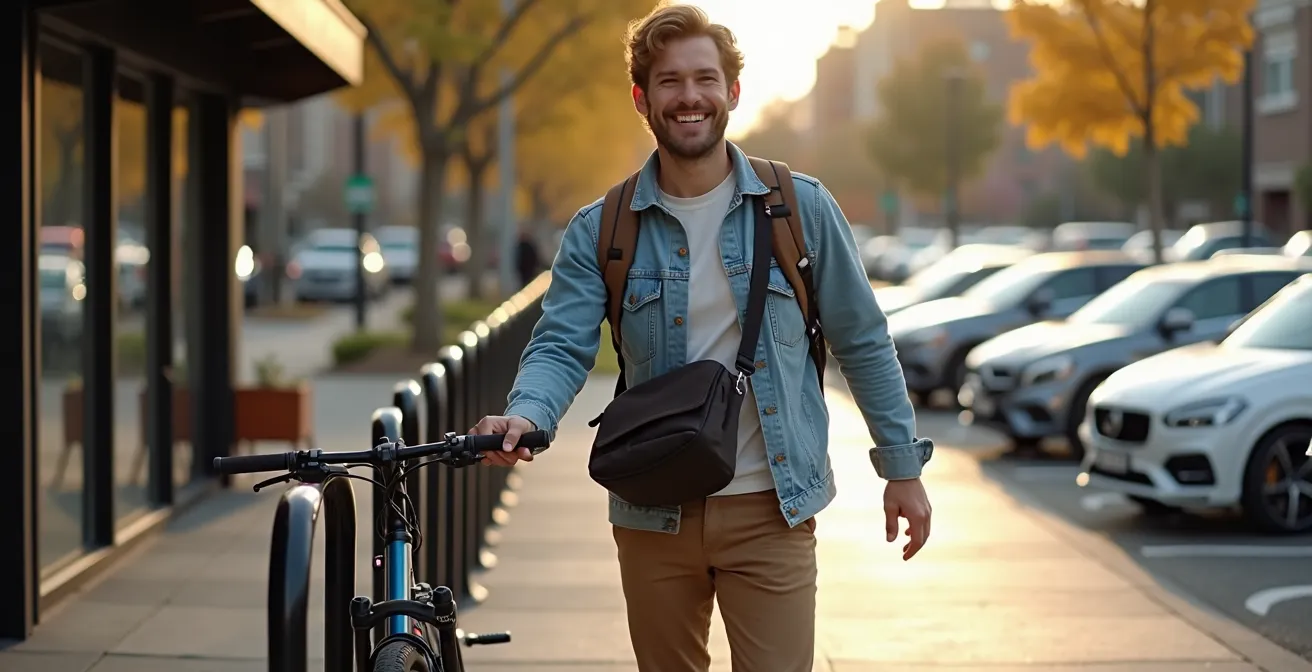
As the image illustrates, the e-bike rider achieves true door-to-door service while car drivers are still circling. When you factor in the full time from leaving your driveway to stepping inside the store, the e-bike is almost always faster for trips under three miles. The perceived speed of the car is a mirage, shattered by the reality of parking inefficiency.
Walking vs Riding: Expanding Your “Local Neighborhood” Radius by 4x
The concept of a “local neighborhood” is often defined by what’s comfortably accessible without a car. For most people, this means a walking radius of about 15 minutes. At an average walking pace, this translates to a circle of roughly one mile, covering an area of about three square miles. This limited range often forces us back into our cars for anything beyond the corner store.
An e-bike fundamentally re-engineers this personal map. It dramatically expands your radius of convenience without introducing the frictions of driving. With the gentle assistance of an electric motor, your comfortable 15-minute travel radius expands from one mile to three or four miles. The area you can spontaneously access doesn’t just triple; it grows exponentially. A four-mile radius covers an area of over 50 square miles—more than 16 times the area of your walking world.
This means the “good” bakery, the larger park, the library, or a friend’s house that previously felt like a “car trip” are now well within the zone of a quick, easy bike ride. This expansion of your effective neighborhood fosters a greater connection to your community and promotes spontaneous local exploration. The e-bike bridges the gap between walking being too slow and driving being too cumbersome.
This table clearly illustrates how the e-bike occupies a unique sweet spot, offering a significant expansion of accessible area compared to walking, and even outperforming a car in urban settings where parking and traffic limit the car’s practical radius. This is a core part of the shift in mobility that e-bikes enable.
| Mode of Transport | 15-Minute Radius | Area Coverage | Spontaneous Trips |
|---|---|---|---|
| Walking | 0.75-1 mile | 3 sq miles | Limited |
| E-Bike | 3-4 miles | 50 sq miles | Frequent |
| Car (urban) | 2-3 miles | 28 sq miles | Parking dependent |
When to Use a Basket vs Backpack for a Quick Milk Run?
One of the most common mental barriers to using a bike for errands is the question of cargo. “How will I carry my groceries?” The image of struggling with plastic bags hanging from the handlebars is a powerful deterrent. However, modern e-bikes and accessories have made carrying goods not just possible, but often easier and more stable than loading up the trunk of a car.
The choice between a basket and a backpack depends entirely on the nature of the errand. For a true “milk run”—grabbing a few essential items—a front basket or handlebar bag is the most efficient solution. It keeps your back free of sweat, allows for quick access, and keeps the weight where you can see it. You can simply drop items in and go, eliminating the need to even take off a backpack. This is peak efficiency for small, planned purchases.
A backpack remains a viable option, especially for unplanned stops or when you need to carry items securely off the bike (like a laptop). However, for frequent errand-running, investing in on-bike cargo solutions is a game-changer. Panniers that clip onto a rear rack offer a low center of gravity and significant capacity, perfect for a week’s worth of groceries. They transform your e-bike into a true utility vehicle.
The key is to match the tool to the task. Having the right cargo setup removes the final piece of friction that might make you reach for your car keys. A well-equipped e-bike is always ready for a spontaneous trip to the store, with no compromises on carrying capacity for everyday needs. The following table provides a simple guide for choosing the right solution.
| Errand Type | Best Solution | Capacity | Comfort Rating |
|---|---|---|---|
| Groceries (5-10 items) | Front Basket | 20-30 lbs | Excellent |
| Work Commute | Panniers | 40-50 lbs | Excellent |
| Quick pharmacy run | Handlebar Bag | 5-10 lbs | Good |
| Bulk shopping | Cargo Trailer | 100+ lbs | Good |
| Fragile items | Padded Panniers | 30-40 lbs | Excellent |
The Error of Locking Your Bike in the Shed Instead of Ready-to-Go
You can own the best e-bike in the world, but if it’s buried in the back of a cluttered garage or locked in a backyard shed, you’ll still grab your car keys out of habit. The final, and perhaps most critical, piece of the efficiency puzzle is creating a departure-ready state. The goal is to reduce the “time to departure” to mere seconds, making the e-bike the path of least resistance.
The “shed error” is a behavioral one. By storing your bike in an inconvenient location, you add multiple steps of friction to the process of using it: walking to the shed, unlocking it, maneuvering the bike out, closing and locking the shed, and then finally getting on your way. This can easily add up to several minutes—enough time for your brain to decide that just hopping in the car is “easier.”
To overcome this, you must create a dedicated “e-bike station” as close to your primary exit as possible. This might be in the garage right by the door to the house, in a covered entryway, or even inside your home or apartment. The bike should be positioned facing outward, fully charged, with all necessary gear—helmet, lock, lights, keys—stored together in one accessible spot. The goal is to go from “I need to go to the store” to “I am riding my bike” in under 30 seconds.
This isn’t about laziness; it’s about smart system design. By removing every possible point of friction, you are engineering a new default behavior. When the e-bike is more convenient to start using than the car, you will naturally start using it more often for the short trips it excels at.
Your Action Plan: Creating a 10-Second Departure E-Bike Station
- Mount Wall Hooks: Install hooks by your main door specifically for your helmet and lock.
- Establish a Charging Zone: Install a charging station within 6 feet of where the bike is stored so it’s always topped up and ready.
- Pre-pack Essentials: Keep a pannier or basket pre-packed with a rain jacket, a spare tube, and a multi-tool.
- Position for Departure: Always store the bike facing outward for an immediate, unimpeded start.
- Create a Landing Zone: Use a small shelf or magnetic holder for your keys, gloves, and removable lights so they are always in the same place.
E-Bike vs Public Transport: Which Is Faster for Commutes Under 5 Miles?
For city dwellers, the choice for short trips often isn’t just between an e-bike and a car, but also public transport. On paper, a train or bus seems efficient. However, just like with a car, the advertised travel time is misleading. The total journey time must include the “first and last mile” problem: the time it takes to walk to the station or bus stop, wait for the transport to arrive, and then walk from the destination stop to your final location.
A transport study in London, for example, highlighted a typical scenario: a journey requiring an 11-minute walk to the station to catch a train that arrives at 8:50 AM. The total door-to-door time is far longer than the 23 minutes spent on the train itself. This waiting time and walking at both ends are fixed overheads that make public transport surprisingly slow for shorter distances.
An e-bike, in contrast, offers a direct, point-to-point solution with near-zero waiting time. You leave when you want and travel directly to your destination’s door. For commutes under five miles, this advantage becomes decisive. While a bus might get stuck in the same traffic as cars, an e-bike can often use dedicated bike lanes or take shortcuts through parks and quieter streets, maintaining a higher average door-to-door speed.
The most powerful advantage of the e-bike over public transport is not just speed, but predictability. A bus can be late, a train can be delayed, but an e-bike journey is remarkably consistent. This reliability is a huge, often-overlooked benefit for commuters.
Riding the bike is usually at worst the same time as driving and most times faster than driving if going anywhere in Menlo Park or Palo Alto. The major benefit is the certainty that if I take my e-bike to work, I will be there in about 30 minutes and I will be home in about 30 minutes.
– California E-bike Commuter, CalBike E-bike Stories
Key Takeaways
- Using a car for trips under 3 miles causes disproportionate engine wear and pollution due to the “cold start penalty.”
- The time spent finding parking and walking to the destination (“door-to-door velocity”) makes cars slower than e-bikes for most short errands.
- An e-bike expands your convenient travel radius by over 4x compared to walking, bringing more of your community within easy reach.
How Switching to E-Mobility Saves $2,000 Annually in City Centers?
While the time savings and convenience are compelling, the financial argument for switching to e-mobility for short trips is staggering. The title’s claim of saving $2,000 annually is a conservative estimate, often focusing solely on direct costs like parking and fuel in a dense urban environment. When you look at the total cost of car ownership, the potential savings are far greater.
Every mile you put on your car has a cost. This includes not just the obvious expenses of fuel and insurance, but also the less visible costs of maintenance, depreciation, and registration. Short, damaging trips accelerate these costs. More frequent oil changes are needed to combat sludge, brakes wear faster in stop-and-go traffic, and the overall vehicle depreciates with every mile clicked on the odometer.
In contrast, the operating cost of an e-bike is minuscule. The electricity to charge an e-bike for a year of regular commuting often costs less than a single tank of gas. Maintenance is simple and inexpensive, comparable to a standard bicycle. There are no registration fees, no mandatory insurance, and parking is almost always free. There are even health benefits to consider; one study found that regular e-bike commuters save an average of over $1,700 annually in healthcare costs compared to their sedentary counterparts.
The following table, based on data from Tern Bicycles, breaks down the complete annual costs. While individual savings will vary based on location and usage, the numbers clearly show that replacing a car with an e-bike for a significant portion of your trips can lead to savings far exceeding the initial $2,000 estimate. The savings on parking alone can justify the switch for many city dwellers.
This comprehensive cost breakdown illustrates the dramatic financial benefits of reducing car dependency.
| Annual Cost Category | Car | E-Bike | Savings |
|---|---|---|---|
| Fuel/Energy | $2,400 | $30 | $2,370 |
| Insurance | $1,600 | $325 | $1,275 |
| Maintenance | $1,050 | $295 | $755 |
| Parking (urban) | $2,730 | $0 | $2,730 |
| Registration/License | $645 | $0 | $645 |
| Total Annual | $8,425 | $650 | $7,775 |
Now that you understand the hidden costs of your car and the profound efficiency of an e-bike, the next logical step is to apply this knowledge. Start by auditing your own travel habits for one week. Identify every trip under three miles and calculate the real time it took, including parking. The results will likely surprise you and provide the data you need to justify making a change that saves you time, money, and stress.