Travel and adventure
Bike travel transforms the simple act of cycling into a gateway for exploration, self-discovery, and genuine connection with landscapes that rush past car windows in a blur. Whether you’re contemplating your first overnight tour or dreaming of multi-week expeditions across continents, adventure cycling offers a unique blend of physical challenge, freedom, and immersion that few other forms of travel can match. The rhythm of pedaling becomes meditation, and each hill conquered reveals not just new vistas, but new capabilities within yourself.
This comprehensive resource introduces you to the essential elements of bike travel and adventure, from choosing the right type of journey for your experience level to selecting gear that won’t let you down. We’ll explore how to plan routes that balance challenge with enjoyment, develop the skills that keep you safe and confident, and discover accommodation options that suit different budgets and comfort preferences. By understanding these foundational aspects, you’ll be equipped to turn your cycling adventures from daunting unknowns into achievable, memorable experiences.
Why Bike Travel Opens New Horizons
Adventure cycling occupies a sweet spot between the slow pace of hiking and the disconnected speed of motorized travel. Moving at 15-20 kilometers per hour, you experience terrain intimately enough to notice wildflowers beside the road, smell bakeries in villages, and feel temperature shifts as you descend into valleys. Yet you cover sufficient distance—typically 50-100 kilometers daily for touring—to watch landscapes transform dramatically over the course of a single day.
The self-sufficient nature of bike travel cultivates problem-solving resilience that extends far beyond the journey itself. When you carry everything needed for survival on your bike, you learn to distinguish genuine necessities from comfortable luxuries. A mechanical issue 40 kilometers from the nearest town becomes an opportunity to improvise rather than a crisis. These challenges, met and overcome, build a quiet confidence that permeates other life areas. Many cycle tourists describe their trips not as vacations from life, but as periods of intensified living where priorities become crystal clear.
Financially, bike adventures prove remarkably accessible compared to other adventure travel forms. After the initial investment in appropriate equipment, daily costs can be minimal—especially when camping and preparing your own meals. This economic efficiency means longer trips become feasible, allowing you to truly settle into the traveling rhythm rather than constantly watching the calendar.
Types of Cycling Adventures: From Day Trips to Epic Tours
Understanding the distinct styles of bike adventure helps you choose journeys matching your current skill level, available time, and comfort preferences. Each approach offers unique rewards and requires different preparation.
Credit Card Touring
This accessible entry point to bike travel involves riding between accommodations—hotels, B&Bs, or guesthouses—carrying only essentials in lightweight panniers or a small backpack. The term references the ability to travel with just payment cards rather than full camping equipment. Daily distances typically range from 40-80 kilometers, leaving ample time for sightseeing, meals at local restaurants, and leisurely starts. Credit card touring works brilliantly for testing whether multi-day cycling suits you, for regions with excellent accommodation infrastructure, or when traveling with companions who value comfort after long riding days.
Bikepacking
Bikepacking represents the minimalist approach, utilizing frame bags, seat packs, and handlebar rolls instead of traditional racks and panniers. This setup keeps weight low and bikes nimble, making it ideal for off-road adventures, gravel routes, and mountain bike tours where handling remains crucial. The gear limitation forces ruthless packing discipline—you quickly learn what’s truly essential. Bikepackers often wild camp or use lightweight shelters, embracing a more rugged, adventurous spirit. The style has surged in popularity recently as riders seek routes beyond paved roads and gravitate toward the aesthetic simplicity of rack-free bikes.
Traditional Cycle Touring
The classic approach employs sturdy touring bikes with front and rear racks supporting four panniers, offering maximum carrying capacity for extended journeys. This setup allows you to bring camping equipment, cooking gear, tools, spare parts, and sufficient clothing for varying conditions. Traditional touring excels for self-supported expeditions lasting weeks or months, travel through regions with limited services, or when comfort items like camp chairs and multiple book choices enhance your experience. The stability of a properly loaded touring bike creates a surprisingly comfortable ride, though maneuverability decreases and you’ll notice the weight on steep climbs.
Planning Your Route: Terrain, Distance, and Navigation
Route planning balances ambition with realism, considering your fitness level, the terrain’s demands, and the experiences you’re seeking beyond simply covering distance.
Assessing Terrain and Daily Distance
Flat terrain allows newcomers to comfortably manage 60-80 kilometers daily, while hilly or mountainous regions might reduce realistic targets to 40-50 kilometers as you climb and descend repeatedly. Wind can prove as significant as topography—a strong headwind might halve your typical speed, turning an expected five-hour ride into a grueling eight-hour battle. When planning, examine elevation profiles alongside distance, calculating total climbing. As a reference point, 1,000 meters of climbing typically equals the effort of an additional 20-30 kilometers on flat ground.
Build rest days into multi-week tours, scheduling them in interesting towns or beautiful locations worth exploring. These recovery periods prevent cumulative fatigue from transforming adventure into suffering, and often provide the most memorable cultural interactions as you linger rather than perpetually arriving and departing.
Navigation Tools and Techniques
Modern cycle tourists typically combine digital and analog navigation for redundancy and reliability. GPS cycling computers or smartphone apps with downloaded offline maps provide turn-by-turn directions and track your progress, while paper maps offer big-picture context and function when batteries die. Popular navigation apps designed specifically for cycling can route you along quieter roads, identify bike paths, and warn of upcoming steep sections.
However, technology shouldn’t replace spatial awareness. Study your route each evening, noting the next day’s major turns, towns, and landmarks. This mental map-making means occasional GPS failures won’t leave you helpless. Asking locals for directions often leads to unexpected route suggestions, cafe recommendations, or invitations that algorithmic routing would never discover.
Essential Gear for Bike Adventures
Selecting appropriate equipment represents one of the most crucial preparation steps, yet newcomers often either over-pack from anxiety or under-pack from inexperience. The ideal loadout balances preparedness with weight consciousness.
The Bike Itself
While specialized touring bikes offer ideal geometry and durability, many successful tours happen on modified mountain bikes, gravel bikes, or even road bikes fitted with racks. The key requirements include reliable components, comfortable geometry for long days, and mounting points for racks or bags. Tire clearance for wider rubber (32mm minimum, ideally 40mm+) provides comfort and puncture resistance. Gearing should include a very low “granny gear” for loaded climbing—a 34-tooth chainring paired with a 32 or 34-tooth rear cog works well for steep terrain.
Carrying Systems and Camping Equipment
Choose panniers with robust mounting systems, waterproof construction or included rain covers, and reflective elements for visibility. Front and rear distribution balances the bike better than rear-only loading. For camping tours, prioritize a lightweight tent (under 2kg), a sleeping bag rated for expected nighttime temperatures, and an insulated sleeping pad—comfort while sleeping directly impacts next-day performance.
A compact stove system allows hot meals and coffee, crucial for morale during cold or rainy stretches. Many touring cyclists favor all-in-one systems where the stove integrates with the pot, minimizing weight and setup complexity.
Clothing and Repair Essentials
Layering systems work better than specialized outfits for every condition. A merino wool base layer, insulating mid-layer, and waterproof breathable jacket handle most weather when combined appropriately. Two sets of cycling-specific clothing—one wearing, one washing—suffice for extended trips. Regular laundry stops keep weight manageable.
Tool kits should address likely mechanical issues: spare tubes, patch kit, tire levers, multi-tool, chain breaker, and spoke wrench form the foundation. Add items specific to your bike’s components. Knowledge matters as much as tools—practice fixing a puncture and adjusting brakes before departure, ideally under the guidance of experienced cyclists or bike shop mechanics.
Building Skills and Confidence for the Road
Physical fitness represents just one dimension of successful bike adventure; mental preparation, technical skills, and safety awareness prove equally vital.
Fitness and Pacing Strategies
Start tours well within your capabilities, gradually increasing daily distances as your body adapts. The first few days typically feel hardest as muscles adjust to continuous effort and your posterior acclimates to saddle time. Many experienced tourers deliberately plan shorter initial stages, then extend distances after the first week when “tour fitness” develops—a specific endurance that differs from recreational cycling fitness.
Pacing means riding at conversational intensity most of the time, reserving harder efforts for unavoidable climbs. If you’re breathing too hard to chat comfortably, you’re likely depleting energy reserves unsustainably. Eat and drink before you feel hungry or thirsty; by the time these sensations register, you’re already behind on fueling.
Safety Awareness and Traffic Navigation
Research traffic patterns and road culture in your destination region. Some countries provide excellent cycling infrastructure and respectful drivers, while others require heightened defensive riding. High-visibility clothing, front and rear lights (even during daylight), and mirrors help you monitor surrounding traffic without constant head-turning.
When possible, route selection that prioritizes lower-traffic roads over shortest distance dramatically improves safety and enjoyment. An extra 10 kilometers on peaceful rural lanes beats the direct route along a busy highway. Local cycling organizations often maintain recommended route databases highlighting scenic, safe options that GPS systems might overlook.
Where to Sleep: Accommodation Options for Cycle Tourists
Accommodation choices significantly impact budget, daily flexibility, and the adventure’s character. Most long-distance tourists mix approaches based on weather, energy levels, and location.
Camping: Freedom and Flexibility
Campgrounds offer facilities like showers, water, and often kitchen areas at modest cost. They provide excellent opportunities to meet fellow travelers and exchange route advice. Wild camping—pitching tents on public or unused land—is legal in some regions and tolerated in others, offering unmatched freedom to stop when fatigue strikes rather than pushing toward predetermined destinations. When wild camping, practice leave-no-trace principles, seek inconspicuous locations away from buildings, and depart early to minimize landowner concerns.
Indoor Alternatives
Hostels, guesthouses, and budget hotels provide rest and recovery, particularly valuable during bad weather or when you need thorough laundry and bike maintenance. Warm-showers networks connect touring cyclists with hosts offering free accommodation, creating cultural exchanges and insider knowledge about local routes. These generosity-based systems work because today’s guest becomes tomorrow’s host, perpetuating a cycle of cycling community support.
Some cyclists plan predominantly camping tours with periodic hotel nights—perhaps every fourth or fifth day—to fully recharge physically and psychologically. This hybrid approach balances adventure with comfort, preventing the cumulative wear that purely rugged touring can inflict.
Starting your bike travel journey requires less specialized expertise and expensive equipment than many assume. Begin with overnight trips close to home, gradually extending range as you refine your system and discover your preferences. Each pedal stroke carries you not just across landscapes, but toward greater self-reliance and a profoundly different perspective on what’s possible when you choose the elegant simplicity of human-powered adventure.
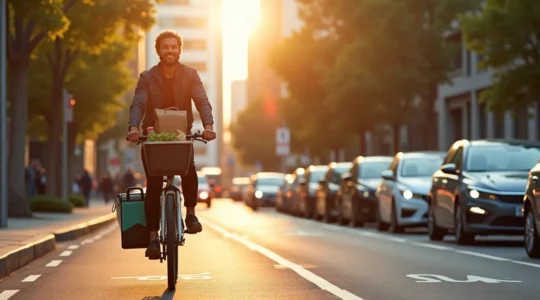
The Asset-Light Life: How to Own Nothing but Access Everything with E-Bikes and Car Share
In summary: Treat your e-bike as your primary daily vehicle and car-share as a specialized tool for specific jobs, not a 1-to-1 car replacement. Calculate your personal breakeven point; for most city dwellers, accessing vehicles via apps is far cheaper…
Read more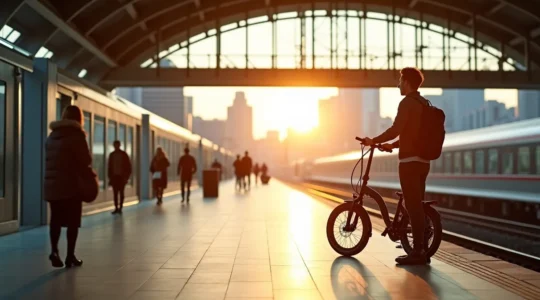
The Train + E-Bike Equation: A Logistician’s Guide to Conquering the 20+ Mile Commute
Mastering a long-distance multimodal commute is a logistics challenge, where the right equipment and strategy save more time and stress than raw speed. The critical failure point is often not the ride, but the transition: a bike that’s too heavy…
Read more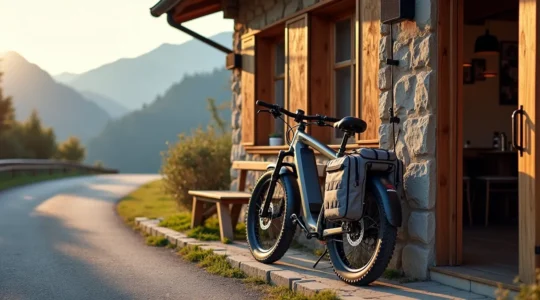
Credit Card Touring vs Camping: Managing E-Bike Charging Logistics on the Road
In summary: Mastering weight distribution by keeping loads low and forward is more critical than total weight for e-bike stability and safety. Successful on-the-road charging relies on a protocol of “charging diplomacy”—offering value as a customer rather than just asking…
Read more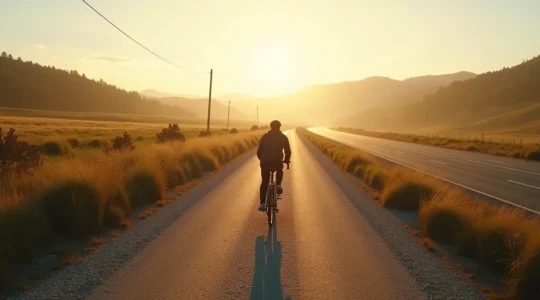
Gravel Paths vs Road Shoulders: Finding Safe E-Bike Routes Out of the City
The greatest barrier to escaping the city on your e-bike isn’t the distance; it’s the fear of the unknown. Mastering a few key logistical principles is what truly unlocks backcountry freedom. Proactively manage your battery as a finite resource, not…
Read more
Google Maps vs. Komoot: Which App Really Predicts Your E-Bike’s Battery Life?
The best e-bike navigation setup isn’t a single app; it’s about matching the right software and hardware to your specific ride to achieve predictive reliability. Komoot’s cyclist-sourced data model offers superior accuracy for off-road terrain and elevation, leading to more…
Read more