
Contrary to popular belief, the future of e-bike connectivity isn’t just about being a passive blip on a car’s radar; it’s about gaining an active voice to negotiate with city infrastructure itself.
- Vehicle-to-Everything (V2X) technology is evolving to allow cyclists to request green lights and predict intersection conflicts, transforming them into active participants.
- This new “Active Digital Presence” extends to security, with GPS tracking radically improving recovery rates, and to data privacy, which becomes a critical vulnerability to manage.
Recommendation: Future-proof your riding experience by understanding the difference between closed-off ecosystems like Bosch’s and open-source platforms, as this choice will define your bike’s ability to adapt to the smart city of tomorrow.
The conversation around e-bikes and smart cities often orbits a single, familiar promise: safety through visibility. We picture a future where cars, equipped with sophisticated sensors, can “see” cyclists, preventing tragic accidents. This vision, while important, is fundamentally passive. It frames the rider as a vulnerable object to be detected and avoided. But what if the true revolution isn’t just about being seen, but about being heard? What if your e-bike could do more than just announce its presence, but actively negotiate its journey through the urban landscape?
The emerging world of Vehicle-to-Everything (V2X) communication, integrated systems, and advanced connectivity is beginning to answer that question. We’re moving beyond simple GPS tracking towards an era where your e-bike has an Active Digital Presence. This isn’t just a technological upgrade; it’s a paradigm shift. It transforms the rider from a fragile road user into an empowered, predictive node within the city’s digital network. The implications touch everything from how we secure our bikes against theft and manage our digital privacy to the very standards of the plugs we use to charge them.
This article explores the architecture of that connected future. We will dissect the critical technologies that are already shaping the next generation of e-bikes, from universal charging standards and advanced anti-theft systems to the fundamental debate between closed and open-source software. We will also navigate the new risks that arise, such as digital privacy vulnerabilities and the legal complexities of speed-assisted travel, to provide a complete picture of the road ahead.
This guide unpacks the key technological shifts defining the future of connected cycling. Below, you will find a detailed breakdown of the innovations and challenges that will determine how you ride, charge, and secure your e-bike in the smart city of tomorrow.
Summary: The Future of the Connected E-Bike
- Why a Universal E-Bike Charging Plug Is the Holy Grail of Infrastructure?
- How Apple Find My and GPS Tags Are Changing Bike Recovery Rates?
- Bosch Smart System vs Open Source: Which Is Better for Future Proofing?
- The Error of Sharing Your Home Location via Strava or Companion Apps
- When Will Green Wave Technology Prioritize Cyclists at Intersections?
- When to Use Two Different Types of Locks to Confuse Thieves?
- How to Avoid “Bricking” Your Bike During a Bluetooth Update Failure?
- Navigating Speed Classes and Legal Limits for E-Assist on Public Roads
Why a Universal E-Bike Charging Plug Is the Holy Grail of Infrastructure?
The explosion of e-mobility has created a paradox: more freedom to ride, but more fragmentation in how we power that freedom. Every major manufacturer—Bosch, Shimano, Yamaha—has historically relied on proprietary chargers. This creates a significant barrier to building a truly seamless urban mobility network, a future where the global e-bike market is projected to grow from USD 26.4 Billion to over USD 45.5 Billion by 2033. For the rider, this means carrying a bulky charger or facing “range anxiety” not from battery life, but from charger incompatibility.
The quest for a universal standard is not just about convenience; it’s the foundational step for smart city integration. A standardized plug, like the one envisioned below, does more than transfer power. It enables a “digital handshake” between the bike and the charging station, opening the door for smart grids, shared public charging infrastructure, and integrated payment systems. It is the physical key to unlocking a network effect for e-bike adoption.
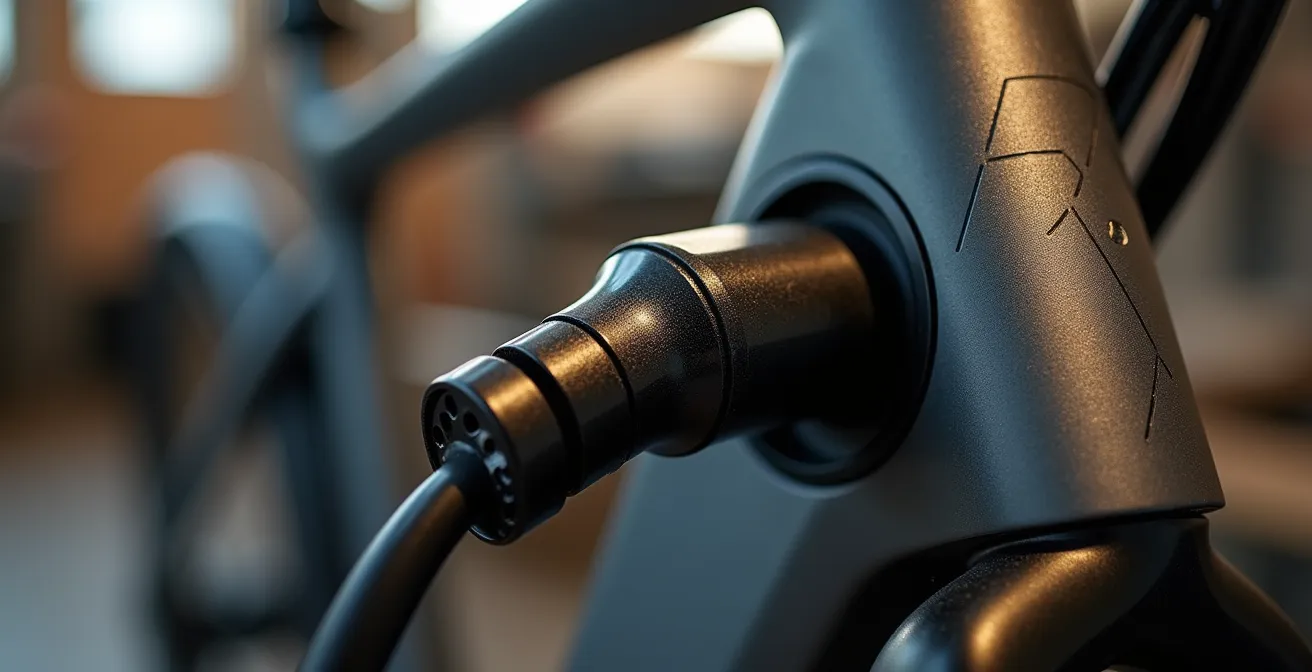
This vision is already taking shape. The Charge2Bike consortium, for instance, has pioneered a universal charging solution. By using adapters, their system is compatible with major brands like Bosch, Shimano, Yamaha, and Panasonic. As confirmed by Bosch CEO Claus Fleischer, the goal is an infrastructure where hire-bikes with this standard are commonplace within five years. This standard allows any compliant manufacturer to tap into universal stations, finally treating e-bike charging not as a product-specific problem, but as a public utility—the true holy grail for sustainable urban transport.
How Apple Find My and GPS Tags Are Changing Bike Recovery Rates?
As e-bikes become more valuable and ubiquitous, they have also become a prime target for thieves. Security data shows that e-bike thefts have surged in recent years, making robust security more critical than ever. Traditional locks provide a physical deterrent, but the real game-changer in recovery is the bike’s newfound ability to broadcast its location. The integration of GPS tags and networks like Apple’s Find My is fundamentally rewriting the story of a stolen bike from one of loss to one of retrieval.
These systems transform an e-bike from a piece of metal into a traceable asset. Unlike old, power-hungry GPS trackers, modern solutions leverage low-energy Bluetooth and vast, crowdsourced networks. An AirTag hidden in a bike’s frame, for example, can ping its location anonymously off any nearby iPhone, creating a powerful and discreet tracking web. This technology is so effective that it’s yielding unprecedented results. In one case, a Las Vegas police officer, commenting on a recovery facilitated by a built-in Urtopia GPS, remarked, “In 20 years, I’ve never seen a bike recovered like this.”
Manufacturers are now integrating this technology directly into the bike’s core system. Aventon’s Advanced Control Unit (ACU) is a prime example, embedding 4G connectivity and GPS tracking deep within the bike. This system enables advanced features like geofencing, which sends an alert if the bike leaves a predefined area, and remote control capabilities. If a thief tampers with the bike, the ACU can trigger a loud alarm while simultaneously notifying the owner’s phone with its precise location. This active, connected defense system marks a profound shift from merely resisting theft to actively enabling recovery.
Bosch Smart System vs Open Source: Which Is Better for Future Proofing?
As e-bikes become sophisticated computers on wheels, a critical question emerges for the tech-savvy rider: should you invest in a closed, meticulously curated ecosystem or an open, flexible platform? This is the core debate between proprietary solutions like the Bosch Smart System and the burgeoning world of open-source e-bike technology. The choice you make today will directly impact your bike’s adaptability, security, and long-term potential within the evolving smart city.
A closed system like Bosch’s offers a compelling proposition: seamless integration and guaranteed reliability. All components—motor, battery, display, and app—are designed to work together perfectly. Updates are delivered over-the-air (OTA) from a single, accountable source, ensuring stability and security. For the user, it’s a plug-and-play experience with clear lines of liability. However, this walled garden comes at the cost of flexibility. API access is limited to chosen partners, and hardware upgrades often require a complete system overhaul rather than modular component swaps.
Open-source platforms offer the opposite. They promise ultimate control and customization. Developers can freely create new applications, and users can mix and match components from different manufacturers. This fosters innovation and allows for modular upgrades, potentially extending the life of the bike. The trade-off is complexity and fragmented responsibility. Security relies on community-driven vigilance, and updates might require more technical know-how. The table below, based on the principles of closed vs. open platforms, outlines these key differences.
| Aspect | Bosch Smart System (Closed) | Open Source Platform |
|---|---|---|
| Security & Liability | Clear accountability (Bosch) | Distributed responsibility |
| API Access | Limited to partners | Open to all developers |
| Update Control | Centralized OTA updates | Community-driven updates |
| Hardware Evolution | Complete system upgrade required | Modular component upgrades |
| Data Ownership | Platform-controlled | User-controlled options |
Ultimately, the “better” choice depends on your priorities. If you value reliability, simplicity, and a single point of contact for support, a closed system is the way to go. If you are a tinkerer who values customization, control over your data, and the ability to adapt your bike to future technologies on your own terms, an open-source approach offers a more future-proof path.
The Error of Sharing Your Home Location via Strava or Companion Apps
In the connected era, every ride generates a trail of data breadcrumbs. Apps like Strava and other companion apps have turned cycling into a social, data-rich experience, but they have also created a significant and often overlooked vulnerability: the unintentional broadcasting of your home location. The simple act of starting and ending every ride from your front door creates a public heat map that points directly to where you live and, more importantly, where your expensive e-bike is stored.
This isn’t a hypothetical risk. Thieves are increasingly tech-savvy, using public ride data to target high-value bikes. Sharing your location undermines all the physical and digital security measures you have in place. It’s a critical blind spot in personal security, and it contributes to a general sense of unease that can deter people from cycling, a barrier that 24% of potential riders cite as a primary concern, according to a Shimano survey. The goal is to maintain your Active Digital Presence for safety and convenience on the road, while establishing a “digital dead zone” around your private life.
Protecting yourself requires a conscious strategy of digital obfuscation. It’s about taking control of your data footprint and making it harder for bad actors to connect the dots. Fortunately, both app developers and users have tools at their disposal to reclaim this privacy without sacrificing the social benefits of tracking their rides. The key is to move from default sharing to deliberate, controlled disclosure.
Your Action Plan: Advanced Privacy Protection for Cyclists
- Establish Privacy Zones: Enable privacy zones in your app’s settings with a minimum radius of 500 meters (or 1/3 mile) around your home and workplace to obscure your exact start and end points.
- Practice Data Poisoning: Occasionally start or stop recording a ride a few blocks away from your home, or even record a short, false route when not riding, to introduce noise into your public data.
- Segment Your Accounts: Create a separate, public-facing account for sharing rides with a community, and keep a private account for detailed personal training logs.
- Disable Automatic Uploads: Switch to manual uploads for all activities. This forces you to review each ride, its map, and its privacy settings before it goes public.
- Embrace Anonymity: Use pseudonyms for your public profiles and avoid linking your cycling accounts to other easily identifiable social media profiles like Facebook or Instagram.
When Will Green Wave Technology Prioritize Cyclists at Intersections?
For decades, the “green wave” has been a concept for cars—a sequence of traffic lights timed to allow for smooth, continuous travel along an artery. For cyclists, however, intersections remain the most dangerous and frustrating points of any urban journey. The advent of V2X (Vehicle-to-Everything) communication is poised to change this, finally giving cyclists the ability to “talk” to the infrastructure and request their own green wave.
This isn’t science fiction; it’s the next frontier of V2I (Vehicle-to-Infrastructure) technology. An e-bike equipped with a V2X unit can broadcast its position, speed, and intended path to a traffic management system. The system, in turn, can analyze this data in real-time. If it predicts a cyclist will arrive at a red light, it can choose to extend the current green phase or shorten the red phase, allowing the rider to pass through without stopping. This “Infrastructure Negotiation” not only improves efficiency and reduces rider fatigue but also drastically enhances safety by minimizing time spent in vulnerable intersection zones.
The groundwork for this future is being laid today. While still nascent, there are already around 1 million cars and 20,000 roadside units in Europe already equipped with V2X. The key is extending this “digital visibility” to cyclists. Recognizing this, the Coalition for Cyclist Safety—a group of 19 leading companies including Audi, Bosch, and Trek—is actively working on standardizing how bikes and cars communicate via V2X. Their focus is on ensuring that cyclists are not just passive dots on a map but active communicators within the road network.
The full deployment of cyclist-prioritized green waves depends on two factors: the widespread adoption of V2X units on bicycles and the upgrading of municipal traffic control systems to receive and act on their signals. While city-wide implementation is likely 5-10 years away, pilot programs are already proving the concept’s viability. The moment your bike can ask for a green light—and get one—is the moment the smart city truly begins to work for everyone.
When to Use Two Different Types of Locks to Confuse Thieves?
In the arms race against bike thieves, a single lock is often a single point of failure. Professional thieves are specialists; one might carry bolt cutters effective against chains, while another uses an angle grinder or a pry bar for U-locks. The most effective physical security strategy, therefore, is not about having the *strongest* single lock, but about deploying a dual-system defense that forces a thief to carry and use multiple, different tools, significantly increasing the time and noise required for the theft.
The principle is simple: pair two locks of fundamentally different designs. The classic and highly effective combination is a high-quality, hardened steel U-lock and a heavy-duty chain lock. This forces a thief to defeat two separate mechanisms that require different techniques and tools. A thief equipped to quickly cut a chain will be stymied by a thick U-lock, and one prepared to grind through a U-lock might not have the leverage or time to deal with a properly secured chain.
Implementing this strategy correctly is as important as the locks themselves. It’s about maximizing the thief’s effort and minimizing their opportunities. Here are the core tactics for a dual-lock strategy:
- Pair for a Purpose: Use a robust 16mm U-lock to secure the bike’s frame to an immovable object. Use a separate hardened chain lock to secure the rear wheel (and frame, if possible).
- Minimize Leverage: Position the U-lock high on the frame and ensure it’s filled with as much of the bike and object as possible, leaving no room for a pry bar or jack.
- Add a Digital Layer: Consider a smart alarm lock as a third layer. While not a physical barrier, its motion-detection alerts can spook a thief or notify you before they’ve even started cutting.
- Target Different Tools: The ultimate goal is to choose a lock combination that requires distinct tools to defeat, such as an angle grinder for one and powerful bolt cutters for the other.
This multi-layered approach, combining different physical challenges with a digital alert system, creates a formidable defense. It shifts the equation in your favor by making your e-bike a much less appealing target than the one next to it with a single, simple lock.
How to Avoid “Bricking” Your Bike During a Bluetooth Update Failure?
In the world of connected e-bikes, firmware updates are essential. They deliver new features, improve motor efficiency, and patch security vulnerabilities. Most of these updates happen seamlessly over-the-air (OTA) via a Bluetooth connection to your smartphone. However, this convenience introduces a new and terrifying risk: a failed update that can “brick” your bike, rendering its electronic system completely unresponsive and turning your high-tech ride into a very heavy conventional bicycle.
A “bricking” event typically occurs when the data transfer between your phone and the bike’s controller is interrupted. This can happen for a variety of reasons: your phone’s battery dies, you walk out of Bluetooth range, an aggressive battery-saving mode on your phone kills the app, or the wireless signal is unstable. When the update process is halted midway, it can leave the bike’s controller with corrupted, incomplete firmware, unable to boot up or function. For closed-ecosystem bikes like those using Bosch’s Smart System, this often means a trip to the dealer for a wired recovery.
Preventing this digital disaster requires treating a firmware update with the same seriousness as a delicate mechanical repair. It’s about creating a stable, controlled environment to ensure the data transfer completes without a hitch.
- Prepare Your Power: Ensure both your e-bike and your smartphone are charged to at least 50% before you begin. Never start an update on low battery.
- Create a Stable Environment: Park your bike in a cool, shaded area with a stable temperature. Keep your phone within 1 meter (3 feet) of the bike’s display for the entire process.
- Optimize Your Phone: Disable any battery-saving or power-optimization modes on your phone, as these are a primary cause of interrupted Bluetooth transfers.
- Download First, Then Install: If the app allows, download the entire firmware file to your phone before initiating the transfer to the bike.
- Have a Backup Plan: Always have the correct USB cable on hand. Some systems allow for a wired update recovery if the wireless process fails, which can save you a trip to the shop.
While manufacturers like Bosch are constantly improving the robustness of their OTA processes, the responsibility for creating a safe update environment ultimately falls on the rider. A few minutes of careful preparation can prevent a costly and frustrating system failure.
Key Takeaways
- The future of e-bike tech is shifting from passive safety (being seen) to an “Active Digital Presence” (communicating with infrastructure).
- A universal charging standard is the physical key to unlocking a truly integrated urban mobility network, moving beyond proprietary plugs.
- Your digital footprint is a major vulnerability; using privacy zones and other data hygiene practices is as crucial as using a good physical lock.
Navigating Speed Classes and Legal Limits for E-Assist on Public Roads
Your e-bike’s “Active Digital Presence” isn’t just about communication and convenience; it’s also a source of data that carries significant legal weight. As e-bikes get faster and more powerful, understanding the legal framework governing their use is paramount. The speed your bike is capable of, and where you ride it, is defined by a classification system that varies by region but generally follows a common structure. Navigating these rules is no longer just a matter of compliance—it’s a matter of liability.
Most jurisdictions, particularly in North America, categorize e-bikes into three main classes. This system determines what is legally considered a “bicycle” versus a motor vehicle, with major implications for where you can ride and what regulations you must follow. An e-bike’s class is defined by its maximum assisted speed and whether it has a throttle. This seemingly simple classification is the dividing line between riding freely on a bike path and needing a license and registration.
The following table breaks down the common e-bike classes, though you must always check your local state or provincial laws for specific regulations.
| Class | Max Assisted Speed | Motor Type | Legal Status |
|---|---|---|---|
| Class 1 | 20 mph (32 km/h) | Pedal-assist only | Treated as bicycle in most jurisdictions |
| Class 2 | 20 mph (32 km/h) | Throttle + pedal-assist | Some restrictions on bike paths |
| Class 3 | 28 mph (45 km/h) | Pedal-assist only | May require license/registration |
Here is where the connected nature of modern e-bikes becomes critical. In the event of an accident, the bike’s onboard controller is a black box holding a perfect record of your speed and motor output. This data is now easily accessible, creating a new layer of accountability, as one industry expert warns:
Insurance investigators can now easily pull data from the bike’s controller after an accident. If it shows assist was active above the legal limit, it can void coverage.
– Industry safety expert, E-bike liability analysis
This powerful quote highlights the new reality: your digital trail has real-world legal and financial consequences. Riding a modified or “unlocked” e-bike that exceeds its class limits is a risk that can extend far beyond a simple traffic fine. As you embrace the benefits of a connected ride, you must also accept the responsibility that comes with the data it generates.
The era of the e-bike as a simple, isolated machine is over. By embracing the technologies that give your bike an active voice and by consciously managing the digital footprint you create, you are not just a rider anymore—you are a pioneer of a smarter, more connected, and more efficient urban future.