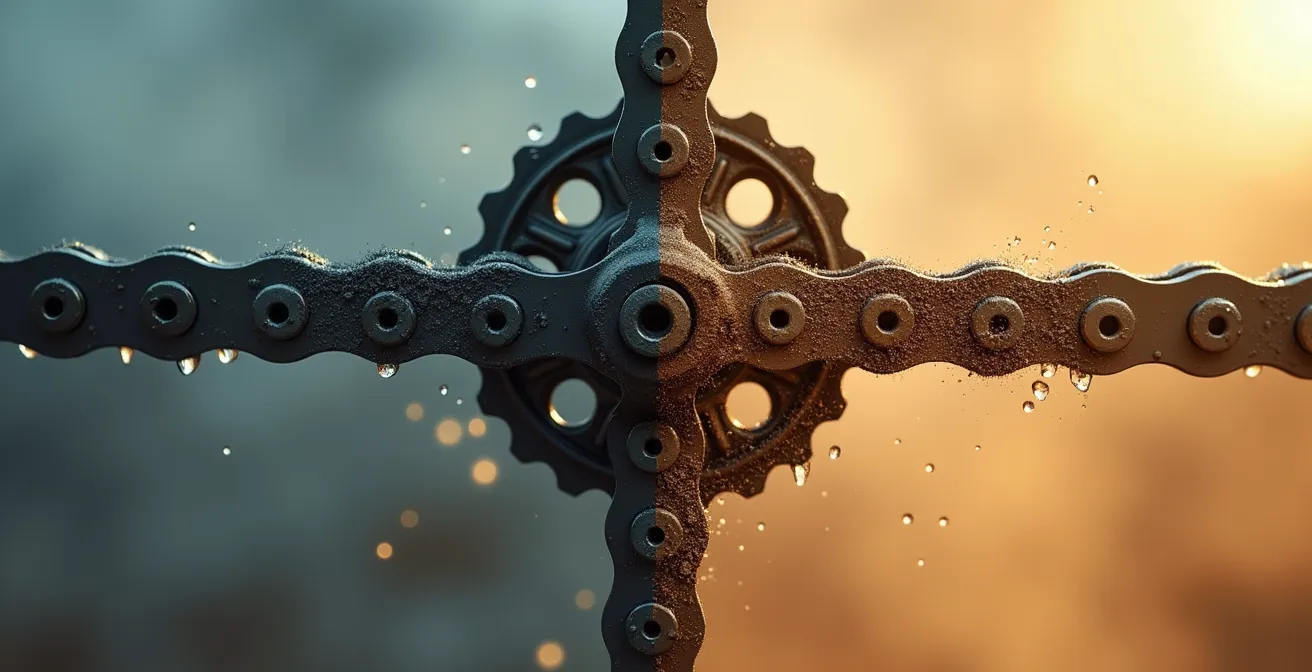
The extreme torque of a mid-drive e-bike renders conventional lubrication methods not just ineffective, but actively destructive to your drivetrain.
- High torque accelerates chain elongation (stretch) at a rate far exceeding that of a non-assisted bicycle, making proactive measurement critical.
- Applying new lube over a dirty chain creates an abrasive “grinding paste” that catastrophically accelerates component wear.
- Specialized lubricants and techniques like hot wax dipping are not luxuries but necessary investments to preserve drivetrain integrity under e-bike loads.
Recommendation: Shift from a “lubricate when noisy” mindset to a “clean-to-lubricate” protocol using a high-pressure lubricant, and replace your chain at 0.5% wear, not 0.75%.
For many e-bike owners, a frustratingly rapid decline in drivetrain performance has become a predictable reality. A once-silent system quickly develops clicks, grinds, and skips, leading to costly and frequent component replacements. Riders are often overwhelmed by a wall of lubricant choices at the bike shop, each promising a miracle cure. The conventional wisdom passed down from the world of traditional cycling—choose wet lube for wet conditions, dry for dry, and apply it regularly—seems logical, yet proves woefully insufficient.
The core of the problem is often misunderstood. It’s not simply a matter of choosing a better “flavor” of oil. The fundamental physics at play in a high-torque, mid-drive e-bike system are an order of magnitude more demanding than what a human cyclist can produce. Standard lubricants, designed for lower pressures and shear forces, fail to maintain a protective boundary film between metal surfaces. This failure initiates a cascade of rapid wear that no amount of simple re-lubrication can halt.
But what if the key wasn’t finding the perfect single bottle of lube, but adopting a completely different, more scientific approach to drivetrain maintenance? This guide abandons the superficial advice and delves into the tribological principles governing e-bike chain wear. We will explore why standard oils fail, the catastrophic effect of contamination, and the specific strategies—from precise application techniques to advanced waxing systems—that are required to manage the immense forces your e-bike generates. This is not just about keeping your chain quiet; it’s about preserving the entire system from premature failure.
This article provides a detailed analysis, based on tribological science and real-world data, to help you understand and manage the unique challenges of e-bike drivetrain maintenance. The following sections break down the critical concepts you need to master.
Summary: A Scientific Approach to E-Bike Chain Longevity
- Why Standard Bike Oil Fails Under the Torque of a Mid-Drive Motor?
- How to Apply Lube to the Rollers Only to Keep the Chain Clean?
- Hot Wax Dipping: Is It Worth the Effort for Daily Commuters?
- The Mistake of Adding Lube Over Dirty Lube That Creates Grinding Paste
- When to Use Silicone Spray on a Carbon Belt Drive System?
- The Mistake of Waiting Until the Chain Skips to Measure Wear
- Why 85Nm of Torque Stretches Steel Links Twice as Fast?
- Why E-Bikes Eat Chains: Managing Wear on High-Torque Mid-Drive Systems
Why Standard Bike Oil Fails Under the Torque of a Mid-Drive Motor?
The fundamental reason standard lubricants underperform on e-bikes lies in the concept of film strength. A lubricant’s primary function is to create a microscopic, high-pressure layer—a “boundary film”—that prevents direct metal-on-metal contact between the chain’s rollers and pins. On a conventional bicycle, the force applied by the rider is intermittent and relatively low. However, a mid-drive motor introduces sustained, high-torque loads that can literally squeeze a standard lubricant out from between these critical surfaces. When this film collapses, the result is accelerated abrasive wear.
This isn’t theoretical; it’s a documented phenomenon. In an engineering analysis, Jakob Deraas Grimsgaard of Kindernay points out, “The added torque of eMTB (mid)motors translates into increased chain tension and much higher rates of wear on the drivetrain, and in particular, on the chain.” This increased tension directly impacts component lifespan. Indeed, research from Kindernay engineering shows that e-bike chains may need replacement every 2000 miles, a stark contrast to the 5000-plus miles achievable on many regular bikes.
Standard bike oils, particularly lightweight “dry” lubes, often lack the necessary additives and base oil viscosity to withstand this immense pressure. They shear away, leaving the steel components to grind against each other. This leads to the primary mode of failure in e-bike chains: not breaking, but material elongation, commonly known as “stretch.” The holes in the inner and outer plates enlarge, and the pins wear down, increasing the effective pitch of the chain. This mismatched pitch then begins to wear the cassette and chainring teeth into a hooked shape, necessitating a full, expensive drivetrain replacement.
How to Apply Lube to the Rollers Only to Keep the Chain Clean?
Effective lubrication is a game of precision, not saturation. The most common mistake riders make is over-applying lubricant, coating the entire exterior of the chain. From a tribological perspective, this is counterproductive. The only part of the chain that requires lubrication is the internal interface between the pin and the roller. Lubricant on the outside of the chain plates serves no purpose other than to act as a magnet for dirt, dust, and grime, which are the primary ingredients of the destructive “grinding paste” we seek to avoid.
The professional method focuses on delivering a minimal amount of lubricant exclusively to the point of entry: the rollers. The following steps ensure that the lubricant gets where it is needed—and nowhere else.
- Degrease Completely: Always start with a surgically clean chain. Use a bike-specific degreaser to strip all old lubricant and contaminants. Never apply new lube over old.
- Choose Appropriately: Select a lubricant engineered for high-pressure applications, considering your typical riding conditions.
- Apply Precisely: While slowly backpedaling, apply one single, small drop of lubricant directly onto the top of each chain roller. This requires patience but is the most critical step.
- Allow for Penetration: Let the chain sit. Wet lubes can penetrate almost immediately, but wax-based dry lubes may require several hours for the carrier to evaporate, leaving the lubricating film behind.
- Wipe Aggressively: This is the step most people fail to perform correctly. Take a clean, dry rag and wipe off all excess lubricant from the outside of the chain. The exterior of the side plates should appear almost dry to the touch. The necessary lubricant is now safely inside the rollers.
This “less is more” approach ensures the chain runs quietly and efficiently while dramatically reducing the accumulation of abrasive contaminants. It shifts the goal from a “wet-looking” chain to a clean-running, internally lubricated system.
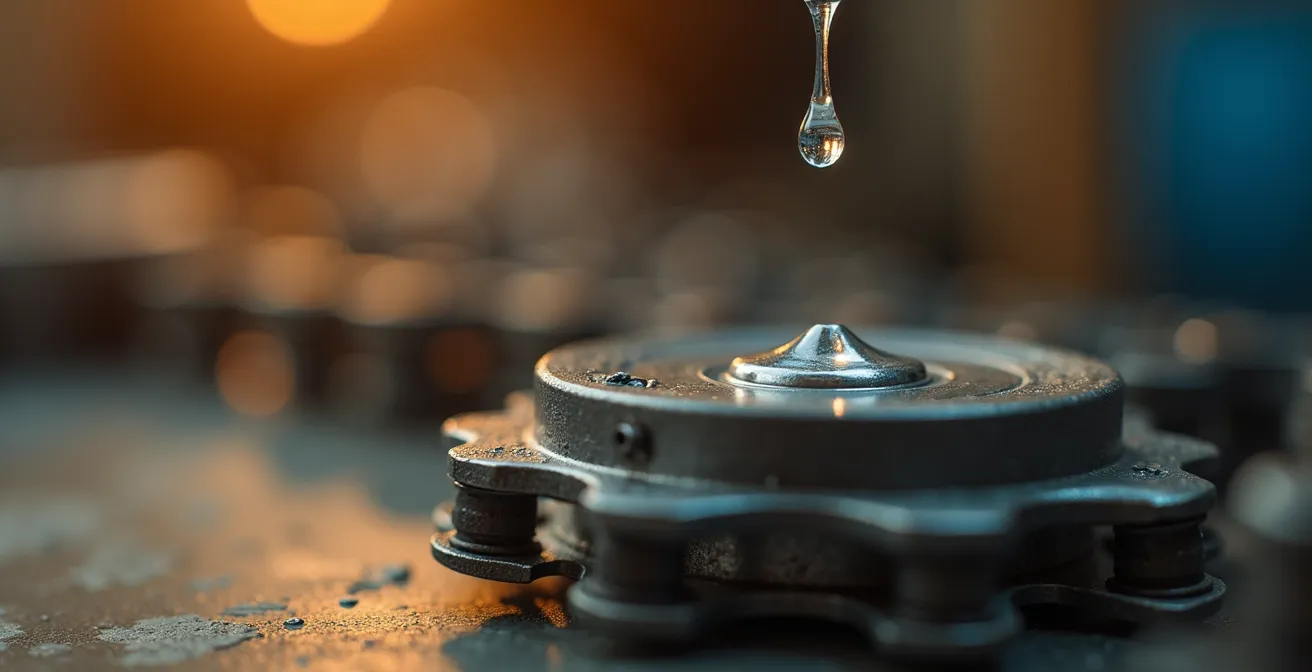
As this image demonstrates, the goal is a targeted application directly to the roller, which allows capillary action to draw the lubricant into the high-friction internal surfaces of the chain.
Hot Wax Dipping: Is It Worth the Effort for Daily Commuters?
For the rider seeking the absolute pinnacle of drivetrain performance, cleanliness, and longevity, hot wax dipping represents a significant paradigm shift from traditional drip lubricants. The process involves removing the chain, stripping it of all factory grease, and immersing it in a molten paraffin wax blend, often in a dedicated small crockpot. The hot, low-viscosity wax penetrates every internal part of the chain. As it cools, it solidifies into a hard, dry, and extremely slippery sacrificial layer of lubricant that is highly resistant to contamination.
The primary advantage is cleanliness. A waxed chain does not attract dirt because it is completely dry to the touch. This eliminates the formation of grinding paste. The trade-off is the initial effort and investment. However, for a high-mileage e-bike commuter, the economic benefits can be substantial, as highlighted by data from lubricant specialists.
| Factor | Traditional Wet Lube | Hot Wax System |
|---|---|---|
| Initial Investment | $15 (bottle of lube) | $150 (crockpot, wax, 3 chains) |
| Chain Lifespan | 1,000 miles | 4,000 miles |
| Cassette Lifespan | 2,000 miles | 8,000 miles |
| Annual Component Cost (12,000 miles/year) | $480 (12 chains + 6 cassettes) | $180 (3 chains + 1.5 cassettes) |
| Efficiency Gain | Baseline | 1-3% battery range increase |
| Break-even Point | N/A | 6 months / 6,000 miles |
Beyond cost savings, there’s a measurable performance benefit. As a case study on the topic explains, independent testing by Zero Friction Cycling has repeatedly shown that hot wax systems are the cleanest and fastest options, maximizing drivetrain life. For an e-bike rider, the reported 1-3% increase in efficiency translates directly into tangible gains in battery range per charge. While the upfront procedure is more involved than using a drip bottle, the long-term financial savings and performance gains make it a compelling option for dedicated commuters.
The Mistake of Adding Lube Over Dirty Lube That Creates Grinding Paste
The single most destructive maintenance error an e-bike owner can make is applying fresh lubricant to a chain that has not been thoroughly cleaned. This seemingly innocuous act creates a viscous, abrasive compound that technicians refer to as “grinding paste.” The fresh lubricant mixes with the old, contaminated lube, which is already saturated with road grit, sand, and metallic particles from normal wear. Instead of lubricating, this dark, gritty slurry acts like a liquid form of sandpaper, circulating throughout the entire drivetrain.
This paste aggressively attacks the most vulnerable and expensive parts of the system. It accelerates the wear on cassette cogs, rounding off their teeth and creating deep valleys. It grinds away at the softer aluminum of chainring teeth, sharpening them into points. And most critically, it works its way inside the chain rollers, where it polishes away the pins and bushings, dramatically accelerating chain elongation. The chain’s pitch no longer matches the cogs, and the system begins to skip under load—a clear sign that catastrophic wear has already occurred.
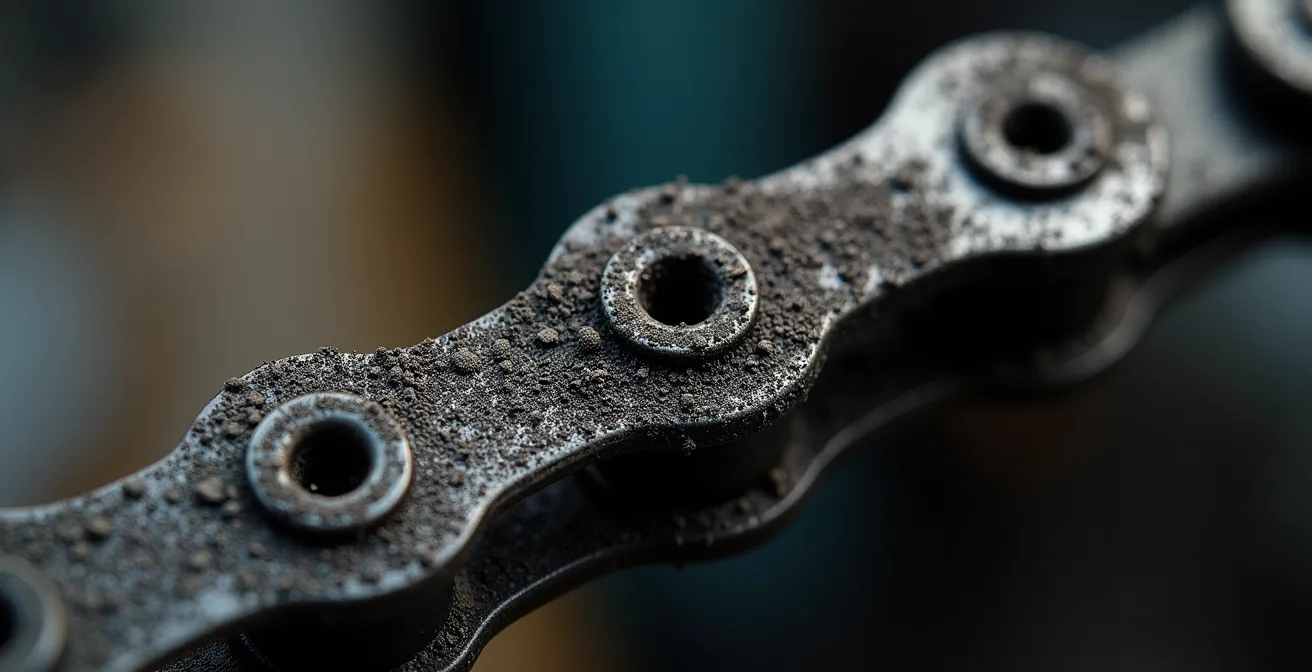
The microscopic damage seen here is not just cosmetic. Each particle of grit embedded in the old lubricant becomes a cutting tool that actively destroys the precision-engineered surfaces of your drivetrain with every pedal stroke. The financial consequence of this neglect is significant; industry data shows that skipping proper chain cleaning can cost e-bike commuters over $200 per year in unnecessary component replacement, a cost that is entirely avoidable with a proper “clean-to-lubricate” protocol.
When to Use Silicone Spray on a Carbon Belt Drive System?
For riders whose e-bikes are equipped with a carbon belt drive, the rules of lubrication are completely inverted. The primary principle of a belt drive system is that it is designed to run 100% dry. The materials—typically a polyurethane body with carbon fiber tensile cords—require no external lubrication for power transmission. Applying any form of traditional chain lubricant (wet, dry, or wax-based) is not only unnecessary but actively harmful. These substances can degrade the belt’s materials and will create a sticky surface that attracts dust and grit, leading to premature wear of the belt and cogs.
There is, however, one very specific and limited scenario where a lubricant is permissible: diagnostics. If a belt drive system develops a persistent squeak or chirp, and you have already verified that belt tension and pulley alignment are correct according to the manufacturer’s specifications, a minimal application of silicone spray can be used as a tool to locate the source of the noise. It is not a long-term solution.
The correct procedure is to apply a very small amount of 100% silicone spray (never a petroleum-based product like WD-40) only to the toothed, or “ribbed,” side of the belt. Do not spray the outside. If the noise disappears, it indicates that an issue with the belt/cog interface is the likely cause, often related to minor contamination or humidity. The silicone provides a temporary quiet period but the underlying cause, often alignment or tension, should still be addressed. Using it as a regular “preventative maintenance” step is incorrect and will ultimately cause more harm than good by attracting abrasive debris.
The Mistake of Waiting Until the Chain Skips to Measure Wear
In the world of high-torque e-bikes, waiting for the chain to start skipping gears is the equivalent of waiting for your car’s engine to seize before checking the oil. By the time symptoms like skipping or poor shifting become apparent, the chain is long past its replacement point, and it has likely inflicted irreparable damage on the much more expensive cassette and chainrings. The key to economic and effective drivetrain maintenance is proactive measurement, not reactive replacement.
An e-bike chain does not “stretch” in the sense of the steel plates becoming longer. Instead, wear occurs at the pivot points: the pins and the rollers. As these tiny components wear down, the distance between each roller increases. This change in “pitch” is what a chain checker tool measures. For standard bicycles, the accepted replacement threshold is 0.75% elongation. For e-bikes, this is far too late. Due to the high forces involved, e-bike maintenance experts recommend chains should be checked every 500 miles and replaced at 0.5% wear. Adhering to this tighter tolerance is what saves the cassette. A slightly worn chain can be replaced for a modest cost; a cassette damaged by an overly-worn chain is a far more expensive proposition.
Investing in a quality, non-drop-in style chain checker tool is essential. Cheaper “drop-in” tools can give inaccurate readings by measuring roller play in addition to pin wear. A precision tool provides an accurate measurement of pin wear only, allowing you to replace the chain at the precise moment to maximize the life of your entire drivetrain.
Action Plan: E-Bike Chain Wear Prevention
- Frequent Checks: Check chain wear every 250 miles (400 km) using a quality, non-drop-in style chain checker tool.
- Early Replacement: Replace the chain immediately once it reaches 0.5% elongation to protect the more expensive cassette and chainrings from premature wear.
- Precision Tooling: Use a tool like the Shimano TL-CN42 or a similar precision gauge that measures only pin wear, not roller movement, for the most accurate reading.
- Strategic Spares: Keep a spare chain on hand. With correctly timed replacements, a single cassette can often last for the lifespan of three to five chains, dramatically lowering long-term costs.
- Log Your Mileage: Document your mileage at each check and replacement to establish a predictive maintenance schedule based on your specific bike, motor, and riding style.
Why 85Nm of Torque Stretches Steel Links Twice as Fast?
The term “torque” is often used in e-bike marketing, but its direct physical impact on the chain is frequently underestimated. Torque is a measure of rotational force, and in a mid-drive e-bike, the motor applies this force directly to the chainring, which in turn pulls on the chain. The sheer magnitude of this force is where the problem lies. A professional road cyclist might generate a peak torque of 40-50 Newton-meters (Nm) in a short sprint. By contrast, many modern mid-drive e-bikes deliver a sustained 85Nm of torque, and some high-performance models can exceed 120Nm.
This sustained, high-level force subjects the chain’s components to immense tensile stress. Every time you accelerate from a stop or climb a hill with motor assistance, the chain is being stretched with a force it was never designed to handle in the world of traditional cycling. This constant, high-tensile load accelerates the wear process at the chain’s weakest points: the pins and the inner surfaces of the rollers. The steel is literally worn away molecule by molecule, leading to the rapid elongation that defines e-bike chain wear.
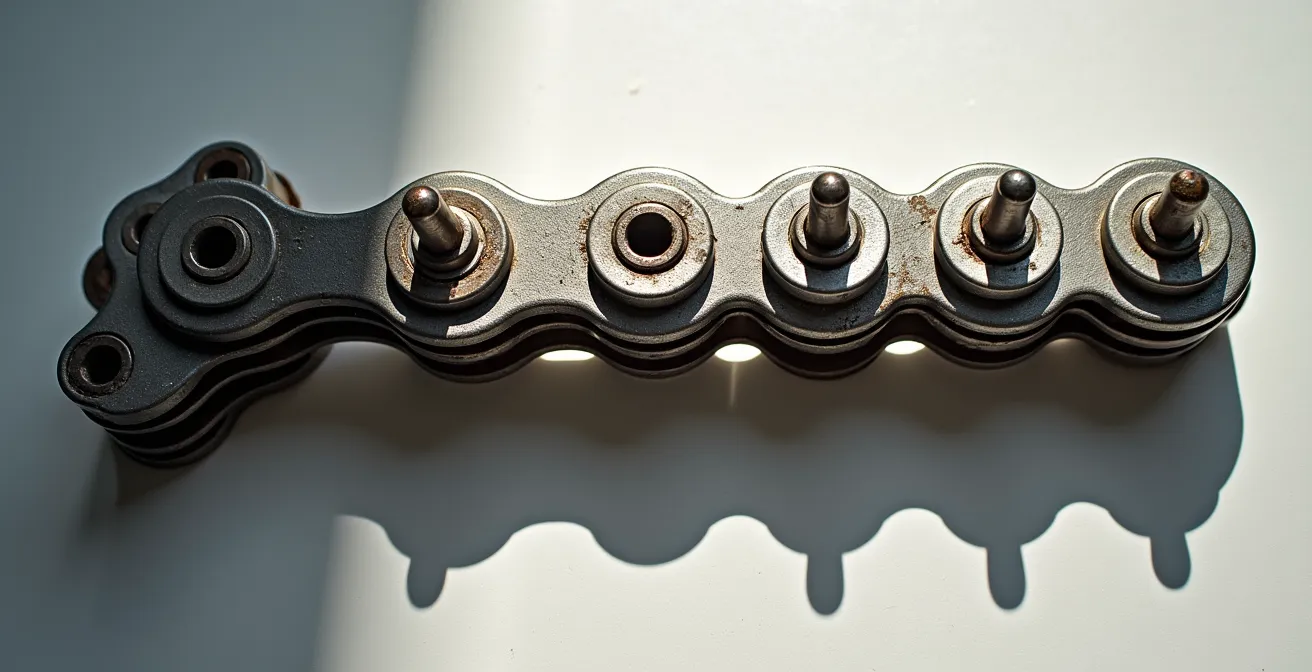
This cross-section illustrates the effect: the pin’s diameter is reduced, and the bushing’s inner wall is eroded. Real-world data from riders confirms this accelerated wear. In a detailed case study of user experiences, riders of powerful mid-drive systems reported chains reaching the 0.75% wear mark in as little as 1,500 miles, a fraction of what would be expected on a non-electric bike. This is the direct, physical consequence of subjecting standard bicycle components to motor-level forces.
Key Takeaways
- Torque is the Primary Culprit: The sustained high torque of an e-bike motor, not the rider, is the main cause of accelerated chain wear and lubricant failure.
- Cleanliness is Paramount: A dirty chain creates an abrasive “grinding paste.” The rule is not to just “lube,” but to “clean-to-lubricate,” ensuring the chain is surgically clean before any new application.
- Measure Early and Often: E-bike chains must be replaced at 0.5% wear, not the traditional 0.75%, to save the more expensive cassette and chainrings from damage. Proactive measurement is the most cost-effective strategy.
Why E-Bikes Eat Chains: Managing Wear on High-Torque Mid-Drive Systems
Synthesizing these tribological principles, a clear picture emerges: e-bikes consume chains at an accelerated rate because they operate in a completely different physical realm than their non-assisted counterparts. The combination of high tensile load from the motor, increased potential for contaminant ingress during all-weather commuting, and the use of lubricants not formulated for such high pressures creates a perfect storm for rapid drivetrain degradation. It is a system under constant, heavy assault.
The specific type of motor and riding conditions create a wide spectrum of wear rates. A powerful, high-torque motor used aggressively on hilly, unpaved trails will wear a chain far faster than a modest commuter bike used on flat terrain. This variability underscores the need for a personalized, measurement-based maintenance schedule rather than a one-size-fits-all approach based on time or distance alone.
| E-Bike Type | Typical Chain Lifespan | Key Wear Factors |
|---|---|---|
| E-MTB (Mid-Drive) | 300-500 km | High torque + rough terrain + dirt exposure |
| Commuter E-Bike | 2,000-6,000 km | Daily use + weather exposure + stop-and-go |
| Trekking E-Bike | Up to 20,000 km | Hub gears + optimal gearing + maintained well |
| City E-Bike | 4,500-10,000 km | Frequent starts + high gear stress |
| Road E-Bike | 4,000-5,000 km | High cadence + sustained power output |
Ultimately, managing e-bike chain wear requires abandoning the casual maintenance habits of the past. It demands a scientific mindset that prioritizes cleanliness above all, employs lubricants as precision tools rather than general-purpose coatings, and relies on empirical data from a quality chain-checker tool to dictate replacement intervals. Treating the chain as a consumable, sacrificial component—to be replaced early at the 0.5% wear mark—is the only financially sound strategy to protect the long-term health of the entire drivetrain system.
Armed with this tribological knowledge, your next step is to critically evaluate the lubricants in your workshop and select a product engineered specifically for the high-pressure environment of your e-bike’s drivetrain, implementing a proactive clean-and-measure maintenance protocol.
Frequently Asked Questions About E-Bike Drivetrain Maintenance
Do carbon belt drives need regular lubrication like chains?
No, belt drives are designed to run 100% dry and require no lubrication for power transmission. Using any lubricant as preventative maintenance is incorrect and can attract dust, leading to premature wear.
When is silicone spray appropriate for belt drives?
Silicone spray should only be used as a diagnostic tool to silence squeaks. Apply minimally to the toothed side only if noise persists after checking tension and alignment.
What lubricants should never be used on belt drives?
Never use petroleum-based or wet/dry chain lubricants. These chemicals can degrade the polyurethane and carbon fiber materials, creating a sticky mess that destroys the belt and cogs.