
The step-through frame’s design isn’t about compromise; it’s a strategic advantage for high-efficiency urban transport.
- Modern engineering has solved historical stability issues, making low-step frames robust for both cargo and speed.
- The ease of mounting and dismounting creates significant, compounding time and energy savings in stop-and-go environments.
Recommendation: Evaluate your next bike based on its daily utility and “micro-efficiencies,” not on outdated frame prejudices.
For decades, the low-step or “step-through” bike frame has been unfairly typecast. Mention it, and the image that often comes to mind is that of a leisurely senior rider or someone in a flowing skirt—a design choice dictated by accessibility and modesty rather than performance. This perception leads many younger, practical urban riders to dismiss it in favor of the traditional, “more serious” diamond frame. But this view is becoming increasingly obsolete.
The conversation around urban mobility is changing. It’s no longer just about top speed or aggressive posture; it’s about efficiency, versatility, and integration into a complex daily routine. What if the very feature that made the low-step frame seem “lesser”—its open, accessible design—is actually its greatest asset in the demanding, stop-and-go reality of city life? The true measure of an urban bike’s performance isn’t found on a race track, but in the dozens of small actions it facilitates every day: carrying groceries, making quick stops, navigating traffic, and arriving at your destination without a wardrobe change.
This article dismantles the old myths by focusing on the modern, functional argument for the low-step frame. We will explore its specific advantages in scenarios that define urban riding, from cargo safety and professional commuting to the raw efficiency demanded by delivery work. We will also tackle the technical objections and demonstrate how today’s engineering has transformed this classic design into a powerful tool for the contemporary city dweller.
Dive into the specific contexts where the low-step frame doesn’t just compete, but excels. The following sections break down the practical, evidence-based reasons why your next urban bike might just have a lower top tube.
Summary: Why Low-Step Frames Are Not Just for Seniors: The Urban Utility Argument
- Why Step-Through Frames Are Safer When Carrying 50 lbs of Cargo?
- How to Ride in a Suit or Skirt Without Wardrobe Malfunctions?
- Step-Through vs Diamond Frame: Is There Really a Wobble at High Speeds?
- The Advantage of Step-Throughs for Delivery Riders Making 50 Stops a Day?
- When to Choose Low-Step for Better Resale Value in the Family Market?
- The Error of Buying a 60lb Bike You Can’t Lift Up Station Stairs
- Poncho vs Jacket: Which Keeps Your Pants Dry Without Overheating?
- Replacing a Second Family Car With an E-Bike: Is It Realistic for Suburban Parents?
Why Step-Through Frames Are Safer When Carrying 50 lbs of Cargo?
When you’re carrying a heavy load, the most critical moments are not when you’re at speed, but when you’re starting and stopping. A 50-pound load of groceries or a child in a rear seat dramatically raises a bike’s center of gravity. With a traditional diamond frame, dismounting requires swinging a leg high over the saddle and the cargo, a move that can easily lead to a loss of balance. The step-through frame eliminates this risk entirely. You can simply step through the frame, keeping both feet close to the ground and maintaining a low, stable center of gravity at all times.
This inherent stability is why so many of today’s leading cargo e-bikes are built on low-step platforms. It’s not an aesthetic choice; it’s a calculated decision based on physics. Modern cargo bike manufacturers go to extreme lengths to validate this safety. For example, some brands follow rigorous testing protocols that simulate the multi-directional stresses of a bike’s entire lifespan with heavy loads. As detailed in Tern Bicycles’ safety testing overview, frames and forks undergo hundreds of thousands of stress cycles to ensure they can handle the dynamic forces of urban cargo hauling, proving that modern step-through designs are anything but weak.
Properly loading your cargo is just as important as the frame design itself. To maximize this built-in safety, follow a clear methodology for securing your items.
Your Action Plan: Safe Cargo Loading on a Step-Through Bike
- Positioning is Priority: Always place heavier cargo as low and as centered as possible within the bike’s wheelbase. Use ratchet straps or cargo netting to ensure nothing can shift during transit.
- Manage Your Load Length: As a rule of thumb, ensure your cargo load does not extend more than 30% of the bike’s wheelbase length. This helps maintain stable handling and effective braking.
- Balance Side Loads: When using panniers, distribute weight as evenly as possible on both sides. Avoid stacking items high on a rear rack, as this creates a top-heavy, unstable load.
- Conduct Regular Brake Inspections: Your brakes work harder with cargo. Inspect them monthly or every 500 km, and replace brake pads that are worn thinner than 1.5 mm immediately.
- Secure and Double-Check: Before every ride with cargo, physically check that all straps are tight and bags are securely clipped in. A loose item can become a dangerous hazard in traffic.
How to Ride in a Suit or Skirt Without Wardrobe Malfunctions?
The daily commute is not a race; for many, it’s the transition between home life and professional life. Arriving at the office presentable and unruffled is a major priority. This is where the step-through frame offers a clear, practical advantage that has nothing to do with age or gender, and everything to do with functional ergonomics. A diamond frame forces an athletic, high-leg swing to mount—a maneuver that’s awkward in a tailored suit and nearly impossible in a pencil skirt without risking a tear or a serious wrinkle.

The low-step design allows a rider to simply step through the frame, keeping their attire perfectly in place. This isn’t just about comfort; it’s about preserving your professional image. The action is graceful, effortless, and removes a significant barrier for anyone who wants to integrate cycling into their workday without needing a full change of clothes at their destination. This small detail completely changes the viability of bike commuting for a huge segment of the workforce.
Case Study: Designing for the Professional Commuter
Bike manufacturers are increasingly recognizing this need. For instance, the design philosophy behind bikes like the Public C7 shows a clear focus on the commuter. Features are not just about performance, but about practicality. An integrated chainguard is a simple but crucial element that protects trousers and skirts from getting snagged in the drivetrain and stained with grease. Furthermore, ergonomic handlebars that promote an upright riding position not only enhance comfort but also help prevent a suit jacket from bunching up and wrinkling. These design choices, combined with a step-through frame, create a machine perfectly tailored to the needs of the urban professional.
Step-Through vs Diamond Frame: Is There Really a Wobble at High Speeds?
One of the most persistent criticisms leveled against step-through frames is that they lack torsional rigidity, leading to a “wobbly” or flexible feel, especially at higher speeds or under heavy pedaling. While this may have been true for older, weaker steel frames, it’s a largely outdated myth when applied to modern bike engineering. Today’s manufacturers use advanced materials and techniques to create step-through frames that are exceptionally stiff and stable.
Techniques like hydroforming allow designers to shape aluminum tubes into complex, oversized, and strategically reinforced profiles that dramatically increase strength without a major weight penalty. On e-bikes, the innovation is even more pronounced. The large down tube that houses the battery is often engineered to act as a massive, rigid spine for the entire frame. This integration of the battery pack as a structural component adds immense torsional rigidity, resulting in a modern step-through that feels solid, stable, and responsive, directly countering the old “wobble” narrative.
For the vast majority of urban riding, the debate is purely academic. The perceived stability advantage of a diamond frame only becomes a factor at speeds most commuters rarely, if ever, reach.
| Speed Range | Step-Through Stability | Diamond Frame Stability | Practical Impact |
|---|---|---|---|
| 0-15 mph (Urban) | Excellent | Excellent | No discernible difference for the rider. |
| 15-25 mph (Commuting) | Very Good | Excellent | Minimal difference; may be felt by very aggressive riders, but not typical commuters. |
| 25+ mph (High Speed) | Good with modern design | Excellent | Only relevant for a tiny fraction of urban riding scenarios. |
This data, which aligns with the findings in studies on bicycle stability dynamics, shows that in the typical urban speed range, the structural differences have no practical impact on safety or control. The choice should be based on utility, not on a high-speed performance metric that doesn’t apply to the use case.
The Advantage of Step-Throughs for Delivery Riders Making 50 Stops a Day?
Nowhere is the urban utility argument for step-through frames more evident than in the world of last-mile delivery. For a delivery rider, a bicycle is not a recreational vehicle; it is a tool for high-frequency work. A rider making 50, 70, or even 100 stops in a single shift is performing the action of mounting and dismounting constantly. This is where micro-efficiencies become paramount. Saving two or three seconds and a small amount of physical effort on every single stop might seem trivial, but over the course of a day, it compounds into significant time and energy savings.
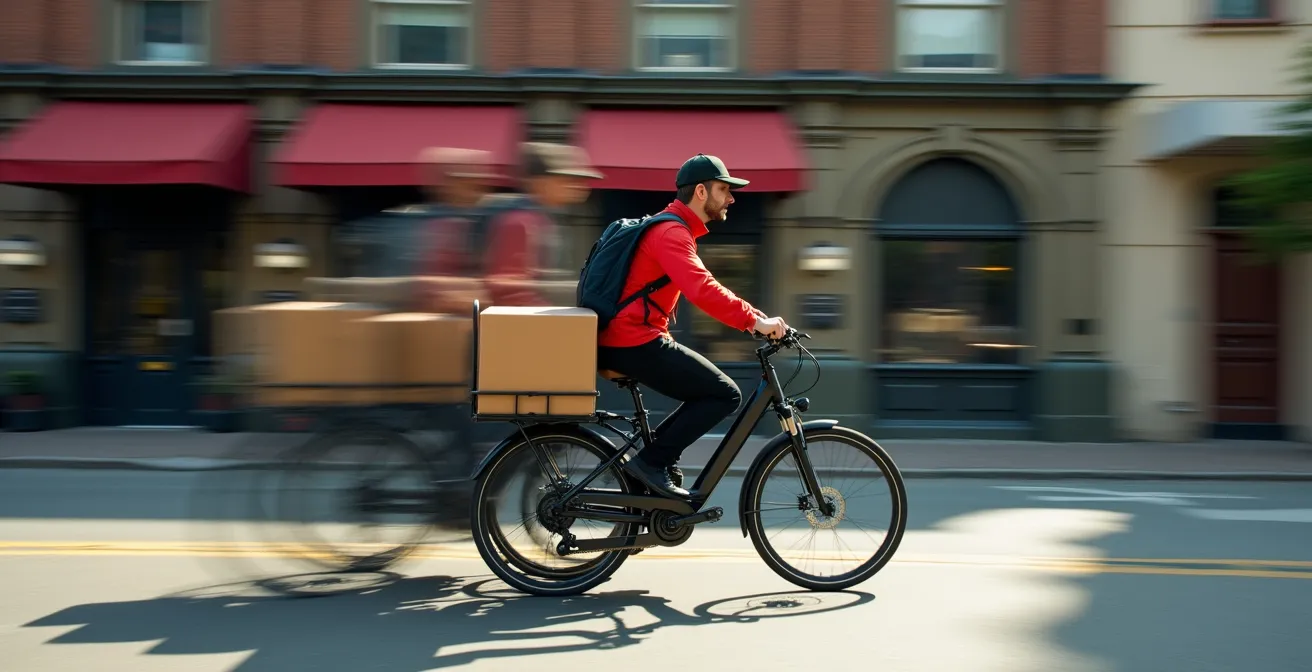
A diamond frame requires the rider to swing a leg over the frame or a loaded rear rack every time they stop and every time they start. A step-through frame reduces this to a simple, fluid motion. This reduces physical fatigue, allowing the rider to stay fresher and more alert for longer, which is also a safety factor. The economic impact is profound. The efficiency gained allows for more deliveries per hour, directly increasing earning potential and reducing the cost per delivery. A comprehensive last-mile delivery study shows the operational cost can be as low as €0.10 per parcel for a cargo bike, compared to €1.10 for a diesel van.
Case Study: Cargo Bikes Outpacing Vans in Dense Cities
The advantage isn’t just theoretical. Real-world studies in congested urban centers like London and Paris have demonstrated that cargo bikes consistently outperform delivery vans in terms of average speed. Riders can leverage a city’s infrastructure in ways vans cannot—cutting through traffic, using bike lanes and bus lanes, and taking shortcuts through streets closed to cars. This agility, combined with the mount/dismount efficiency of a step-through design, creates a delivery system that is not only greener and cheaper but often significantly faster for the final leg of a package’s journey.
When to Choose Low-Step for Better Resale Value in the Family Market?
Thinking about a bike as a long-term investment involves considering its resale value. While niche, high-performance bikes might appeal to enthusiasts, a bike with broader appeal will almost always be easier to sell and retain more of its value in the general market. This is where the step-through frame becomes a strategic financial choice, particularly for families.
A step-through bike is inherently more accessible to a wider range of people. It can be comfortably used by a tall parent, a shorter parent, a visiting grandparent, or a teenager. This versatility makes it a “one size fits most” family asset. When it comes time to sell, your potential market isn’t limited to athletic adults of a specific height. It includes:
- Commuters of all ages looking for practicality.
- Older riders who value safety and ease of use.
- Parents looking for a shared-use family bike.
- Anyone with minor mobility or flexibility issues.
This larger pool of potential buyers naturally creates more demand, leading to a faster sale and a better price. The cargo bike market, where step-through designs are prevalent, is a perfect example of this trend. It’s a rapidly expanding segment, with market data from Cycling Electric showing around 10,000 cargo bikes sold in the UK alone in 2022. As more families look to replace car trips with bike trips, these versatile, accessible machines will only become more sought-after on the secondhand market.
The Error of Buying a 60lb Bike You Can’t Lift Up Station Stairs
The e-bike revolution has been transformative, but it has come with a literal heavy price: weight. Many powerful e-bikes, especially those with large batteries and cargo capabilities, can easily top 60 or 70 pounds (27-32 kg). For the urban rider whose commute involves a flight of stairs at a train station or up to an apartment, this weight can turn a dream machine into a daily nightmare. This is a critical error in judgment for many first-time e-bike buyers who focus on power and range but forget the physical logistics of their daily route.
Due to their large size and weight, especially when loaded, cargo bikes can be difficult to maneuver. Taking a turn too quickly or braking abruptly can lead to a loss of balance, increasing the risk of falling.
– DPPP, The Dangers of Using Cargo Bikes
While no frame design can magically make a 60-pound bike feel light, the step-through frame can make it significantly more manageable. The open space in the frame often creates a natural, balanced grip point for a “suitcase carry,” which is far more ergonomic than trying to hoist a bike by a high top tube. The lower center of gravity also makes the initial lift less awkward. If you find yourself with a bike that’s heavier than you anticipated, mastering a few techniques is essential for survival.
- Find the balance point: Experiment to find the natural grip point in the frame’s open space that allows you to carry the bike like a suitcase, keeping it close to your body.
- Use available infrastructure: Many public stairways now have narrow wheel gutters or ramps alongside them. Use these to guide your bike up or down instead of lifting it.
- Master the two-stage lift: For short stair sets, lift the front wheel onto the first step, then roll it forward and lift the rear wheel to follow through. This breaks the lift into two more manageable motions.
- Minimize accessory weight: Be mindful of the weight of locks, bags, and racks. Opting for lightweight accessories can make a small but noticeable difference.
Poncho vs Jacket: Which Keeps Your Pants Dry Without Overheating?
Riding in the rain presents a classic dilemma: do you wear a full waterproof jacket and pants, arriving dry but often overheated and sweaty (the “boil-in-the-bag” effect), or do you risk getting soaked? For the step-through rider, there is a third, superior option: the cycling poncho. This simple garment works in perfect harmony with the bike’s geometry to provide excellent rain protection without the overheating issues of a sealed jacket.

Because of the typically upright posture and open frame of a step-through, a well-designed cycling poncho can drape over the rider and the handlebars. This creates a protective ‘tent’ effect. Your torso, arms, and most importantly, your legs are shielded from falling rain. At the same time, the open bottom allows for massive amounts of airflow, preventing the buildup of heat and moisture from within. It’s a simple, elegant solution that keeps you dry and comfortable.
This method is far less effective on a diamond-frame bike with a more aggressive, forward-leaning posture. The frame gets in the way, and the rider’s position prevents the poncho from draping correctly to cover the legs. It’s a small but perfect example of how the step-through frame’s “less athletic” design enables a more practical and comfortable solution for a very common urban cycling challenge.
Key Takeaways
- Function Over Form: The primary value of a step-through frame is its superior utility in high-frequency, stop-and-go urban environments.
- Myth Busted: Modern engineering, including hydroforming and integrated batteries, has rendered concerns about frame “wobble” or weakness obsolete for urban use.
- Compounding Efficiency: Small, repeated time and energy savings from easy mounting/dismounting add up to a significant advantage for commuters and delivery riders.
Replacing a Second Family Car With an E-Bike: Is It Realistic for Suburban Parents?
The ultimate test of a vehicle’s utility is whether it can meaningfully replace a car. For years, this idea was a fantasy for most suburban families, whose lives are defined by school runs, grocery hauls, and distances too long for a traditional bike. However, the combination of powerful electric motors and highly functional cargo bike designs—many of which are step-throughs—is making this a tangible reality.
The financial incentive alone is staggering. A car is a constant drain of resources, from insurance and fuel to maintenance and depreciation. The 2025 cost analysis by Tern Bicycles demonstrates an annual ownership cost saving of over $6,300 when replacing a second car with an e-bike. This isn’t a small lifestyle tweak; it’s a major financial decision that can free up a significant portion of a family’s budget.
But it’s the practicality of the modern cargo e-bike that truly makes it a viable car replacement. A step-through cargo bike can be configured to carry two children safely. Its low center of gravity makes it stable even when loaded, and the electric assist flattens hills, turning a daunting 5-mile trip to school into a pleasant 20-minute ride. It has enough capacity for a week’s worth of groceries. For the countless short trips that make up the bulk of a second car’s usage, the e-bike is not just an alternative; it’s often a faster, more enjoyable, and profoundly cheaper solution.
By re-evaluating your needs based on daily utility rather than outdated perceptions of performance, you can make a smarter, more efficient choice. Assess your daily routes, your cargo needs, and the number of stops you make, and you may find that the most practical vehicle for your life has a much lower top tube than you ever expected.