
A torque sensor’s higher cost is justified not by the feature itself, but by its transformation of the e-bike into a truly symbiotic extension of the rider’s body.
- It delivers intelligent power modulation that enhances control, extends battery range, and provides a more effective workout.
- It eliminates the frustrating power lag of cadence sensors, making urban stop-and-go traffic safer and more manageable.
Recommendation: For any rider who values responsive control and efficiency over raw, unregulated power, the torque sensor is the only logical choice for a primary commuter vehicle.
In the burgeoning world of e-bikes, the debate between cadence and torque sensors often gets simplified to a matter of cost versus “feel.” Buyers are told that torque sensors offer a more “natural” or “intuitive” ride, a vague descriptor for a feature that can add hundreds of dollars to the price tag. This leaves many serious commuters wondering: is this premium a genuine investment in performance, or simply a luxury tax? The easiest way to tell the difference on a test ride is to feel for the power delivery. If the motor kicks in with a noticeable delay and a sudden surge, it’s a cadence sensor. If the bike seems to amplify your own effort instantly and proportionally, you’re experiencing a torque sensor.
The common wisdom suggests settling for a cadence sensor on budget models, accepting its “on/off” nature as a necessary compromise. But for a rider navigating the unpredictable rhythm of a daily commute—dodging traffic, starting on inclines, and modulating speed through pedestrian zones—this compromise has tangible consequences. It leads to a jerky, unpredictable ride that can undermine confidence and efficiency. The core issue isn’t just about comfort; it’s about control, safety, and the very efficiency the “e” in e-bike is supposed to provide.
But what if the key to justifying the cost isn’t in the abstract concept of “feel,” but in the quantifiable, real-world advantages of its underlying technology? The truth is, a torque sensor’s value is rooted in its engineering principle of intelligent power modulation. It’s not just a switch; it’s a sophisticated strain gauge that measures your exact pedaling force, hundreds of times per second, to deliver a perfectly proportional amount of assistance. This article will deconstruct how this single engineering principle provides a superior return on investment through tangible benefits in traffic control, battery range, and even rider fitness.
This in-depth analysis will explore the specific mechanisms that make a torque sensor an essential component for the discerning commuter. We will examine how it behaves in real-world scenarios, how to maximize its responsiveness, and why it ultimately provides a safer, more efficient, and more engaging ride that cadence systems simply cannot match.
Summary: A Deep Dive into Torque Sensor Technology for Commuters
- Why Cadence Sensors Feel “Jerky” in Stop-and-Go Traffic?
- How Torque Sensors Extend Range by 15% Through Smart Power Delivery?
- Cadence vs Torque: Which Sensor Promotes Better Leg Strength?
- The Error of Ignoring Sensor Calibration That Causes Power Lag
- How to Pedal Naturally to Maximize Torque Sensor Responsiveness?
- Why Staying in Zone 2 Is Easier on an E-Bike and Better for Fat Loss?
- Why a Software Update Might Make Your Bike Feel Slower Off the Line?
- Is It Cheating? Why You Still Burn 300 Calories an Hour on an E-Bike?
Why Cadence Sensors Feel “Jerky” in Stop-and-Go Traffic?
The fundamental flaw of a cadence sensor is its binary logic: it only knows if you are pedaling or not. It does not measure how hard you are pedaling. This creates a noticeable delay, followed by an abrupt surge of full power for the selected assistance level. For a commuter, this “situational inefficiency” is most pronounced and frustrating in dense, stop-and-go urban environments. When you need a quick, controlled start from a traffic light or need to subtly adjust speed in a bike lane, the cadence sensor is always one step behind your intentions.
Case Study: The Quarter-Turn Lag
To quantify this delay, consider a common scenario. Testing by Electroheads reveals that cadence sensor bikes often require a quarter turn or more of the pedals before the motor assistance engages. This lag is particularly challenging when starting on an incline or needing a rapid getaway from a busy intersection. It is this exact delay and subsequent power surge that creates the characteristic “jerky” sensation, forcing the rider to constantly brake to tame the motor’s crude output. This sentiment is widely shared, with one survey indicating that a significant majority of urban riders notice and prefer the alternative.
A torque sensor, by contrast, operates as a true amplifier of rider input. It measures the force you apply to the pedals and delivers a proportional response instantly. If you push lightly, you get a gentle nudge. If you push hard for a quick acceleration, the motor delivers maximum power in perfect sync. This rider-input amplification is not a luxury; it is a critical safety and control feature in a dynamic urban setting. It allows for precise maneuvering, smooth starts, and a ride that feels like a symbiotic partnership between you and the machine, rather than a constant battle against it.
How Torque Sensors Extend Range by 15% Through Smart Power Delivery?
One of the most compelling, data-backed arguments for a torque sensor is its superior energy efficiency. While it may seem counterintuitive that a more powerful-feeling system can use less battery, the secret lies in its intelligent power modulation. A cadence sensor is wasteful by design; it delivers a fixed wattage regardless of your effort or the terrain. Whether you’re soft-pedaling on a flat or straining up a small incline, it draws the same amount of power, often providing more assistance than needed and draining the battery unnecessarily.
A torque sensor, however, dispenses power with surgical precision. It gives you exactly the power you ask for, and no more. On a flat road where you’re pedaling lightly, it provides minimal assistance. When you hit a hill and your effort increases, it seamlessly ramps up the power to match. This eliminates wasted energy, directly translating to more miles per charge. For a serious commuter, this efficiency is a major benefit. A 2023 study found that torque sensor-equipped e-bikes achieve a 10-15% greater range on average, which can mean an extra 5-10 miles—the difference between getting home or searching for a charging outlet.
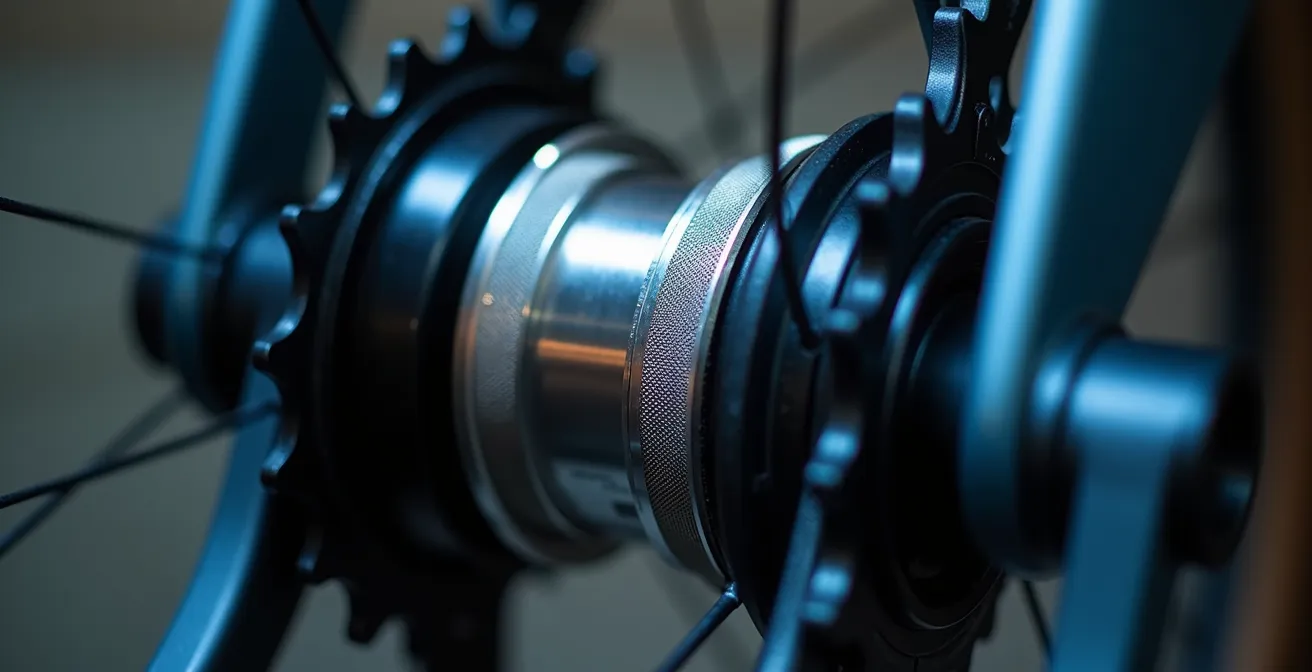
This efficiency becomes even more pronounced on varied terrain. On hilly routes, where a cadence sensor would constantly be in a state of inefficient, full-power surges, torque sensors have been shown to be dramatically more conservative. Tests show they can consume up to 22% less energy on such routes compared to their cadence-based counterparts. This is because the system isn’t fighting the terrain with brute force; it’s working with the rider to overcome it efficiently. The result is a longer range, a longer-lasting battery, and a lower cost of ownership over time.
Cadence vs Torque: Which Sensor Promotes Better Leg Strength?
The debate over which sensor provides a “better workout” is often clouded by the myth that e-biking is “cheating.” The more relevant question for a discerning rider is: which system promotes more effective and consistent muscular engagement? With a cadence sensor, the on/off power delivery encourages a lazy pedaling style known as “ghost pedaling.” Riders learn they only need to turn the cranks, with minimal effort, to keep the motor engaged. This leads to long periods of low-intensity effort with minimal fitness benefits.
A torque sensor, conversely, demands and rewards consistent rider effort. Because the assistance is directly proportional to your input, you are incentivized to maintain steady pressure on the pedals. This constant engagement turns a commute into a legitimate workout. A study published in the Journal of Transport & Health confirmed this, finding that riders on torque-sensor e-bikes engaged in longer rides and achieved superior cardiovascular benefits. The natural, engaging ride quality encourages the rider to be an active participant rather than a passive passenger.
Furthermore, this dynamic assistance model is kinder to the rider’s body. The smooth application of power, which mirrors natural cycling, reduces stress on the knees and hips. Instead of abrupt, jerky forces, the power is delivered in a fluid wave that complements the pedal stroke. This isn’t just about comfort; it’s about long-term joint health. According to a biomechanics study, the dynamic assistance from a torque sensor can lead to a significant 30% reduction in joint strain during extended rides. This makes it a superior choice for commuters looking to build functional strength and endurance without risking injury.
The Error of Ignoring Sensor Calibration That Causes Power Lag
A high-performance machine requires precise tuning, and a torque sensor is no exception. Perhaps the most overlooked aspect of ownership is the need for proper calibration. Unlike a simple cadence sensor, a torque sensor needs to establish a “zero-torque” baseline. This tells the system what “no pressure on the pedals” feels like, allowing it to accurately measure any force you apply. Ignoring this simple procedure is the primary cause of many reported issues, such as power lag, erratic assistance, or the system failing to engage at all.
As the Macfox Technical Team notes in their guide, “Improper calibration can cause erratic assist or error codes.” Most modern e-bikes perform this calibration automatically when you power on the system, which is why it’s critical to ensure there is no weight on the pedals during startup. These sealed, bottom-bracket-integrated units are highly durable and waterproof, but their accuracy depends entirely on this initial electronic reference point. Overlooking this can make a premium bike feel sluggish and unresponsive, negating the very benefits you paid for.
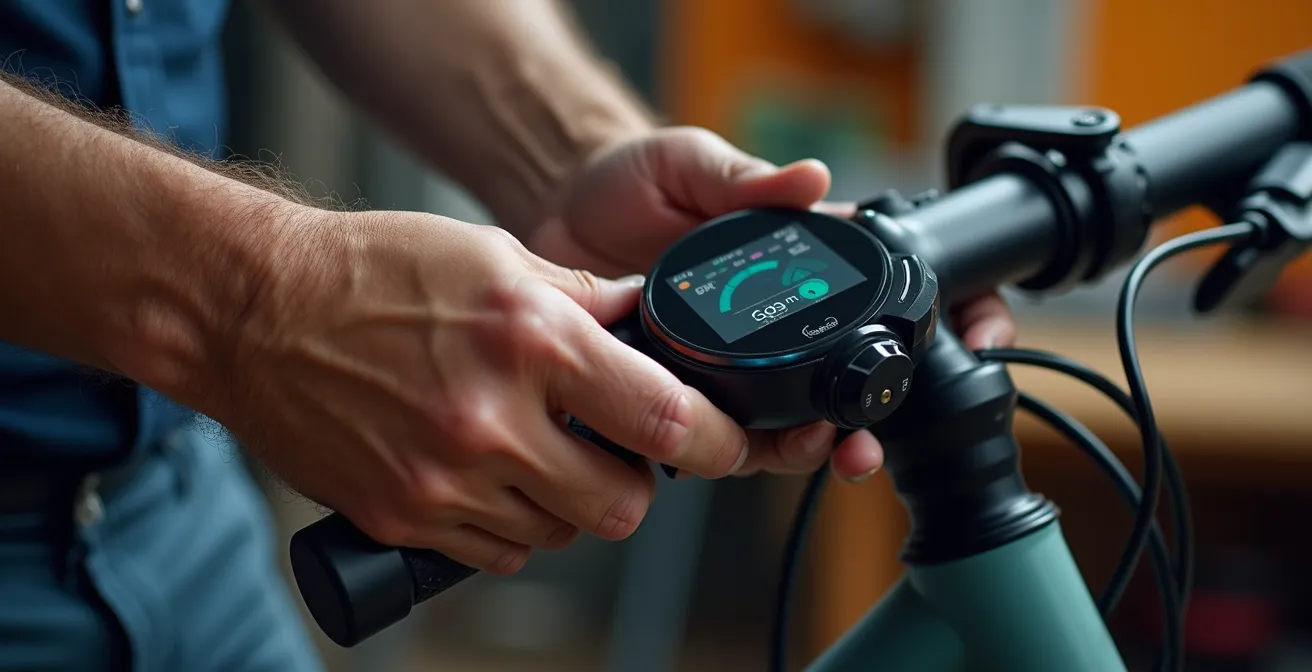
For any torque sensor owner, performing a periodic manual check or ensuring the bike is stationary at startup is a non-negotiable part of the pre-ride routine. It’s a simple habit that ensures the system’s brain is working with clean data, guaranteeing the instant, fluid response that defines a high-quality ride. It ensures the longevity and optimal function of this sophisticated component.
Your Action Plan: Pre-Ride Torque Sensor Calibration Checklist
- Power on the bike with pedals completely stationary and level to allow the sensor to establish a zero-torque baseline.
- Wait a full 10 seconds for the system to complete its initialization process before mounting or pedaling.
- For certain systems (check your manual), perform a single backward pedal rotation if required by the manufacturer to finalize calibration.
- Check the display for any error codes related to the torque sensor; resolve these before starting your ride.
- Test with gentle, firm pressure on one pedal to confirm that you get an immediate, proportional motor response.
How to Pedal Naturally to Maximize Torque Sensor Responsiveness?
Owning a torque sensor is only half the battle; learning to “speak its language” unlocks its full potential. The system is designed to reward smooth, consistent power application. Riders who pedal in erratic, forceful bursts are not fully leveraging the technology. The goal is to achieve a state of “system symbiosis,” where your pedaling and the motor’s assistance blend into a single, seamless output. This requires a conscious shift from “mashing the pedals” to “spinning in circles.”
The key is to apply firm, even pressure throughout the entire 360-degree rotation of the crank. Think of drawing a perfect circle with your feet, eliminating the “dead spots” at the top and bottom of the stroke where a cadence sensor would falter. This continuous data feed allows the torque sensor to deliver an incredibly smooth and predictable wave of power. To achieve this, riders should focus on maintaining an optimal 70-90 RPM cadence. This higher-cadence spinning motion is more efficient and provides the sensor with the consistent input it needs to perform at its best. Using your bike’s gears to stay in this RPM range, especially on hills, is crucial.
By adopting this technique, you are not just making the ride feel smoother; you are actively communicating your intentions to the motor. You are telling it precisely how much help you need at any given moment. This level of communication is impossible with a cadence sensor, which can only shout “ON!” or “OFF!”. Mastering this pedaling style transforms the bike from a tool into a true partner.
Your Action Plan: Smooth Power Application Technique
- Apply firm, consistent pressure throughout the entire 360-degree pedal rotation, not just on the downstroke.
- Think of ‘spinning in circles, not mashing squares’ to feed the sensor a continuous stream of force data.
- Maintain a steady pressure rather than relying on erratic bursts of high power, which can feel jerky even with a torque sensor.
- Select the appropriate gear to avoid ‘lugging’ in a high gear at low speed, which creates uneven force.
- Focus on the consistency of your force application over the maximum amount of force; smoothness is the goal.
Why Staying in Zone 2 Is Easier on an E-Bike and Better for Fat Loss?
For commuters interested in the fitness aspect of their ride, the torque sensor offers a powerful and often overlooked benefit: the ability to maintain a specific heart rate zone. Zone 2 training, a low-intensity steady-state cardio (LISS) where the body primarily burns fat for fuel, is notoriously difficult to maintain in a varied urban environment. Hills, wind, and stops constantly push your heart rate into higher, anaerobic zones.
This is where the concept of metabolic consistency, enabled by a torque sensor, becomes a game-changer. By providing proportional and instantaneous assistance, a rider can modulate their effort to keep their heart rate perfectly stable. Approaching a hill? Instead of standing up and spiking your heart rate into Zone 4, you simply apply a bit more pedal pressure, the motor adds the exact power needed, and you ascend while remaining comfortably in Zone 2. A 45-minute commute can thus be transformed from a chaotic series of sprints and coasts into a highly effective, controlled fat-burning session. This level of control is simply unattainable with a cadence sensor, whose fixed power output will inevitably push you out of your target zone on any incline.
The following table breaks down precisely why a torque sensor is the superior tool for controlled-effort training during a commute.
| Feature | Torque Sensor | Cadence Sensor |
|---|---|---|
| Zone 2 Maintenance | Precise control with proportional assist | Difficult due to on/off assistance |
| Hill Response | Adjustable to maintain heart rate | Fixed power pushes into higher zones |
| Effort Consistency | Smooth, maintainable for 45+ minutes | Jerky transitions disrupt rhythm |
| Fat Burning Efficiency | Optimal due to steady-state cardio | Reduced due to intensity spikes |
Why a Software Update Might Make Your Bike Feel Slower Off the Line?
A common complaint among e-bike owners is that after a software update, their bike suddenly feels “slower” or less aggressive from a standing start. This is often perceived as a downgrade, but for high-end systems featuring torque sensors, it’s typically a sign of refinement, not a reduction in power. Manufacturers are constantly tweaking the algorithms that interpret the data from the torque sensor, and these updates are designed to improve the overall ride quality.
As the technical team at Cycling Electric explains, this is often a very deliberate choice. In their analysis, they note that “a new update might intentionally reduce initial torque for a smoother, less ‘jerky’ start, prioritizing control and a premium feel over raw acceleration.” This is a move away from the “drag race” mentality and toward a more sophisticated, controlled application of power. The goal is to eliminate any hint of an abrupt kick, making the initial engagement so smooth it’s almost imperceptible. This enhances safety and control, especially in tight spaces or on slippery surfaces.
Case Study: The Evolution of Bosch and Brose Motors
The history of motor development shows this trend clearly. Early-generation motors from industry leaders like Bosch and Specialized/Brose (around 2017) had a more pronounced lag, feeling closer to a cadence sensor. Through successive software updates—without any hardware changes—these manufacturers dramatically refined the algorithms. They reduced the lag while simultaneously smoothing out the initial power delivery. This evolution demonstrates how software is used to tune the “personality” of a motor, often sacrificing a feeling of raw, instant power for one of superior control and refinement, which is the hallmark of a premium torque sensor system.
Key Takeaways
- A torque sensor’s value is in its intelligent, proportional power delivery, not just a vague “natural feel.”
- This technology provides tangible benefits: superior control in traffic, a 10-15% increase in battery range, and a more effective, joint-friendly workout.
- Proper calibration and smooth pedaling technique are essential to unlocking the full potential of a torque-sensor e-bike.
Is It Cheating? Why You Still Burn 300 Calories an Hour on an E-Bike?
The most persistent myth surrounding e-bikes is that riding one is “cheating.” However, when using a bike equipped with a quality torque sensor, this couldn’t be further from the truth. The system is engineered to assist, not replace, the rider’s effort. It acts as a consistent training partner that forces you to contribute meaningfully to the workload, especially during the most demanding phases of a ride: accelerating and climbing.
The torque sensor forces you to help the ebike when it needs it the most, when it is accelerating and when climbing… you get to utilize your bikes shifter gear train to find just the right gear where you maintain the desired speed for the desired pedal input.
– ElectricBike.com Review Team, Torque Sensors on Electric Bikes Analysis
Unlike a cadence sensor that allows for “ghost pedaling,” a torque sensor requires you to generate real force to receive assistance. This enforced engagement means you are always performing a significant amount of work. Studies and real-world data show that it’s common for an e-bike rider to maintain a consistent workload of around 150 watts of human effort, which is a very respectable level of output. This effort translates directly into a significant calorie burn, often in the range of 300-400 calories per hour, comparable to a brisk walk or a light jog—but far more engaging and practical for a commute.
Ultimately, the torque sensor enables people to ride longer, tackle hills they would otherwise avoid, and use their bike in place of a car more often. It turns a commute into a consistent, low-impact workout that burns significant calories without the punishing intensity that might deter a rider from getting on the bike in the first place. It is not cheating; it is smart, sustainable, and effective exercise integrated seamlessly into daily life.
For the serious commuter, choosing an e-bike is an investment in a primary transportation vehicle. The decision should not be based on a spec sheet, but on how the machine performs in the real world. A torque sensor is more than a feature; it is the core of a sophisticated system that offers unparalleled control, superior efficiency, and a more engaging physical experience. While it’s not a simple aftermarket upgrade—it’s integral to the frame and motor design—its inclusion signals a manufacturer’s commitment to ride quality over cost-cutting. To truly appreciate its value, the next step is to test ride a high-quality, torque-sensor-equipped bike and feel the difference firsthand.